Your selection
Research, Patient care / 07.01.2025
Developing a CRISPR therapy for muscular dystrophy
Researchers at the Experimental and Clinical Research Center in Berlin are developing a targeted treatment for muscular dystrophy with the help of gene-editing. Preclinical research led by the Spuler Lab published in “Nature Communications” now paves the way for first-in-human clinical trials.
Researchers at the Experimental and Clinical Research Center (ECRC), a joint institution of the Max Delbrück Center and Charité – Universitätsmedizin Berlin, have developed a promising gene-editing approach intended to restore the function of a protein that is essential to repair and regrow muscle in patients with muscular dystrophy diseases.
The dysferlin protein is primarily responsible for repairing cell membranes. People with certain mutations in the gene coding for dysferlin develop muscular dystrophy – a group of muscle wasting diseases that affect thousands around the world.
Professor Simone Spuler and her team led by Dr. Helena Escobar in the Myology Lab at ECRC have successfully removed muscle stem cells from two patients with limb-girdle muscular dystrophy, corrected the genetic error and restored functioning dysferlin proteins in cell culture. In new mouse models of the disease, they used the same process to collect cells, edit them and transplant the corrected cells back into mice, where protein function was restored and muscles began to regrow.
The preclinical findings, reported in “Nature Communications,” give the team confidence to move forward to human clinical trials. This would involve taking muscle cells from patients, editing them in the lab and transplanting the patient’s own cells back into targeted muscles. The researchers note this therapy is not a complete cure – it would be limited to one or two muscles.
“We have over 600 muscles in our body and it is not easy to target all of them,” says Spuler. “We are starting very humble with targeting one or two muscles. But if this therapy works, it will heal the muscle.”
Body of work
For nearly 20 years, Spuler and her collaborators have been working to understand dysferlin, its role in muscular dystrophy and ways to cure these rare but devastating inherited diseases. In the case of limb-girdle muscular dystrophy, muscle deterioration is progressive and young adults lose the ability to walk and normal use of their arms and hands.
“You go from being a good athlete in your teens to being in a wheelchair by 40,” says Spuler, who sees this first-hand with her patients at an outpatient clinic at ECRC.
Escobar, first paper author and molecular biologist in Spuler’s Lab, has been working on methods to collect muscle stem cells from patients and use gene-editing tools to fix mutations.
“We started with a more common mutation so that we can help as many patients as possible,” Escobar says.
Classical CRIPSR
To fix the dysferlin mutation, Escobar uses CRISPR-Cas9, which is often described as “gene-editing scissors” and for which a Nobel Prize was awarded in 2020. The molecular scissors are guided to a precise location along a DNA molecule and then cut it, forcing the cell to repair the DNA. The aim is for the mutation to be corrected during the repair process, resulting in a properly functioning gene. The researchers tested their editing system in several cellular models all with very similar results: It worked with a high success rate and minimal unintended consequences.
Notably, the editing did not result in an exact match to the desired genetic sequence and there were four changes in the generated dysferlin protein. The team conducted a thorough analysis of the changes in collaboration with Professor Oliver Daumke, who heads the Structural Biology of Membrane-Associated Processes Lab at Max Delbrück Center.
“Even with these four changes, the generated protein is very similar in function to the wild type, which is the version we see in healthy individuals. It localized along damaged cell membranes and muscle was regenerated,” Escobar says.
Crucial model and clinical trial
As part of this project, the researchers developed a new mouse model in collaboration with Dr. Ralf Kühn, who leads the Genome Engineering & Disease Models Lab at Max Delbrück Center. The mouse model closely mimics the specific dysferlin mutation and resulting disease, and enabled the researchers to evaluate how the complete therapy works – taking muscle stem cells, correcting them and transplanting the cells back. They especially wanted to learn if the immune system would reject the cells or attack the generated dysferlin proteins.
“We didn’t see an immune response against the transplanted cells or generated proteins, which is promising for taking this into a clinical trial,” Spuler says.
The team is now seeking funds to launch the first human clinical trial. If the trial is successful, it would still be many years before it is broadly accessible.
Simone Spuler and Helena Escobar are co-inventors on a pending patent application on gene editing of human muscle stem cells. Spuler is co-founder of MyoPax GmbH and MyoPax Denmark ApS. The study was funded by the Gisela Krebs foundation.
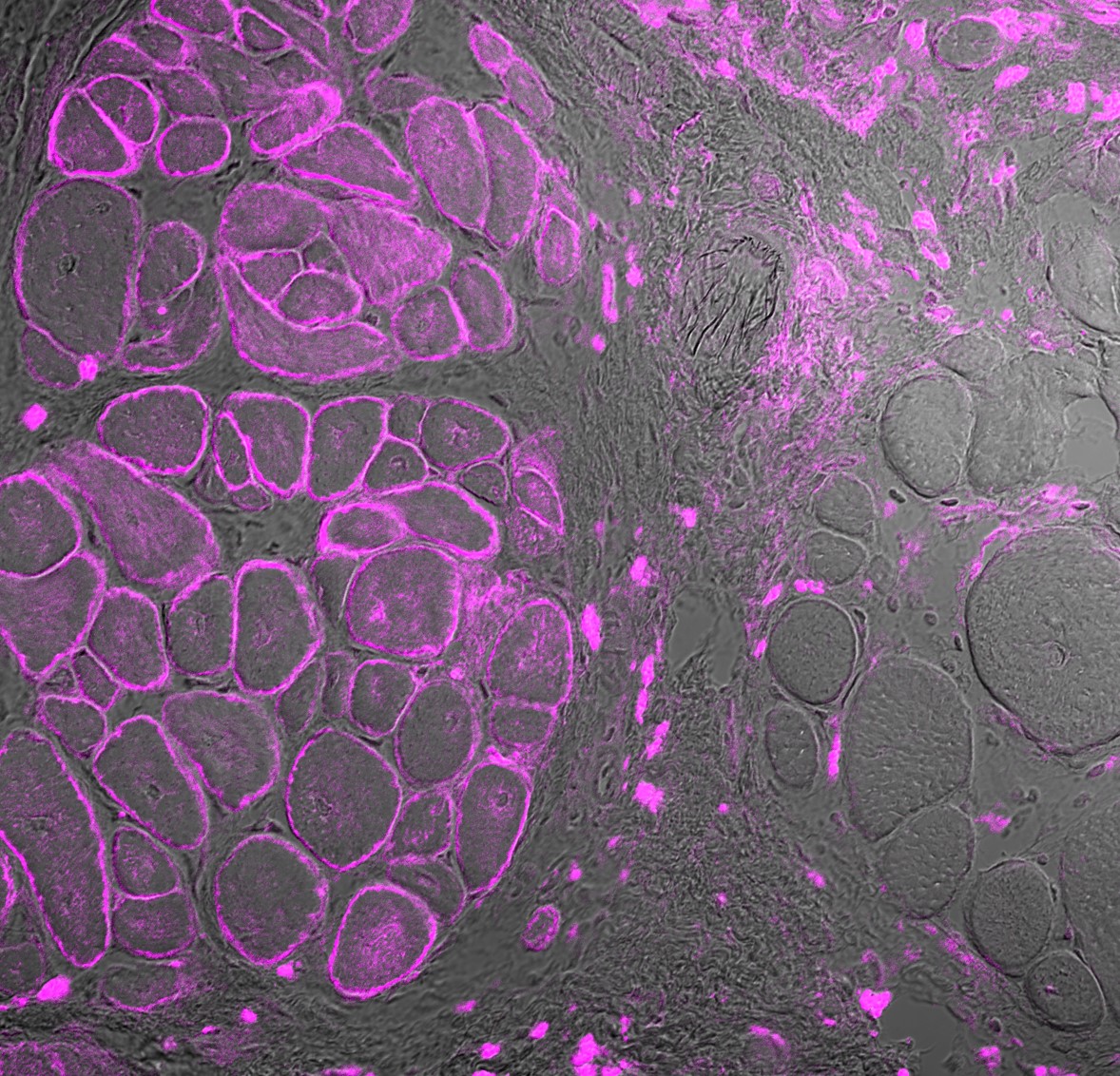
Left: Muscle fibers expressing dysferlin (purple) made from gene-edited muscle stem cells transplanted into a mouse that lacks dysferlin. Right: Muscle fibers from the recipient mouse that are diseased and lack dysferlin.© Andreas Marg, AG Spuler, ECRC
Source: Press Release Eckert & Ziegler
Developing a CRISPR therapy for muscular dystrophy
Overview News
News Buch Berlin
Eckert & Ziegler: Strong FY 2025 with Positive Outlook
Eckert & Ziegler SE (ISIN DE0005659700, TecDAX) set a new record in fiscal year 2025 with sales of €312.0 million. Compared to the previous year, sales rose by approximately €16 million (+5%).
more ...Launch of the Einstein Center for Early Disease Interception
At the Einstein Center for Early Disease Interception, researchers from twelve Berlin institutions will be pooling their expertise to explore new approaches to prevention, long before symptoms appear,...
more ...Strengthen international cooperation in clinical trials
As part of the Australian Clinical Trials Initiative, ACTI, Australian companies and representatives of the Australien Government’s Trade and Invest Commission, Austrade, visited the Berlin-Buch Scien...
more ...Events Buch Berlin
05.04.2026, 11:00
Tierische Ostern im Schildi-Park
Mit Esel, Alpaka, Ziegen, Eierparcours, Eiertrudeln, Osterhasen, Stockbrot, Ständen uvm.
more ...11.04.2026, 10:00
Geführte Wanderung durch das Stadtgut und den Schlosspark in Buch
Manfred Pinkwart lädt ein
more ...16.04.2026, 09:00
Gläsernes Labor - Unsichtbare Welten: Mikroplastik in Mensch und Natur
Vorbeikommen und mitmachen: Spannende Experimentierkurse für Kids und Megamikroskopie im Zeiss-Großplanetarium
more ...