Exploring Berlin-Buch
Berlin-Buch, today one of the largest biomedical locations in Germany, is a symbiosis of tradition and modernity where research and medical treatment are closely linked. For more than one hundred years Buch has been making medical history.
At the beginning of the 20th century, five large properties were developed into the largest and, at that time, most modern hospital complex in Europe. They were built according to the plans of the legendary municipal building director Ludwig Hoffmann. Even today, the publicly accessible areas of the former hospitals and nursing homes impress the visitor due to their spacious park areas and pleasantly proportioned buildings, which contain elements reminiscent of the Baroque and Classical period.
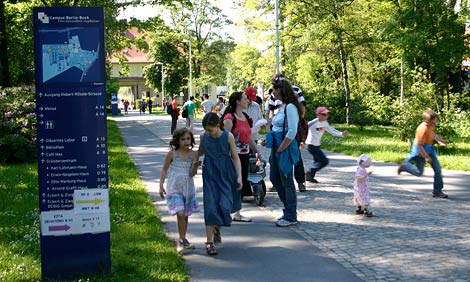
You will see a mixture of buildings from different eras on the research campus – from the first laboratory buildings to today’s ultra-modern and architecturally sophisticated buildings. Designed as a park, the green campus is an inviting place for walking. Along the different pathways are many works of art, such as "Two Lighthouses for the MDC" by the artist Olafur Eliasson.
The Schlosskirche, one of the four remaining Baroque churches in Berlin, is located in the center of Buch. As ensemble, the church, castle park and municipal estate represent the early history of Buch.
For those seeking leisure and relaxation, the Buch Forest, which belongs to the Barnim Nature Reserve, offers paths for walking and hiking, biking and horseback riding. These paths run along the former sewage fields, where highland cattle and Konik horses graze year round.
News Buch Berlin
Stopping stomach cancer before it starts
A team headed by Michael Sigal’s lab has revealed how Helicobacter pylori reprograms the stomach lining at the cellular level, allowing cancer to develop. The findings, published “Nature Communicatio...
more ...How calcium channels in muscle cells open together
Using cryo-electron microscopy, the Kudryashev lab has revealed how muscle cell calcium channels open synchronously. The findings, published in “Nature Communications,” may explain a mechanism behind...
more ...Award for entrepreneurial spirit: Christian Hackenberger receives the UNIPRENEURS Prize
Prof. Dr. Christian Hackenberger of the Leibniz Forschungsinstitut für Molekulare Pharmakologie (FMP) at the Campus Berlin-Buch and Humboldt University of Berlin has been awarded the UNIPRENEURS Prize...
more ...Events Buch Berlin
02.10.2026, 14:30
Tag der offenen Tür in der Evangelischen Schule Buch
Wer sind wir? Ein Haus des Lernens, der Gemeinschaft und der Partnerschaft mit dem hiesigen Wissenschaftsstandort: Das ist die Evangelische Schule Buch. Wir sind eine staatlich anerkannte, ganztägige ...
more ...04.10.2026, 17:00
Konzert des neuen Generationenorchester Pankow (GOPA)
Das neue Generationenorchester Pankow führt Werke von Schuber, Grieg, Bizet und Dvorak auf.
more ...06.10.2026, 16:00
Blutstammzellen und Krebs: Wie Einzelzelltechnologien neue Wege zur personalisierten Medizin eröffnen
Vorlesungsreihe: Neue Wege in der Biomedizin: Aktuelle Forschungsthemen vom Campus Berlin-Buch
more ...