Your selection
Research / 17.07.2026
How the skin distinguishes cool from warm
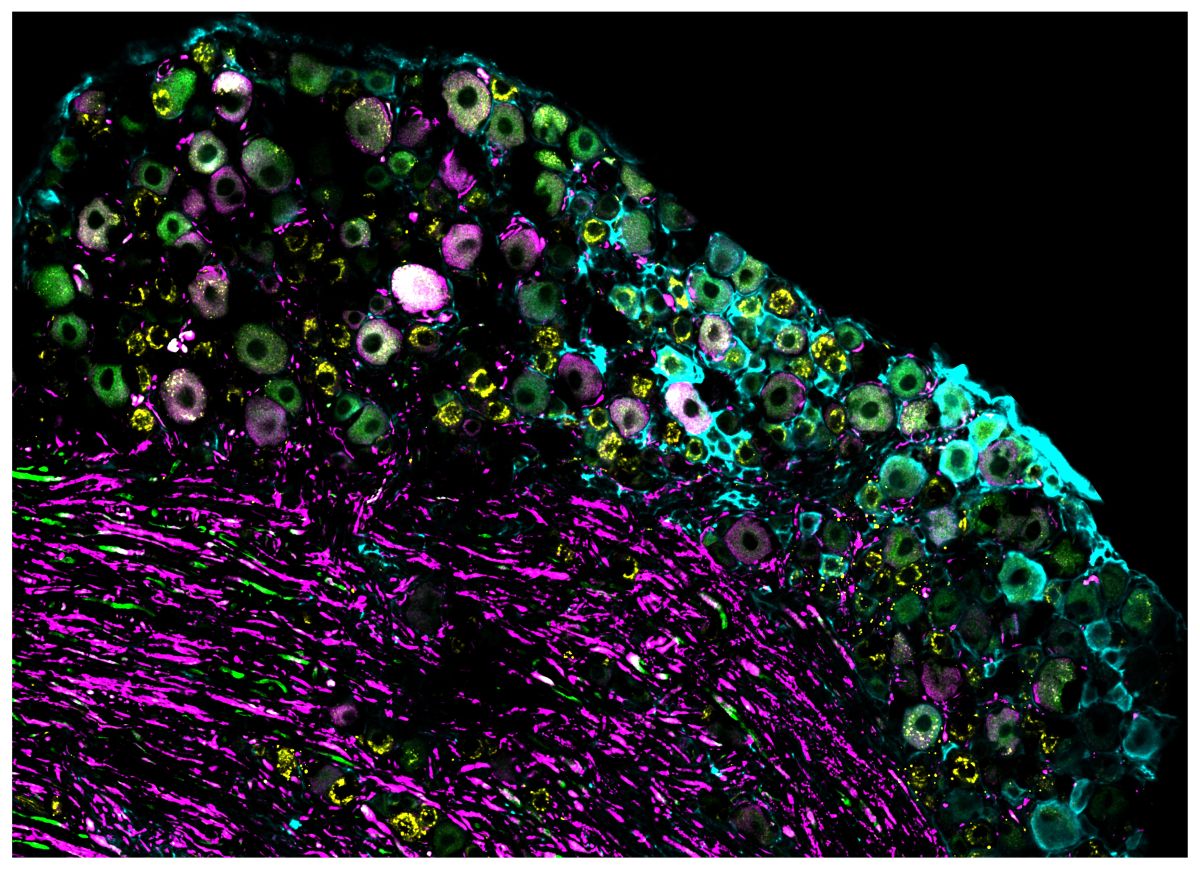
Researchers in the lab of James Poulet have uncovered how the nervous system senses cool and warm temperatures. The findings, published in “Neuron” challenge a long-standing view of temperature sensing and could guide future research into pain and sensory disorders.
Whether we hold a warm mug or step onto a cool floor, specialized nerve cells in the skin constantly report temperature to the brain. Scientists have long assumed that separate groups of sensory cells detect non-painful cool and warm temperatures. Now researchers led by Drs. Phillip Bokiniec and Clarissa Whitmire in the Neural Circuits and Behavior Lab of Dr. James Poulet at the Max Delbrück Center have found that this assumption is too simplistic.
“Rather than relying on separate “warm” and “cool” sensors, we found that the nervous system appears to use one population of cells that signals both directions of temperature change,” explains Bokiniec, who shares first authorship of the study with Whitmire. Bokiniec is a now researcher in the Sensory Neural Coding lab of Dr. Clarissa Whitmire at the Queensland Brain Institute.
Using advanced imaging in mice, the team report in “Neuron” that most temperature-sensitive nerve cells are activated by cooling, and merely reduce their activity when the skin warms. The researchers also showed that these cells react to the actual temperature of the skin rather than simply detecting how much it has changed. This finding reshapes scientists’ understanding of one of the body’s most fundamental senses.
“Scientists have known about these neurons for years,” notes Poulet, “but they were thought to be relatively rare. What surprised us was discovering that they make up most of the temperature-sensing cells.”
Imaging neurons in live mice
The researchers developed a method to image hundreds of temperature-sensing nerve cells in the spinal sensory ganglia of awake mice over time. They gently warmed and cooled the animals’ paws while recording the activity of individual neurons using two-photon microscopy. They also performed this experiment in anesthetized mice and found the same result. This proved that that the anesthetic itself did not affect their results.
The team then selectively blocked or activated temperature-sensitive ion channels. Blocking the protein TRPM8 — long known as the body’s main sensor for detecting cool temperatures — eliminated both the response to cooling and the dampening effect that warming has on these nerve cells. This showed that a single molecular sensor can generate signals for both cool and warm, challenging the traditional view that separate receptors are needed for each sensation.
The team also developed a computer model to test their hypothesis. It showed that simply changing the activity of a TRPM8 was enough to reproduce the different response patterns seen in the experiments.
Understanding sensory disorders
Temperature sensation is essential for everyday life, but it is also disrupted in many medical conditions, including neuropathic pain, diabetic neuropathy, chemotherapy-induced nerve damage and disorders that cause abnormal sensitivity to cold. “Understanding how healthy temperature sensing works is a prerequisite for understanding what goes wrong in disease,” says Whitmire.
The researchers next plan to investigate how these signals are processed in the spinal cord, how painful temperatures are encoded, and whether the same principles apply in humans.
Text: Gunjan Sinha
Figure: A cluster of nerve cells from a mouse that carries sensory information from the hind leg to the spinal cord. Some of these nerve cells detect temperature, while others respond to different sensations such as touch or pain. The different colors highlight specific groups of cells.
Further information
Overview News
News Buch Berlin
OMEICOS’ OMT-28 Headed for Phase 3 in Primary Mitochondrial Diseases (PMD) Following Positive End-of-Phase 2 Meeting with the FDA
OMEICOS, a late-stage clinical biopharmaceutical company developing first-in-class small-molecule therapeutics for mitochondrial and inflammatory disorders, today announced the successful completion o...
more ...A single cocaine dose alters mouse brain cells
Researchers led by Ana Pombo have found that just one exposure to the drug can create changes in mouse brain cells that persist for at least two weeks. Their findings were presented at the Federation ...
more ...How the skin distinguishes cool from warm
Researchers in the lab of James Poulet have uncovered how the nervous system senses cool and warm temperatures. The findings, published in “Neuron” challenge a long-standing view of temperature sensi...
more ...Events Buch Berlin
11.08.2026, 15:00
Ferienprogramm in der Stadtbibliothek: Experimente zu "Vulkane - Kälte - Wärme - Küchenchemie"
Wissenschaftliche Experimente mit Ilona Kurth
more ...25.08.2026, 18:00
Campus-Kino: "Choices of the heart - the Margaret Sanger Story"
Film über die Krankenschwester Margaret Sanger, die 1914 zur wegweisenden Kämpferin für die Rechte von Frauen wurde.
more ...25.08.2026, 18:30
Podiumsdiskussion mit Politiker:innen zum Schwerpunkt Wohnungsbauvorhaben in Buch, speziell "Buch am Sandhaus"
Unter anderem geht es um den Schutz der angrenzenden Naturräume, die Moorwiese, den Ausbau des ÖPNV und Anpassungen des B-Plans 3 - 95
more ...