News 2026
Living / 01.10.2026
Baumarbeiten zur Sicherstellung der Verkehrssicherheit im Schlosspark Buch geplant
Im Schlosspark Buch werden im Ergebnis regelmäßiger Baumkontrollen zum Ende dieses Jahres und zu Beginn des kommenden Jahres insgesamt 69 Maßnahmen an Bäumen zur Sicherstellung der Verkehrssicherheit durchgeführt. Darunter sind auch 38 Fällungen. Die betroffenen Bäume weisen erhebliche Schäden auf und können teils wegen Fäulnis, Pilzbefall oder abgestorbenen Kronenteilen nicht mehr sicher erhalten werden. Insbesondere geschädigte oder instabile Kronenbereiche können unter der Einwirkung von Windlasten einer erhöhten Bruchgefahr unterliegen.
Bei den weiteren 31 Maßnahmen handelt es sich um fachgerechte Baumpflegearbeiten, darunter Kronenkappungen, -sicherungsschnitte und -einkürzungen. Dabei werden geschädigte oder bruchgefährdete Bereiche gezielt zurückgeschnitten und die auf die Bäume einwirkende Windlast reduziert, soweit dies fachlich erforderlich und möglich ist.
Zeitweise Absperrungen und Einschränkungen
Die Arbeiten werden durch Beschäftigte des Bezirksamtes Pankowdurchgeführt. Während der Arbeiten kann es vorübergehend zu Absperrungen und Einschränkungen in einzelnen Bereichen des Schlossparks kommen. Die Absperrungen dienen dem Schutz der Besucherinnen und Besucher und sind unbedingt zu beachten. Es wird um Verständnis für die notwendigen Maßnahmen gebeten. Sie dienen dazu, Gefahren zu beseitigen und die sichere Nutzung des Schlossparks dauerhaft zu gewährleisten.
„Dem Bezirksamt Pankow ist bewusst, dass Fällungen von Bäumen gerade in einem historischen Park wie dem Schlosspark Buch ein sensibles Thema sind und viele Menschen diese Bäume mit guten Erinnerungen verbinden. Jeder Baum, der entfernt werden muss, ist einer zu viel. Gleichzeitig tragen wir die Verantwortung dafür, dass der Park sicher genutzt werden kann. Die regelmäßigen Baumkontrollen zeigen, wo Bäume oder einzelne Kronenbereiche eine Gefahr darstellen. Wo eine fachgerechte Pflege möglich ist, wird diese durchgeführt. Wo ein Baum nicht mehr sicher erhalten werden kann, müssen wir handeln. Ich bitte deshalb um Verständnis für die notwendigen Maßnahmen und die damit verbundenen Einschränkungen.“, erklärt Manuela Anders-Granitzki, Bezirksstadträtin für Ordnung und Öffentlicher Raum.
Research, Patient care / 29.09.2026
Stopping stomach cancer before it starts
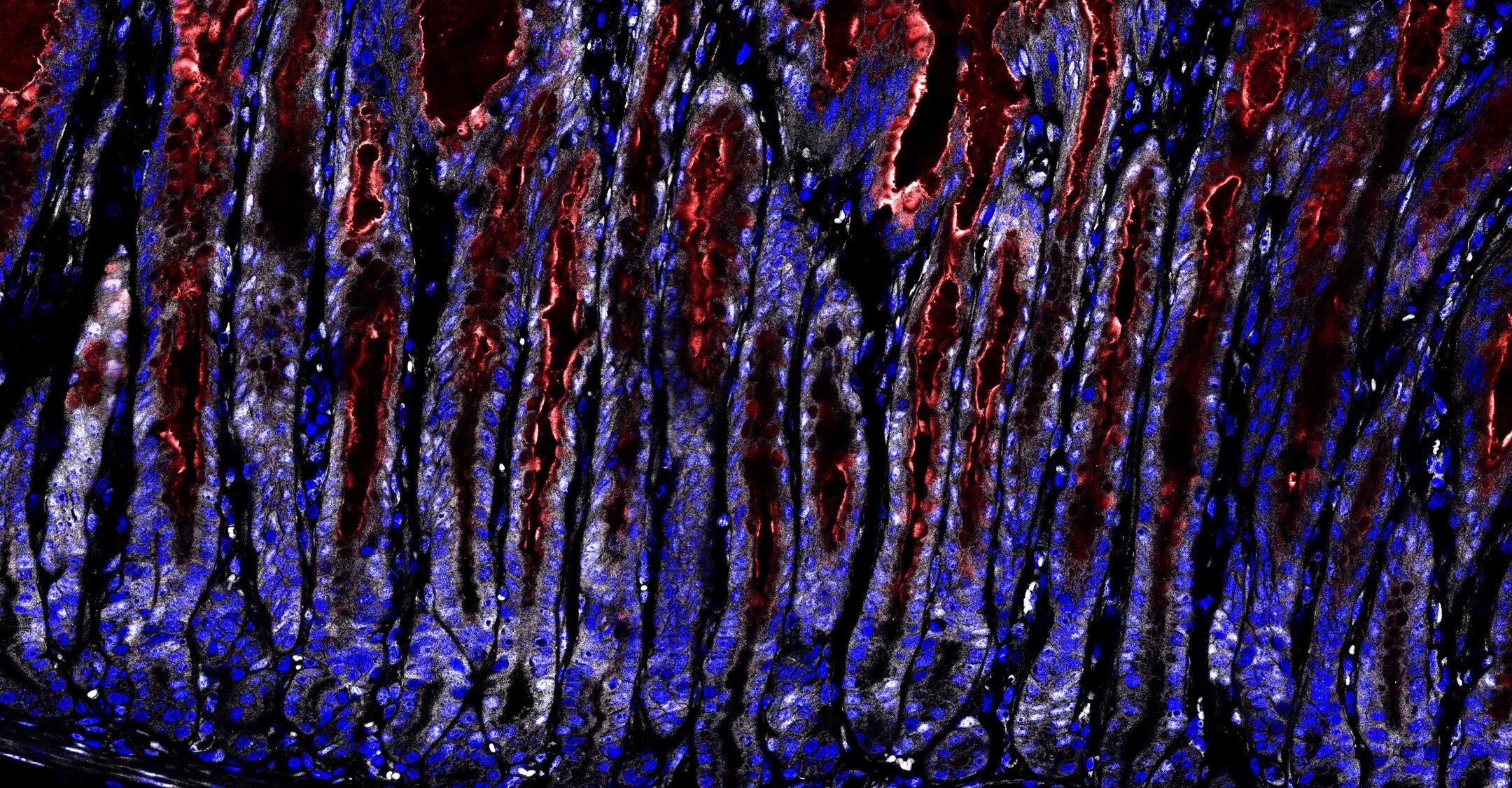
A team headed by Michael Sigal’s lab has revealed how Helicobacter pylori reprograms the stomach lining at the cellular level, allowing cancer to develop. The findings, published “Nature Communications,” pave the way toward prevention.
Disease almost never develops overnight. If illnesses are detected in later stages, however, they often prove difficult to treat — the same holds true for stomach cancer. Years before the condition sets in, the stomach lining gradually begins to change. The most frequent trigger: The common stomach bacterium Helicobacter pylori (H.pylori), which is primarily transmitted within families. If parents or grandparents have had stomach cancer caused by H.pylori infection, their descendants are also at high risk of developing the disease.
A team led by Dr. Michael Sigal, Professor of Translational Gastrointestinal Oncology at Charité – Universitätsmedizin Berlin and Group Leader of the Gastrointestinal Barrier, Regeneration and Carcinogenesis lab at the Berlin Institute of Medical Systems Biology of the Max Delbrück Center (MDC-BIMSB), and Dr. Manqiang Lin at Charité, has uncovered how exactly the bacteria remodel the stomach lining to promote cancer. “If we understand what happens in the stomach tissue even before cancer develops, we might be able to intervene,”explains Sigal. The research was published in “Nature Communications.”
Sigal is also a member of the recently launched Berlin Cluster of Excellence ImmunoPreCept, a collaboration spearheaded by researchers at Charité and MDC-BIMSB and that includes several other partners. ImmunoPreCept is dedicated to identifying disease-causing processes and halting them before it is too late. In this context, researchers from the cluster and other institutions have joined forces to, among other things, determine what occurs in the gastric mucosa at the cellular and molecular levels when it is exposed to H.pylori over extended periods of time.
The fact that H.pylori promotes the development of cancer has long been known. But what types of cells are involved? In what order do they relay signals? And which of these signals is the most important? “We knew from previous studies that the bacterium disturbs the balance of growth signals in the stomach lining. What we were missing was the link between the inflammation that had been triggered and tissue remodeling. This is because the mucous membrane does not behave the way one would actually expect. It grows rapidly, though without stem cells multiplying in the process. “We thought there must be another program at work that has been overlooked until now,” explains Sigal.
Stepwise like a game of chess
The researchers harnessed single-cell sequencing to analyze tens of thousands of cells from the diseased stomach lining and determined, for each cell type, which genes are turned on during an infection. In order to identify the cause and effect, they used animal models in which specific genes in certain cells were selectively inactivated. Tiny, laboratory-grown miniature versions of the gastric mucosa, known as organoids, and assembloids — combinations of mucosal and connective tissue cells developed specifically for this purpose — were used in subsequent investigations to simulate communication between the different cell types and to selectively interrupt this communication. In this way, the researchers were able to observe which cells in the tissue are actually located adjacent to one another and exchange signals. They then used publicly available datasets to verify whether these findings also apply to human tissue.
The research team encountered a program that works similar to a game of chess: Each step paves the way for the next. The chain culminates in precancerous lesions and then cancer, explains Dr. Giulia Beccaceci, first author of the study and an early-career researcher in Sigal’s lab. “The infected stomach lining doesn’t just grow faster, but actually transitions to a fundamentally different state. A process is gradually activated that normally occurs only during embryonic development and wound healing.”This is the reason why the tissue undergoes such lasting changes.
The process sets in when H.pylori overcomes the stomach’s natural defense system. A signal fails to be transmitted that normally ensures the controlled renewal of the surface cells of the mucous membrane and their tolerance of bacteria. Consequently, the immune system is alerted; immune cells migrate to the site and produce pro-inflammatory mediators, primarily interleukin-1β. This, in turn, does not affect the mucous membrane itself, but rather the underlying connective tissue. From there, the decisive signal is finally transmitted: A tissue hormone that normally helps heal injuries switches the mucous membrane into repair mode. As a result, the cells grow uncontrollably and divide more frequently. “So connective tissue isn’t just a bystander, but the actual switch,” Beccaceci adds.
Disease progression can be halted
Now that researchers better understand how H. pylori infection leads to chronic gastritis, precancerous lesions and ultimately cancer, they may be able to prevent disease progression. “People with an increased risk — for example, due to a family history of stomach cancer, symptoms, or a known infection — should be tested for the stomach bacterium and, if the test is positive, treated with antibiotics,” says Sigal. “This is simple and has been proven to reduce the risk of stomach cancer. This is due to the fact that it removes persistent irritation from the tissue.”
The gastric mucosa, however, does not fully return to normal after antibiotic treatment in all affected individuals. In some cases, the tissue has already been permanently reprogrammed, and the risk that cancer will develop remains. “In order to reliably identify these individuals, we are currently developing markers that can detect, in mucosal tissue samples, whether the tissue is on its way to becoming precancerous,” explains Sigal. “In addition, we now understand the individual steps in the chain and, as a result, the potential targets for drugs.” Consequently, this triangular communication via connective tissue could be disrupted by making these cells unresponsive to the inflammatory mediator interleukin-1β. That would prevent tissue changes and abnormal mucosal growth.”
Researchers are also encouraged by findings from previous population studies, which showed that regular use of known anti-inflammatory drugs was associated with a lower risk of gastrointestinal tumors. These medications also block a component of the pathway now identified: the enzyme COX‑2. This confirms that the mechanism works, and the new findings will help interrupt the pathway in an even more targeted manner and with fewer side effects.
About the study
In addition to scientists at Charité, MDC-BIMSB and the ImmunoPreCept Excellence Cluster, other collaborators included: The Institute for Experimental Internal Medicine at Otto von Guericke University Magdeburg, the Max Planck Institute for Infection Biology, Berlin, the Berlin Institute of Health (BIH) at Charité, the BIH Charité Clinician Scientist Program, and the Berlin School of Integrative Oncology (BSIO) at Charité. The research was funded by, among others, the European Research Council (ERC Starting Grant REVERT), the Deutsche Forschungsgemeinschaft, the Federal Ministry of Research, Technology, and Space, the Einstein Center 3R, and the ImmunoPreCept Excellence Cluster.
Joint press release by Charité — Universitätsmedizin Berlin and the Max Delbrück Center
Text: Charité – Universitätsmedizin Berlin
Further information
Sigal Lab
Gastrointestinal Barrier, Regeneration and Carcinogenesis
Research / 25.09.2026
How calcium channels in muscle cells open together
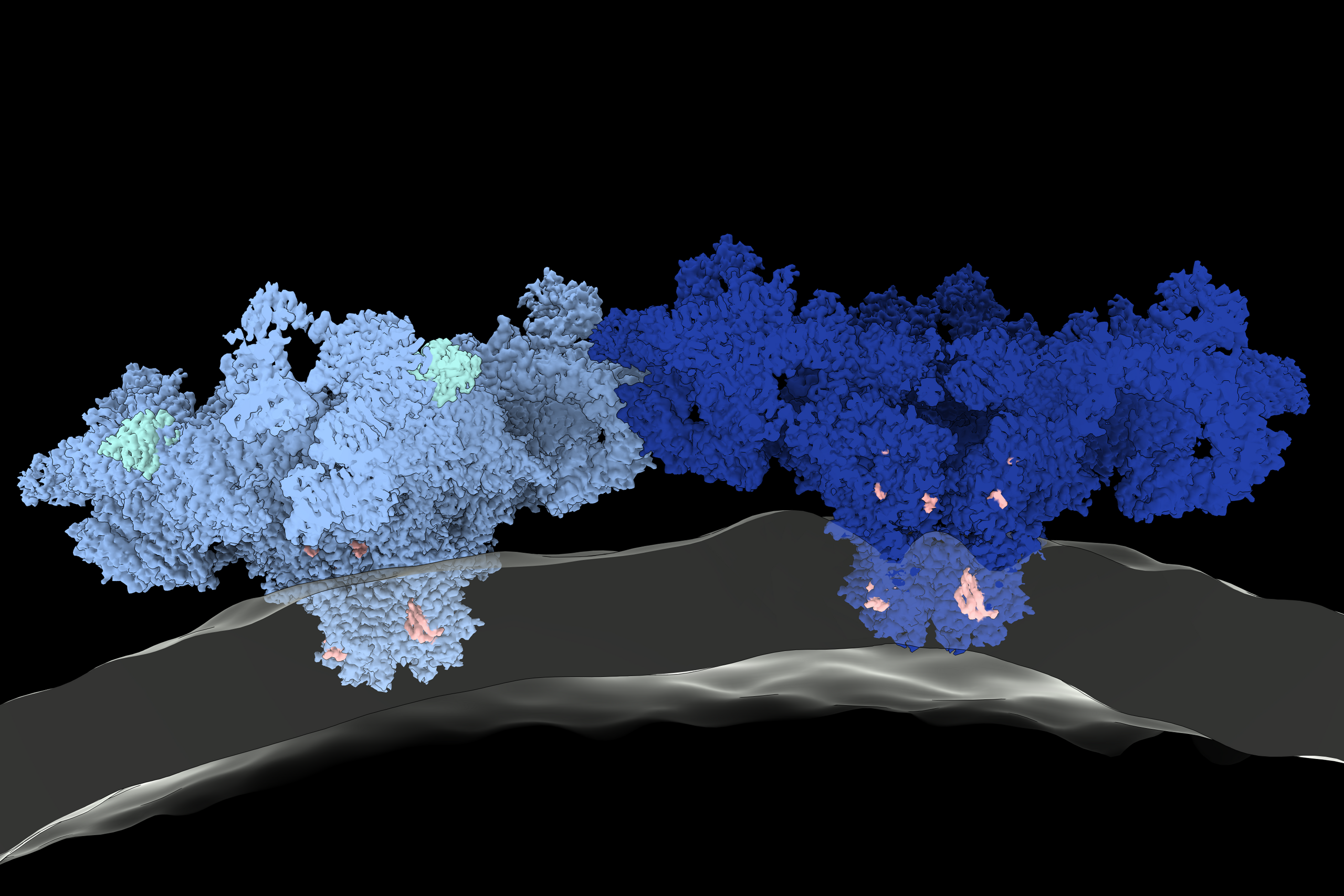
Using cryo-electron microscopy, the Kudryashev lab has revealed how muscle cell calcium channels open synchronously. The findings, published in “Nature Communications,” may explain a mechanism behind serious muscle diseases.
Every step we take begins with a burst of calcium inside our muscle cells, causing them to contract. To prepare for action, the cells keep calcium locked in an internal compartment, the sarcoplasmic reticulum. Studding its membrane are thousands of RyR1 channels — the largest known ion channels — that contain pores that release the calcium. For a muscle to contract properly, RyR1 channels must open synchronously via a mechanism known as “coupled gating.” How they accomplish this has been unclear since it was described almost 30 years ago.
A team led by Dr. Vasilii Mikirtumov, a former doctoral student in the In Situ Structural Biology Lab of Dr. Misha Kudryashev at the Max Delbrück Center, has now captured the first high-resolution 3D images of RyR1 at six stages of opening inside the intact sarcoplasmic reticulum membrane. The work is published in “Nature Communications.”
Although the structure of RyR1 has been described before, previous studies used channels that had been removed from the membrane. Instead, the Kudryashev lab studied the structure of RyR1 in its natural environment using the advanced imaging techniques of cryo-electron microscopy and tomography. “Because RyR1 is a membrane protein, you have to pull it out with detergents to purify it. But that environment can be disruptive to such a sensitive protein,” says Mikirtumov, who is now a postdoctoral researcher in the lab of Christian Spahn at Charité – Universitätsmedizin Berlin. “We wanted to capture the structure of the channel in its native membrane and find out whether its opening mechanism looks different there.”
The researchers found that it does. The images show that neighboring channels remain in contact with each other when transitioning from the closed to open states. This contact, or interface, mediates coupled gating: as one channel rotates open, it strains the interface with its neighbor, making it easier for that channel to rotate and open too. “It’s like the cogs in a clock,” says Kudryashev, senior author of the paper. “Once one cog turns, it primes its neighbors to turn, too.”
Six snapshots of an opening channel
The team isolated the sarcoplasmic reticulum from rabbit muscle and imaged it at the Core Facility for Cryo-Electron Microscopy, which is run jointly by Charité – Universitätsmedizin Berlin, the Max Delbrück Center and the Leibniz-Forschungsinstitut für Molekulare Pharmakologie (FMP). The Kudryashev lab has specialized expertise in cryo-electron microscopy and tomography and the computational tools necessary to analyze the resulting data.
“We shoot electrons through the sample and take thousands of pictures, each with many copies of the same protein,” explains Mikirtumov. “Then we average them all together, and that gives us a high-resolution 3D reconstruction.”
By adding small molecules to initiate channel opening, the researchers caught RyR1 at six stages between fully closed and fully open. Comparing the structures revealed the full opening motion: The bulky outer part rotates within the plane of the membrane, like turning the ring of a camera lens, while the pore in the channel widens to roughly twice its original width.
Using cryo-electron tomography, the team also imaged pairs of neighboring channels at five stages of opening. They found neighboring channels were more likely to be synchronized, and that two interacting closed channels were more stable than two closed channels in isolation. These findings support coupled gating and suggest that channels hold each other shut.
A target for treating muscle disease
Mutations in the RyR1 gene cause malignant hyperthermia, a life-threatening reaction to some anesthetics, and congenital myopathies that weaken muscles. Many of these mutations alter the channel exactly where it touches its neighbor.
“A lot of these mutations don’t seem to affect how a single channel opens, but rather how channels cooperate with their neighbors,” says Mikirtumov. “We mapped several of them onto the interface, and we think that in these cases, it’s the cooperation between channels that breaks down.”
The researchers propose that disruption at the interface between channels makes them leaky, releasing calcium when they should retain it. This makes the interface itself a target for therapies.
The team is already testing the idea. “We need to prevent the channels from opening spontaneously,” says Kudryashev. “Now that we know how the inactive state is organized, we can design biologics or small molecules to stabilize this closed state.”
Text: Anita Waltho
Image: Two ryanodine receptor 1 (RyR1) channels interacting side-by-side in their native sarcoplasmic reticulum membrane. This cryo-EM structure reveals how neighboring calcium-release channels physically touch, coordinating their opening for a fast, synchronized calcium signal that triggers muscle contraction. Credit: Vasilii Mikirtumov, Kudryashev Lab, Max Delbrück Center
Source: Press Release Max Delbrück Center
How calcium channels in muscle cells open together
Research, Patient care, Education / 24.09.2026
125 Jahre Blutgruppensystem – Zellbiologie erforschen im Gläsernen Labor
1901 legte der Mediziner Karl Landsteiner den Grundstein für die moderne Transfusionsmedizin. Sein Blutgruppensystem wird im Schülerlabor auf dem Campus Berlin-Buch anschaulich erklärt – durch die Bestimmung der eigenen Blutgruppe
Für seine wissenschaftliche Entdeckung der verschiedenen Blutgruppen A, B und 0 an der Universität Wien, die er 1901 veröffentlichte, erhielt der Mediziner Karl Landsteiner den Nobelpreis. Dieses System ermöglichte später erstmals sichere Bluttransfusionen, ohne Folgeerkrankungen oder sogar Lebensgefahr.
In einem umfassenden Experiment trennte er Blut von Probanden in die Bestandteile Serum und Blutkörperchen auf und mischte anschließend die roten Blutkörperchen mit unterschiedlichen Seren. In einigen Proben verklumpte das Blut, in anderen nicht. Aus diesem Agglutination genannten Phänomen leitete er die Einteilung der Blutgruppen ab. Dieses System wurde knapp 40 Jahre danach um den Rhesusfaktor ergänzt, an dessen Entdeckung Karl Landsteiner ebenfalls beteiligt war.
Bedeutung für die Medizin vermitteln
Im Schülerlabor des Gläsernen Labors wird das Thema regelmäßig aufgegriffen: Die Blutgruppenbestimmung ist Teil von Kursen für die Sekundarstufe im Bereich Zellbiologie zu den Themen Immunabwehr, Herz-Kreislauf und Rauchen und wird auch in einem Kurs der Grundstufe durchgeführt. Die Schülerinnen und Schüler lernen, wie wichtig Blutgruppen in der Medizin sind, welche Bedeutung sie in der Immunologie haben und wie Labordiagnostik funktioniert. Mit dem Einverständnis ihrer Eltern finden sie in den Kursen auch heraus, welche Blutgruppe sie selbst haben.
„Für Bluttransfusionen ist es entscheidend, die AB0-Blutgruppe und den Rhesusfaktor zu kennen. Wir erklären, warum besonders der Rhesusfaktor eine wichtige Rolle spielt – zum Beispiel bei Bluttransfusionen oder besonders während einer Schwangerschaft“, sagt Biologin Claudia Jacob, die das Gläserne Labor leitet.
Auch der Einfluss der Genetik wird anschaulich vermittelt: „Für viele Jugendliche ist die Vererbung der Blutgruppen ein faszinierendes Beispiel, wie genetische Merkmale von den Eltern an ihre Kinder weitergegeben werden. Dass zum Beispiel ein Elternpaar mit Blutgruppe A ein Kind mit Blutgruppe 0 haben können, überrascht viele zunächst – ist genetisch aber durchaus möglich“, so Claudia Jacob.
Das Blutgruppensystem ABO
Die roten Blutkörperchen (Erythrozyten) besitzen Oberflächenstrukturen, sogenannte Antigene. Menschen mit Blutgruppe A haben A-Antigene, Menschen mit B B-Antigene. Bei Blutgruppe AB sind beide Antigene vorhanden, während Blutgruppe 0 keines dieser beiden Antigene besitzt.
Im Blutplasma befinden sich wiederum Antikörper gegen die Antigene, die auf den eigenen Erythrozyten fehlen. Menschen mit Blutgruppe A besitzen daher Anti-B-Antikörper, Menschen mit B Anti-A-Antikörper. Bei Blutgruppe 0 sind keine Antikörper vorhanden, bei AB in der Regel keine Anti-A- oder Anti-B-Antikörper.
Antikörper erkennen passende fremde Antigene und können an diese binden. Deshalb ist die Bestimmung der Blutgruppe vor einer Bluttransfusion besonders wichtig: Treffen Antikörper des Empfängers auf die entsprechenden fremden Antigene der übertragenen Erythrozyten, kann es zu einer Verklumpung (Agglutination) und anschließenden Zerstörung der roten Blutkörperchen kommen. Eine solche Reaktion kann lebensgefährlich sein.
Research, Innovation, Education / 24.09.2026
Award for entrepreneurial spirit: Christian Hackenberger receives the UNIPRENEURS Prize
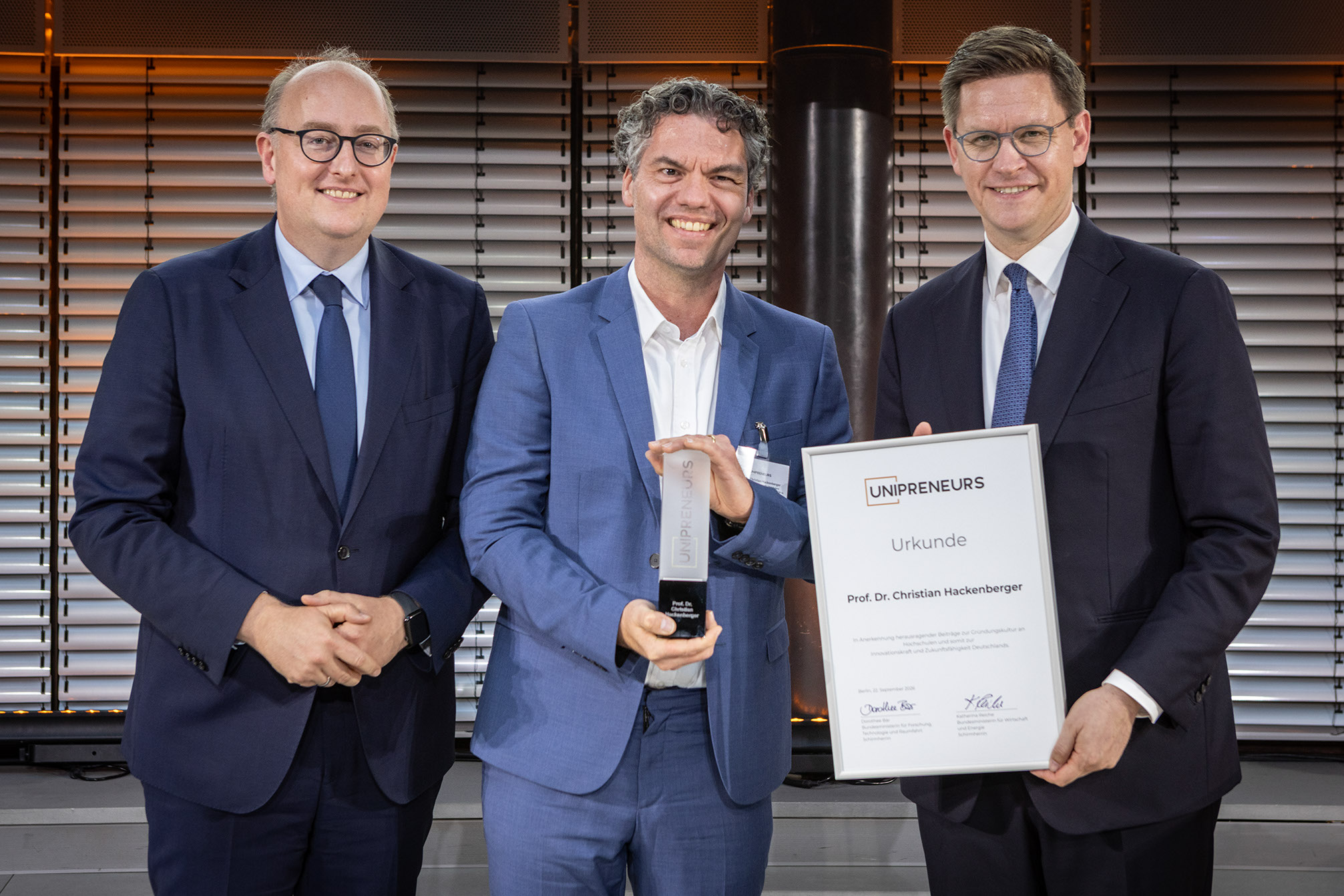
Prof. Dr. Christian Hackenberger of the Leibniz Forschungsinstitut für Molekulare Pharmakologie (FMP) and Humboldt University of Berlin has been awarded the UNIPRENEURS Prize. He is now one of 20 professors nationwide to be honored for their commitment to spin-off companies. The prize recognizes individuals who, in addition to their research and teaching, have made a significant contribution to transferring innovations to the business sector.
“I am incredibly delighted about this award; it is a fantastic recognition for my colleagues and me, especially since it underscores the importance of basic academic research. And of course, I am immensely proud to be part of such a great founding team that set Tubulis’ success story in motion,” says Prof. Dr. Christian Hackenberger.
Christian Hackenberger has been conducting research on methods for modifying peptides and proteins since 2005. After moving to the FMP and Humboldt University of Berlin, his team developed the so-called P5-labeling method in 2017 for the production of novel antibody-drug conjugates (ADCs). The method provides easy access to ADCs that are more stable and effective than other molecules on the market—without the need for additional genetic modification of the antibodies.
From P5-labeling to Tubulis
Hackenberger has received numerous awards for his research, which includes the development of cell-permeable antibodies, including the DFG’s Heinz Maier-Leibnitz Prize, the Max Bergmann Medal, the UCB-Ehrlich Award for Excellence in Medicinal Chemistry, and, in 2020, as the very first recipient, the “Breakthrough of the Year” Award from the Falling Walls Foundation in the life sciences.
This year, UNIPRENEURS honored 20 professors across Germany from more than 800 nominations. Together, they have supported around 600 startups as mentors, advisory board members, or investors; 90 percent of the honorees have founded a company themselves.
About UNIPRENEURS
UNIPRENEURS is an initiative aimed at strengthening spin-offs at German universities and non-university research institutions, led by the Stifterverband für die Deutsche Wissenschaft. The Federal Ministry of Research, Technology, and Space, as well as the Federal Ministry of Economics, are joint patrons of the initiative. UNIPRENEURS presents its award every three years.
More Information:
https://www.hu-berlin.de/en/news/detail/christian-hackenberger-receives-the-unipreneurs-award-for-outstanding-commitment-to-entrepreneurship
Source: Leibniz-Forschungsinstitut für Molekulare Pharmakologie
Research / 16.09.2026
Mapping the molecular pathways of heart disease
An international team has created a detailed molecular map of hypertrophic cardiomyopathy, one of the most common forms of heart disease. Their findings, published in “Science Translational Medicine,” identify biological pathways that could pave the way for more precise treatments.
Heart muscle disease comes in many forms, the most common of which are hypertrophic cardiomyopathy (HCM), which causes the heart muscle to become thick and stiff, and dilated cardiomyopathy (DCM), in which the left ventricle balloons, thinning the chamber’s walls. Both types make it hard for the heart to pump properly and can eventually cause it to fail.
A team led by researchers at the Max Delbrück Center and Brigham and Women’s Hospital now shows in “Science Translational Medicine” the detailed molecular activity underlying HCM, including which pathways it shares with DCM.What’s more, they were able to distinguish early stage from late stage, and genetic from non-genetic HCM.
The research was co-led by Dr. Eleonora Adami (Max Delbrück Center, Hübner lab) and Dr. Yuri Kim (Brigham and Women’s Hospital) as part of an international collaboration that included researchers at Harvard (Seidman Lab), Imperial College London (Noseda Lab), the University of Alberta (Oudit Lab), Helmholtz Munich, TU Munich (Heinig Lab), and Herz und Diabeteszentrum NRW (Milting Lab).
Studying disease one cell at a time
To characterize the cellular and molecular signatures of HCM, the researchers used single-nucleus RNA sequencing to analyze heart tissue from 47 patients spanning early stage to end-stage HCM, including people with non-genetic forms of the disease. The researchers then compared these gene expression profiles with data from healthy donor hearts and heart tissue affected by DCM.
The technology allowed them to document which genes were active in nearly one million individual heart cells. They created a comprehensive molecular map detailing gene activity according to stage of disease and genetic status.
They found a few “surprising” differences, says Adami. In early-stage HCM, for example, fibroblasts — which produce and maintain the extracellular matrix that surrounds cells — expressed less collagen IV. In effect, this would likely destabilize the matrix. They also found that patients with genetic HCM had proportionally fewer cardiomyocytes compared to healthy donors, along with elevated expression of genes related to irregular heartbeat and scar tissue formation.
“It has long been known that HCM patients with a known genetic cause tend to suffer more severe disease, yet the molecular mechanisms accounting for this have remained unknown,” says Adami. “We show that these patients have a distinct pattern of gene activity in their hearts.”
Additionally, the researchers identified the gene PRR16 as a potential contributor to the enlarged muscle cells that are characteristic of HCM.
HCM, not just a disease of muscle cells
In a final step, the team showed that an AI model trained on the gene expression data from heart muscle cells could accurately distinguish early stage from late-stage HCM, separate HCM from DCM, and correctly identify patients with genetic versus non-genetic HCM.
Based on gene expression data from fibroblasts alone, the model was also able to make the same distinctions. “This was interesting,” explains Kim, “because cardiomyopathies are usually thought of as diseases of heart muscle cells only.”
“It was intriguing to see that the unbiased multiomics factor analysis revealed that so many different cell types contribute to the signatures that distinguish between patient groups and controls,” says Dr. Matthias Heinig, an author at Helmholtz Munich and TU Munich.
“By mapping gene expression at single-cell resolution across disease stages and genetic subtypes, we’ve built a molecular signature of HCM’s clinical spectrum,” Hübner adds. “This should provide a foundation for future work on more targeted treatments.”
Text: Gunjan Sinha
Source: Press Release Max Delbrück Center
Mapping the molecular pathways of heart disease
Research / 15.09.2026
How a protein shapes the cell membrane
Invaginations of the cell membrane called caveolae protect cells from mechanical stress, allow nutrients to enter the cell, and serve as signaling hubs. The teams of Oliver Daumke and Misha Kudryashev now describe in “Nature Communications” the structure of a protein chain that stabilizes caveolae.
Our cells’ membranes have many functions. They not only provide mechanical protection, but also precisely control which substances enter or leave the cells. If they fail to perform these tasks, disease can result. Their structure is correspondingly complex: The outer cell membrane, for example, often features bottle-shaped invaginations called caveolae. Among others, they protect the cells of blood vessels, which are frequently exposed to strong mechanical forces. In addition, caveolae serve as signaling centers that help regulate blood pressure. Cells also absorb nutrients — especially fatty acids — via caveolae.
Researchers at the Max Delbrück Center have now discovered how caveolae — which are found in nearly all cells of our body — are stabilized to the outer cell membrane. “A chain of protein molecules wraps around the neck of these bottle-shaped structures to support them,” explains Dr. Oliver Daumke, Group Leader of the Structural Biology of Membrane-Associated Processes lab. Together with Dr. Misha Kudryashev, Group Leader of the In Situ Structural Biology lab, they have now elucidated the structure of this protein chain. Daumke had previously shown that without the protein EHD2 — of which the chain is composed — caveolae are not securely anchored in the cell membrane.
The authors hope that the new study could help, for example, to regulate fat uptake by cells and thus lead to better treatment of lipid metabolism disorders. The work is published in “Nature Communications.” Most of the experiments were conducted by first author Dr. Elena Vázquez-Sarandeses, a former doctoral student in Daumke’s lab, and Dr. Vasilii Mikirtumov, a former doctoral student in Kudryashev’s lab.
A chain with many links
Kudryashev and his team have developed new cryo-electron microscopy methods, which enabled them to resolve how two molecules of the EHD2 protein combine to form a dimer, thereby creating the individual chain links. “Certain parts of these EHD2 links then attach to one another, forming a chain,” explains Vázquez-Sarandeses. “We were able to observe how this chain wrapped itself around the tubular membrane structures we used for our experiments.”
EHD2 is a protein composed of 540 amino acids. As the researchers have now discovered, the first 19 amino acids act as a spacer. They ensure that only one chain at a time wraps around the neck of the caveolae. “Without it, multiple chains align side by side, causing the caveolae to lose their typical shape and function,” says Daumke. And without functioning EHD2 chains, the bottlenecks become increasingly thinner and longer and eventually detach from the cell membrane.
“This study was technically very challenging. But it helps us understand how proteins come together to perform a specific task within the cell — in other words, how molecular functions become cellular functions,” Daumke adds. This is a key focus of Helmholtz research.
Essential for muscles, the heart and blood vessels
Next, the scientists will try to visualize the EHD2 chains in living cells — precisely at the neck of a caveola. “If we succeed, we’ll also examine the protein chains in cells with altered caveola function. Then we might better understand the resulting diseases,” Daumke says.
In addition to lipid metabolism disorders, defective caveolae can cause diseases of the muscles, blood vessels, heart, lungs, and kidneys. “Without these invaginations, cells are less able to withstand mechanical stress. They’re also less able to regulate signaling processes,” explains Daumke. “That’s why tissues such as muscles, the heart, and blood vessels — which are constantly exposed to stress — are particularly vulnerable.”
Text: Anke Brodmerkel
Source: Press Release Max Delbrück Center
How a protein shapes the cell membrane
Research / 02.09.2026
A Google-like search engine for single-cell RNA
Nikolaus Rajewsky and his team have built a search engine that can scan data from millions of single cells from thousands of experiments worldwide in seconds. The tool, described in “Nature,” makes it possible to answer previously impossible questions about RNA biology.
Imagine doctors had the potential to understand exactly what cells caused a patient’s cancer, or whether pathogens contributed to the disease. They could then use the information to tailor a treatment plan to the patient’s specific cancer. But answering such questions would mean wading through data from thousands of experiments locked in massive databases around the globe. Moreover, the search would take several days at the very least.
Now, researchers at the Berlin Institute of Medical Systems Biology of the Max Delbrück Center (MDC-BIMSB) present a search engine that radically simplifies such tasks: “Malva.” It is the first platform that can quickly sort through massive single-cell data using sequence information only, explains Daniel León-Periñán, first author of the study in “Nature.” León-Periñán is a doctoral student in the Systems Biology of Gene Regulatory Elements lab of Dr. Nikolaus Rajewsky, Director of MDC-BIMSB.
“Like Google did for the internet 30 years ago, Malva allows scientists and AI tools to search across millions of cells in seconds — without downloading huge files or needing a reference genome, and without deep computational expertise,” adds Rajewsky, senior author of the paper. “Malva transforms static transcriptomic atlases into dynamic resources, which will further our understanding of RNA biology. It will also be potentially transformative in helping researchers understand how health slides into disease, or how and which cells respond to specific medical treatments.”
The need for a tool to search RNA data
Single-cell RNA sequencing gives researchers a remarkably detailed view of what is happening inside individual cells at any given point in time. Over the past decade, researchers around the world have amassed terabytes of data. But anyone wishing to mine it to learn more about a DNA or RNA sequence of interest faces multiple hurdles. They would need to download and reprocess petabytes of raw files, which no single lab has the capacity to do, and figure out how to standardize data from different sources.
What’s more, because of the way the data is indexed, information about RNA isoforms — multiple RNA variants coded by the same gene — is extremely limited.
To simplify the task and to expand the types of questions the data can answer, León-Periñán and co-first author Dr. Nikos Karaiskos, also from the Rajewsky lab, have reprocessed data from public repositories and made it searchable by nucleotide sequence. Additionally, Malva indexes spatial data, so researchers can also find where in a tissue section a particular RNA is located.
Malva is designed to expand continuously. Every time new single-cell RNA data becomes available in the literature, it gets downloaded to a server located at the Max Delbrück Center, processed and added to existing data.
Broad application
There are innumerable use-case scenarios, says Karaiskos. “They can range from the very simple, like: ‘In what cell type is this particular gene expressed?’ to much more complex.”
Other platforms can also be used to answer simple questions, Karaiskos adds. But they can’t, for example, answer questions about RNA biology. This is because RNA isoforms are not each indexed to a reference gene individually, but rather treated as a single entity. This makes it impossible to distinguish whether any particular RNA isoform is expressed in any specific cell type, he says. “Having the flexibility to search by RNA sequence in Malva gives us the ability to answer questions from this data that were previously not answerable.”
Moreover, because these platforms map their data to a reference genome, which is a composite of a few individual human DNA samples, anyone looking for information about RNA produced from rare or unique gene variants may not find much. Malva, on the other hand, enables access to a much more diverse RNA dataset.
The Malva platform also includes sequence information from multiple species, including bacteria, viruses and fungi. Thus, researchers can study how these microorganisms affect human cells and cause disease.
The platform is currently freely available to scientists. The three researchers are in the early phases of launching a start-up to make Malva commercially available. A patent on the technology is pending.
Text: Gunjan Sinha
Source: Press Release Max Delbrück Center
A Google-like search engine for single-cell RNA
Research, Innovation, Patient care, Education / 02.09.2026
Forschung für die Zukunft der Medizin: Vorlesungsreihe „Neue Wege in der Biomedizin“ startet im Oktober
In der Vorlesungsreihe „Neue Wege in der Biomedizin“ geben Wissenschaftlerinnen und Wissenschaftler der Einrichtungen des Campus Berlin-Buch Einblicke in ihre aktuelle Forschung. Die Vorlesungsreihe richtet sich vor allem an Lehrkräfte und Schülerinnen und Schüler, Interessierte sind herzlich willkommen. Die Vorträge finden mit Ausnahme des Termins der Neurowissenschaftlichen Gesellschaft im Zeiss-Großplanetarium statt.
Exzellente Wissenschaft für die Gesundheit
Der Campus Berlin-Buch ist ein moderner Wissenschafts-, Gesundheits- und Biotechnologiepark mit Unternehmen sowie Einrichtungen der Grundlagen- und klinischen Forschung. International genießt der Forschungscampus hohes Ansehen. Maßgebend dafür sind das Max Delbrück Center, das Leibniz-Forschungsinstitut für Molekulare Pharmakologie (FMP) sowie das auf klinische Forschung spezialisierte Experimental and Clinical Research Center (ECRC) von Charité und Max Delbrück Center und das Berlin Institute of Health (BIH). Die Einrichtungen arbeiten eng zusammen und verbinden auf einzigartige Weise Grundlagen- und patientenorientierte Forschung. Die Ergebnisse dieser vielfältigen Zusammenarbeit helfen gesunden Menschen, Krankheiten vorzubeugen, sie verbessern zudem Diagnostik und Therapie von Erkrankungen – zunehmend mit marktfähigen Verfahren.
Die Auftaktvorlesung hält am 6. Oktober Prof. Dr. Simon Haas von der Charité – Universitätsmedizin Berlin. Er spricht zum Thema "Blutstammzellen und Krebs: Wie Einzelzelltechnologien neue Wege zur personalisierten Medizin eröffnen". In den weiteren Vorlesungen geht es unter anderem um Plastik im Kopf und um die Frage Was Kokain mit unserem Gehirn macht – Epigenetische Veränderungen im Belohnungssystem. Die Themenauswahl folgt dem Lehrplan der Berliner Schulen.
Die Vorträge finden außer im November jeweils dienstags von 16 bis 18 Uhr im Kinosaal des Zeiss-Großplanetariums in deutscher Sprache statt. Die Teilnahme ist kostenlos. Um Anmeldung wird gebeten.
Übersicht der Vorträge
Dienstag, 6. Oktober 2026, 16-18 Uhr
Blutstammzellen und Krebs: Wie Einzelzelltechnologien neue Wege zur personalisierten Medizin eröffnen
Prof. Dr. Simon Haas
Charité – Universitätsmedizin Berlin, Max Delbrück Center & Berlin Institute of Health (BIH)
Ort: Zeiss-Großplanetarium, Kinosaal
Prenzlauer Allee 80, 10405 Berlin
Eintritt frei. Anmeldung erforderlich: E-Mail: ticket@planetarium.berlin
Mittwoch, 4. November 2026, 16 bis 18 Uhr
Plastik im Kopf: Nanoplastik findet sich auch in unserem Gehirn. Welchen Einfluss hat das auf die Zellfunktionen unseres Zentralorgans?
Paula Leupold, Florian Bartsch, Georg Braune
Doktoranden Forschungsgruppe Nikolaus Rajewsky, Max Delbrück Center
Ort: Zeiss-Großplanetarium, Prenzlauer Allee 80, 10405 Berlin
Eintritt frei. Anmeldung erforderlich: E-Mail: ticket@planetarium.berlin
**************************************************
SONDERVERANSTALTUNG
Donnerstag, 5. November 2026, 14:00 -17:30 Uhr
Fortbildungsveranstaltung der Neurowissenschaftlichen Gesellschaft e.V. im Rahmen der
Vorlesungsreihe: Neue Wege in der Biomedizin: Aktuelle Forschungsthemen vom Campus Berlin-Buch
Die Wurzeln chronischer Schmerzen verstehen
Prof. Dr. Gary Lewin
Leiter der Forschungsgruppe Molekulare Physiologie der somatosensorischen Wahrnehmung, Max Delbrück Center
Von der Forschung zur Anwendung: Ein Spin-off gegen neuromuskuläre Leiden
Dr. Ines Lahmann
Wissenschaftlerin im Labor von Prof. Dr. Mina Gouti, Max Delbrück Center, Projektleitung NMJCare Spin-Off Max Delbrück Center, Stammzell-Modellierung der Entwicklung und Erkrankung
Workshop:
Translationale Wissenschaft: Ernährung, Darm, Bluthochdruck. Wie erforscht man das?
PD Dr. Florian Herse
Wissenschaftler, AG Müller/Dechend, Hypertonie bedingte Endorganschäden, ECRC, Charité
Vorab haben Sie um 13:00 Uhr die Möglichkeit das Tierhaus des Max Delbrück Centers im Rahmen einer Führung zu besuchen. Führung ins Tierhaus des Max Delbrück Centers (begrenzte Teilnehmerzahl; Vergabe der Plätze in der Reihenfolge der Anmeldung) Nadja Daberkow-Nitsche, Leiterin Abteilung Tierexperimentelle Serviceleistung, Max Delbrück Center
Ort:
BerlinBioCube, Robert-Rössle-Str. 10, 13125 Berlin
Anmeldung erforderlich:
E-Mail: h.fenz@campusberlinbuch.de
**************************************************
Dienstag, 1. Dezember 2026, 16-18 Uhr
Was Kokain mit unserem Gehirn macht – Epigenetische Veränderungen im Belohnungssystem
Dr. Christoph Thieme
Forschungsgruppe Epigenetische Regulation und Chromatinstruktur, Max Delbrück Center
Ort: Zeiss-Großplanetarium, Kinosaal
Prenzlauer Allee 80, 10405 Berlin
Eintritt frei. Anmeldung erforderlich: E-Mail: ticket@planetarium.berlin
Dienstag, 5. Januar 2027, 16:00 bis 18:00 Uhr
Ist da Gentechnik drin? Genetisch veränderte Organismen im Tierfutter und auf unserem Teller
Prof. Ralf Einspanier
Professor a.D. für Veterinär-Biochemie an der Freien Universität Berlin (FUB)
Ort: Zeiss-Großplanetarium, Prenzlauer Allee 80, 10405 Berlin
Eintritt frei. Anmeldung erforderlich: E-Mail: ticket@planetarium.berlin
Mehr zur Vortragsreihe und zur Anmeldung unter https://www.glaesernes-labor.de/de/event
Living / 02.09.2026
Grundstein für Neubauensemble im WaldhausQuartier gelegt
Der Grundstein ist gelegt für das Neubauensemble, das direkt neben dem historischen Waldhaus an der Zepernicker Straße errichtet wird. Am 2. Juli hatten die Bauherren Steffen Goldmann (Goldmann Group) und Dirk Germandi (Profi Partner AG) alle am Projekt beteiligten Partner und Gäste zu dem feierlichen Akt geladen und gemeinsam auf das Projekt geblickt. In vier modernen Neubauten entstehen 195 neue Wohnungen mit insgesamt 10.450 m2 Wohnfläche. 87 der Wohneinheiten sind möblierte Apartments. Außerdem wird es eine Tiefgarage mit 114 Stellplätzen geben. Schon jetzt ist das Projekt zu 90 Prozent an Kapitalanleger verkauft (Preis für eine 77 m2-Wohnung ca. 500.000 Euro).
Von der Lungenheilstätte zum Wohnpark
Das 1904 von Stadtbaurat Ludwig Hoffmann im Stil eines neobarocken Schlosses errichtete Waldhaus soll »zeitnah denkmalgerecht vitalisiert werden«, wie von der Grundstücksgesellschaft WaldhausQuartier mbH zu vernehmen ist. Das Waldhaus diente einst als Lungenheilstätte und zu DDR-Zeiten als Orthopädische Klinik, erweitert durch einige Neubauten (u. a. mit Schwimmbad), die mittlerweile alle abgerissen wurden. Seit 34 Jahren steht das Gebäude nun schon leer – ein lost place. »Mit der denkmalgerechten Sanierung des historischen Waldhauses werden eine Architekturikone und ein einmaliger Standort in eine neue Zeit geführt«, formulierte es Steffen Goldmann von der Goldmann Group, die das Projekt gemeinsam mit der PROFI PARTNER Projektentwicklung GmbH realisiert.
Die Bauarbeiten verlaufen in zwei Bauabschnitten mit je zwei Häusern. Die Fertigstellung des Rohbaus ist Ende 2026 geplant. Die Übergabe der fertigen Wohnungen soll am 1. August 2027 erfolgen – sofern der Winter mild werde, so die Grundstücksgesellschaft.
Im schlossartigen Altbau entstehen weitere 90 Wohnungen
Im Altbau entstehen neben Gewerbe weitere 90 Wohnungen. Wer als (gewerblicher) Hauptmieter einzieht, ist noch nicht bekannt. Das historische Pförtnerhaus werde ebenfalls saniert und könnte sich beispielsweise als Verwaltungsgebäude für das Facility Management eignen. Die historische Parkanlage wird erhalten, alte Wege und ein Waldspielplatz entstehen neu.
Die beiden Projektentwickler Steffen Goldmann und Dirk Germandi haben bereits viel Erfahrung mit der Sanierung von Denkmälern gesammelt – auch in Berlin-Buch. So bauten sie z. B. im Ludwig Hoffmann Quartier ehemalige Klinikgebäude zu Wohnhäusern mit 338 Wohnungen um. Mit der gleichen Kombination aus Sachkenntnis und Fingerspitzengefühl wollen sie sich dem WaldhausQuartier widmen. Sie bezeichnen den Standort als spektakulär und freuen sich, ein prachtvolles, dem Verfall preisgegebenes Bauwerk aus der Kaiserzeit zu neuem Leben zu verhelfen. Die vier Neubauten seien bewusst nicht höher als das Denkmal gehalten und sollen sich so mit ihrer Klinkerfassade in die umliegende Gartenanlage gut einpassen.
Die Neubauten entstehen im Effizienzhaus-40-Standard. Sie verbrauchen lediglich 40 Prozent der Primärenergie des Referenzgebäudes. Die Außenwände bestehen aus Ziegeln, mit ihnen sollen etwa 700 t CO2 eingespart werden. Dächer, die sich für Photovoltaik eignen, werden entsprechende Anlagen erhalten. Beheizt werden die Gebäude mit zwei Luft-Wärmepumpen, die ebenfalls mit Strom aus den Photovoltaikanlagen betrieben werden. (Infos: www.profi-partner.de)
Landeseigene Wohnungsbaugesellschaft Howoge errichtet 130 Wohnungen auf dem Areal
Doch nicht nur Goldmann und Germandi bauen hier neue Wohnungen. Auch das städtische Wohnungsunternehmen Howoge ist angetreten, 130 Wohnungen, insbesondere Familienwohnungen, zu errichten. Wie die stellvertretende Pressesprecherin Annemarie Rosenfeld gegenüber »BB« erklärt, befinde sich das Projekt planmäßig in der Phase der Bauvorbereitung. Aktuell haben die Abrissarbeiten auf dem Gelände sowie die Sanierung des Bestandsfledermauskellers begonnen. Der Wohnungsbaustart habe sich verschoben, weil im Rahmen des Planungs- und Genehmigungsprozesses umfangreiche Verträglichkeitsstudien mit Blick auf das direkt angrenzende Flora-Fauna-Habitat-Gebiet durchgeführt werden mussten. »Die gesamte Planung wurde so optimiert, dass sie den Anforderungen des Natur- und Artenschutzes gerecht wird«.
Baustart ist voraussichtlich im Dezember 2026, die Fertigstellung wird im Oktober 2028 angepeilt.
Text: Kristiane Spitz
Dieser Artikel erschien zuerst in der September-Ausgabe des Bucher Boten 2026. Veröffentlichung mit freundlicher Genehmigung des Bucher Boten.
Foto: Grundsteinlegung mit (v.l.) Pankows Baustadtrat Cornelius Bechtler, Baumamtsleiter Klaus Risken, Bauherr Steffen Goldmann, Kerstin Lindstädt, der Leiterin der Unteren Denkmalpflege von Pankow sowie Bauher Dirk Germandi
(Foto: Grundstücksgesellschaft Waldhausquartier mbH)
Research, Patient care / 01.09.2026
„Deutsches Lungenzentrum Charité-ELK“ wird zu einer der bedeutendsten Einrichtungen Europas
Gemeinsame Pressemitteilung von Charité und Evangelischer Lungenklinik
Die Charité – Universitätsmedizin Berlin und die Evangelische Lungenklinik gründen zum 1. September das „Deutsche Lungenzentrum Charité-ELK“ (DLZC-ELK). Das neue Zentrum ist ein standortübergreifender Verbund, der neue Maßstäbe in der Lungenmedizin setzen wird. Ziel ist es, insbesondere Menschen mit schweren, seltenen und komplexen Lungenerkrankungen frühzeitiger, präziser und nach neuesten wissenschaftlichen Erkenntnissen zu diagnostizieren und zu behandeln.
Die enge Verknüpfung von universitärer Spitzenmedizin mit hochspezialisierter pneumologischer und thoraxchirurgischer Versorgung ermöglicht eine Kombination aus Forschung, klinischer Exzellenz und interdisziplinärer Expertise. Das neue Zentrum vereint international führende Kompetenzen in allen Bereichen der Lungenerkrankungen – von thorakaler Onkologie und Palliativmedizin über Thoraxchirurgie bis hin zur pneumologischen Intensiv- und Beatmungsmedizin einschließlich der Beatmungsentwöhnung, Frührehabilitation und Schlafmedizin. Das Zentrum bietet für die Patient:innen standardisierte Behandlungspfade, gemeinsame multidisziplinäre Fallkonferenzen sowie eng abgestimmte Prozesse, die für eine nahtlose Versorgung über alle Standorte hinweg sorgen.
Als eine der größten Universitätskliniken Europas bringt die Charité ihre herausragende Forschungsinfrastruktur, klinische Expertise und Lehrkompetenz in die Kooperation ein. Die Evangelische Lungenklinik ergänzt den Verbund als spezialisiertes, als erstes in Berlin anerkanntes GBA-Lungenzentrum mit umfassender Erfahrung in Pneumologie, Thoraxchirurgie, Beatmungs- und Schlafmedizin sowie interdisziplinärer Intensivmedizin.
Auch in Forschung und Lehre setzt das DLZC-ELK neue Impulse: Gemeinsame Studien, innovative Therapieansätze sowie standortübergreifende Aus- und Weiterbildungskonzepte stärken die internationale Sichtbarkeit und sichern die medizinische Versorgung von morgen. Gesteuert wird der Verbund durch ein gemeinsames Management bei organisatorischer Eigenständigkeit beider Partner. Damit leistet das DLZC-ELK zugleich einen zentralen Beitrag zur Weiterentwicklung der Krankenhausversorgung in Berlin und Brandenburg.
„Mit dem Deutschen Lungenzentrum Charité-ELK bündeln wir universitäre Spitzenmedizin und spezialisierte Versorgung auf höchstem Niveau. Für unsere Patientinnen und Patienten bedeutet das eine individuellere, schnellere und wissenschaftlich fundierte Behandlung – insbesondere bei seltenen und komplexen Erkrankungen“, erklärt Prof. Heyo K. Kroemer, Vorstandsvorsitzender der Charité.
Cathleen Biesen, Geschäftsführerin der Evangelischen Lungenklinik , ergänzt: „Gemeinsam schaffen wir einen der führenden Verbünde für Lungenmedizin in Europa. Für die Menschen in Deutschland entstehen dadurch deutlich besser koordinierte und hochspezialisierte Versorgungsstrukturen.“
Charité – Universitätsmedizin Berlin
Die Charité gehört mit mehr als 100 Kliniken und Instituten an 4 Campi sowie 3.293 Betten zu den größten Universitätskliniken Europas. Forschung, Lehre und Krankenversorgung sind miteinander vernetzt und ergänzen sich. Im Jahr 2025 konnten 147.997 voll- und teilstationäre Fälle sowie 853.377 ambulante Fälle versorgt werden. https://www.charite.de/
Evangelische Lungenklinik
Die Evangelische Lungenklinik ist ein umfassend zertifiziertes Fachkrankenhaus für Pneumologie/Beatmungsmedizin und Thoraxchirurgie im Verbund der Johannesstift Diakonie gAG in Berlin-Buch. Sie verfügt über eine besondere Expertise in der Pneumologie, Thoraxchirurgie, Beatmungsmedizin-Weaning, Schlafmedizin sowie interdisziplinäre Intensivmedizin. Jährlich werden rund 7.000 stationäre und etwa 45.000 ambulante Patient:innen in unserer Klinik und dem MVZ behandelt. Die Evangelische Lungenklinik ist Lungenzentrum nach G-BA-Richtlinien und im ambulanten und stationären Sektor eigenverantwortlich überregional tätig. https://www.johannesstift-diakonie.de/medizinische-versorgung/evangelische-lungenklinik
Research, Innovation, Patient care, Education / 21.08.2026
“The coolest part is vortexing”
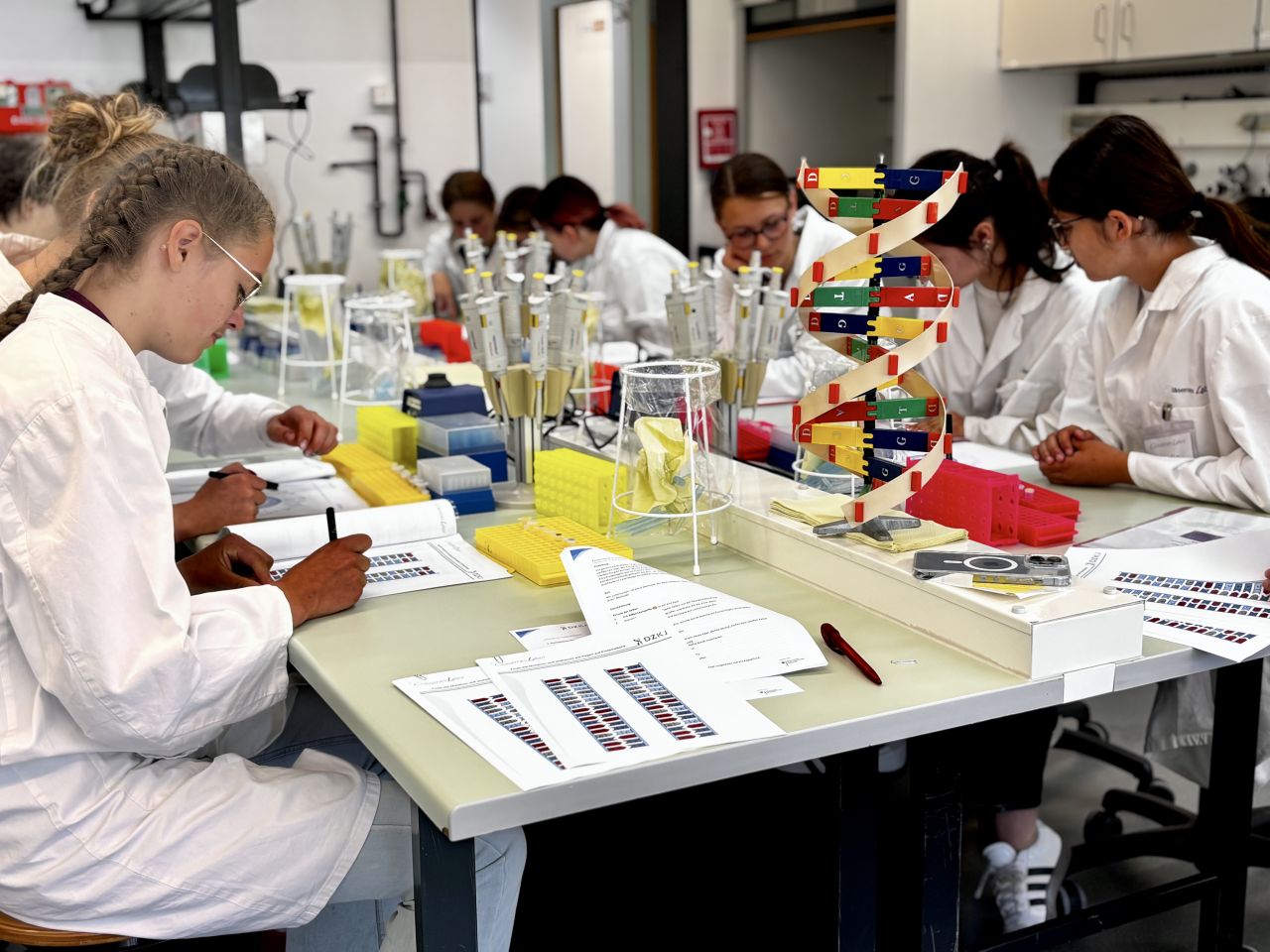
One week, two topics, and plenty of new experiences: 25 young people take a deep dive into research on rare diseases and immunology at the Life Science Learning Lab “Gläsernes Labor,” including by analyzing their own genes.
Stella stares intently at the reaction tube in her hand. The tall girl is standing at a lab bench in the Gläsernes Labor on the Buch campus. The “Rare Diseases” group is conducting its final experiment during the Gläsernes Labor project week. The 25 teenagers, aged 13 to 19 — most from Berlin and some from the surrounding Brandenburg area — want to find out how much a sample can be diluted while still yielding results from the polymerase chain reaction (PCR). The group’s concentration is palpable: For the experiment to work, they have to pipette precisely and carefully. But it’s also fun. “The vortexing was definitely the coolest part of this week,” says Stella, laughing as she tosses her long blonde ponytail over her shoulder. To “vortex,” samples are placed on an electric shaker or vortex mixer, which causes the container to vibrate rapidly. This ensures that the components of the liquid mix thoroughly.
This project week is special. Unlike the Gläsernes Labor’s usual course program, it does not take place as part of the school curriculum during the year, but rather during summer vacation. “Young people sign up out of their own interest, which creates a completely different dynamic,” says Ulrike Mittmann, a biotechnologist. The scientist oversees the molecular biology program at the Gläsernes Labor. The subjects of the project week — rare diseases and immunology — are also key focus areas for the German Center for Child and Adolescent Health (DZKJ), which launched and designed the project week in collaboration with the Gläsernes Labor and the Max Delbrück Center in 2025. “It’s important to us that young people get to know what everyday research is like and understand what concrete steps are being taken to advance research to improve children’s health,” says Dr. Nancy Freitag, scientific project manager at the DZKJ.
A visit to a research lab
The final day of project week is heading into the home stretch with plenty of energy and a good dose of scientific input. Over the past few days, Stella and the other teens have learned and applied the fundamentals of current research. Now they’re discovering how this knowledge is put to use in everyday research.
Dr. Kerstin Fentker, a postdoctoral researcher in the Proteomics Research Group at the Max Delbrück Center, presented her DZKJ-funded work on cystic fibrosis, a disease that, like many rare diseases, begins in childhood or adolescence. About three to five out of every 10,000 children develop the disease. “The cause is a genetic defect that impairs an ion channel on cell surfaces. This throws the salt-water balance out of equilibrium: too little water reaches the mucosal surface, and thick mucus forms in the lungs,” explains the researcher. Bacteria multiply in this mucus, leading to repeated infections and inflammation.
Fentker has been investigating how two specific medications influence these processes. Her findings can be used to further improve treatment and help young patients in the long term.
The teenagers also learned about challenges that can arise in everyday research. “Blood samples we receive from partner hospitals can vary considerably in quality. We notice immediately if there are major differences in how the samples were processed,” says doctoral candidate Pauline Fahjen during a discussion with the students. With large sample sizes, such technical differences can be statistically accounted for. Sometimes, however, samples must be excluded from further analysis if the quality is too poor. “This is especially painful when it comes to samples of heart tissue or rare tumors,” says the researchers.
Analyzing DNA
Stella finds these insights and the many new discoveries “really cool overall.” The student, who traveled all the way from Eberswalde in Brandenburg specifically for each project day, chose the topic of rare diseases because she believes it’s important to help sick children, even when only a few people are affected. “I especially like that we could really delve into the topics and ask follow-up questions,” says Stella. She also found it fascinating that the program covered “background knowledge”— for example, who invented PCR and how it was further developed.
PCR is an important technique for analyzing genetic material. During the project week, students learned how to use it and applied it themselves on multiple occasions. For Valentina, an 11th-grader at a Berlin high school, PCR was also one of the highlights: “It was great to learn and apply a technique that we had previously only heard about in theory in class. I also really liked analyzing my own genome,” she says. Valentina came across the Gläsernes Labor’s summer program online. To avoid the boredom that loomed during her school break, she had specifically searched for “something involving biology and chemistry.”
The project weeks will continue to evolve
At the end of project week, the Rare Diseases and Immunology groups presented their findings to one another. The program focusing on the body’s immune system was also diverse. The students visited the Molecular Genetics of Allergic Diseases research group at the Max Delbrück Center, determined their own blood types, analyzed white blood cells, detected peanut DNA in various products, and tested themselves for specific allergies.
When Mittmann asks the group: “Would you have liked to have had one more day?” a unanimous “Yes!” rings out. “More time would be better,” agrees Mittmann. “I had to cut short some exciting discussions so we could finish and at least take a short break in between,” she adds.
In May 2027, feedback meetings will be held with the DZKJ to further refine project week programs. The Max Delbrück Center will continue to help organize and fund project weeks for another five years, initially. “For this phase, we hope there will also be programs for children affected by rare diseases and their families,” says Nancy Freitag of the DZKJ. Stella is also eager for more: She has already decided to take part in another project week during the next summer vacation.
Text: Wiebke Peters
Source: Gläsernes Labor
„Am coolsten ist das Vortexen“
Research / 18.08.2026
Kirstin Bodensiek appointed Administrative Director
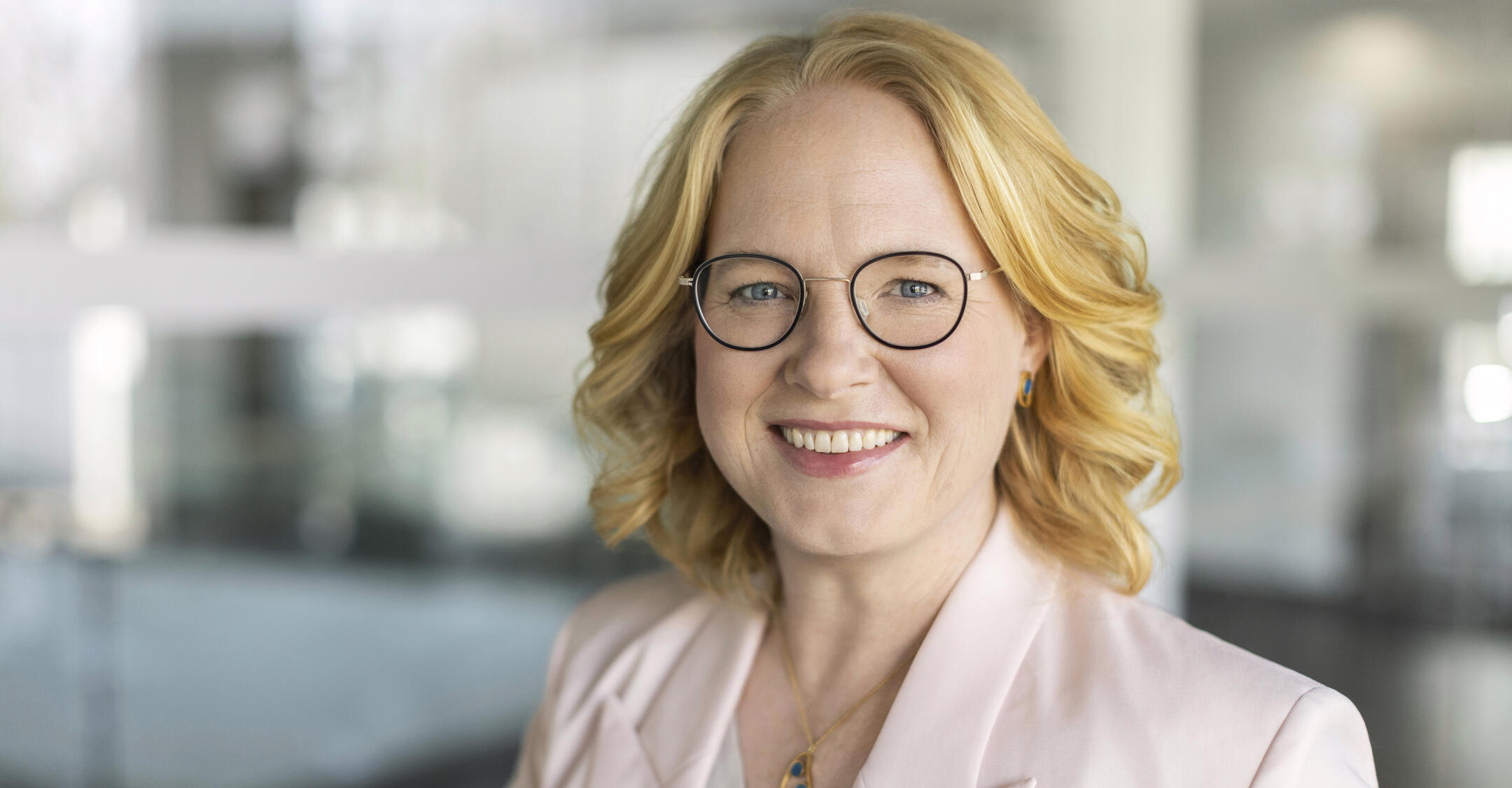
As of August 15, 2026, Kirstin Bodensiek has officially taken the helm as Administrative Director of the Max Delbrück Center. She is stepping into the permanent position after leading the center on an interim basis.
Following a successful transition period, Kirstin Bodensiek has officially taken over as Administrative Director of the Max Delbrück Center as of August 15, 2026. She succeeds Dr. Heike Graßmann, who was appointed State Secretary of the Saxon State Ministry for Science, Culture and Tourism on February 1, 2025.
“Science and administration are not separate worlds. Both contribute to our center’s success. I am extremely pleased to continue leading the Max Delbrück Center with Kirstin. I greatly value her perspective and her commitment to preparing the Max Delbrück Center for the future,” says Dr. Maike Sander, Scientific Director of the Max Delbrück Center.
“An important factor in my decision to officially continue as Administrative Director was the team-spirit I have experienced working with Maike. We look at all aspects of our center as a whole and work together across areas of responsibility and organizational structures to find the best solutions,” says Bodensiek. “The department heads have also given me their full support from the very beginning. I have not taken that for granted.”
Ultimately, every employee at the Max Delbrück Center contributes to improving the health of society. “That is a worthwhile goal — and I feel that I can make a contribution,” adds Bodensiek. “I want to empower people to take responsibility. That requires close dialogue with colleagues from all areas of the center. It’s an exercise I find particularly valuable.”
About Kirstin Bodensiek
Kirstin Bodensiek studied law at Humboldt-Universität zu Berlin and European law at Leiden University. She completed Germany’s second state examination in law in 2001. From 2002 onward, she held various positions at Deutsche Verkehrs-Assekuranz-Vermittlungs GmbH in Bad Homburg, a subsidiary of Deutsche Bahn AG. She was officially admitted to practice law in July 2018.
At the Max Delbrück Center, Bodensiek gradually took on increasing responsibility. From October 2018 to January 2025, she headed the Legal Department and served as deputy to Administrative Director Professor Heike Graßmann. When Graßmann was appointed State Secretary of the Saxon State Ministry for Science, Culture and Tourism, Bodensiek took over as interim Administrative Director. Following a successful transition period, she officially became Administrative Director of the Max Delbrück Center on August 15, 2026.
In addition to her role at the Max Delbrück Center, Bodensiek has coordinated the Helmholtz Association’s working group on Kaufmännische Informationsverarbeitung (commercial information processing) since April 2026. She is also active in the Genshagen Circle, serves as Chair of the Association Court of the Berlin Volleyball Association, and volunteers at sporting events such as the Special Olympics.
Further information
- Max Delbrück Center website
- Max Delbrück Center Strategy 2030
- Heike Graßmann, new State Secretary in Sachsen
- “We at the MDC” with Kirstin Bodensiek, 2021
The Max Delbrück Center for Molecular Medicine in the Helmholtz Association lays the foundation for the medicine of tomorrow through our discoveries of today. At locations in Berlin-Buch, Berlin-Mitte, Heidelberg, and Mannheim, interdisciplinary teams investigate the complexity of disease at the systems level – from molecules and cells to organs and entire organisms. Together with academic, clinical, and industry partners, and as part of global networks, we turn biological insights into innovations for early detection, personalized therapies, and disease prevention. Founded in 1992, the Max Delbrück Center is home to a vibrant, international research community of around 1,800 people from over 70 countries. We are 90 percent funded by the German federal government and 10 percent by the state of Berlin.
Innovation / 13.08.2026
Eckert & Ziegler Remains on Track in the First Half of 2026
2nd Quarter 2026:
- Sales: €76.4 million (PY: €80.6million)
- EBIT before special items: €17.4 million (PY: €19.2 million)
- Net income: €12.1 million (PY: €11.8 million)
1st Half Year 2026:
- Sales: €149.3 million (PY: €148.8 million)
- EBIT before special items: €33.3 million (PY: €35.4 million)
- Net income: €22.4 million (PY: €21.4 million)
Forecast 2026:
- Sales of around €320 million (confirmed)
- EBIT before special items of around €80 million (confirmed)
Berlin, 13 August 2026. Eckert & Ziegler SE (ISIN DE0005659700, TecDAX) reported sales of €149.3 million in the first half of 2026. The group’s adjusted EBIT dropped by just under 6% to €33.3 million. Adjusted EBIT in the Medical segment rose by nearly 7% to €24.9 million. Net income grew by approximately 5% to €22.4 million, or €0.36 per share. Adjusted for the extraordinary licensing revenue in the same period of the previous year, group sales increased by 4% and earnings by as much as 9%. The licensing business had not yet generated revenues in 2026.
In the Medical segment, sales in the first half of the year totaled €80.9 million, slightly above the prior-year level (€80.5 million). The pharmaceutical radioisotopes business remains the most important revenue driver. The Isotope Products segment generated sales of €68.5 million, which were nearly unchanged compared with the prior year.
For the current fiscal year 2026, the Executive Board confirms its profit forecast published on
26 March 2026, with sales of around €320 million and an adjusted EBIT of around €80 million.
The complete quarterly report can be viewed here: https://www.ezag.com/Q22026en
About Eckert & Ziegler.
Eckert & Ziegler SE with more than 1.000 employees is a leading specialist for isotope-related components in nuclear medicine and radiation therapy. The company offers a broad range of services and products for the radiopharmaceutical industry, from early development work to contract manufacturing and distribution. Eckert & Ziegler shares (ISIN DE0005659700) are listed in the TecDAX index of Deutsche Börse.
Contributing to saving lives.
Living, Patient care / 12.08.2026
Gynäkologie und Geburtshilfe am Helios Klinikum Berlin-Buch wächst: Neue Räumlichkeiten und ein neuer Chefarzt stärken den Standort
Die Gynäkologie und Geburtshilfe am Helios Klinikum Berlin-Buch wächst weiter. Nach der Fertigstellung des Erweiterungsbaus ergänzen zukünftig neue Räumlichkeiten das Angebot für werdende Eltern. Zudem können zwei zusätzliche Kreißsäle im Hauptgebäude eingerichtet werden, sodass in Zukunft sechs Kreißsäle zur Verfügung stehen. Darüber hinaus wird Dr. med. Sebastian Hentsch zum 01. Oktober 2026 die Position als Chefarzt für Gynäkologie und Geburtshilfe antreten. Mit diesen Neuerungen baut der Standort weiter seine Versorgung von Patient:innen und werdenden Müttern aus.
Mit der Fertigstellung des Erweiterungsbaus am Helios Klinikum Berlin-Buch im April 2026 stehen werdenden Müttern zukünftig noch modernere Infrastruktur und mehr Komfort in weiteren Räumlichkeiten zur Verfügung. Der lichtdurchflutete Anbau bietet Platz für den erweiterten Kreißsaalbereich mit neuen Vorwehenzimmern. Diese sind ein großer Zugewinn für die schwangeren Patientinnen und bieten zusätzlich auch Platz für deren Partner:innen. So können Patientinnen in der frühen Geburtsphase stationär aufgenommen werden und sich Paare gemeinsam auf die Geburt vorbereiten. In Zukunft wird das Klinikum insgesamt 6 Kreißsäle zur Verfügung haben, da aktuell noch zwei weitere gebaut werden. Die Einrichtung und die Ausstattung der Kreißsäle, wie beispielsweise Gebärhocker, Seil/Tuch, Pezziball, Entspannungsbadewanne, multifunktionales Kreißbett oder der Gebärwanne bieten modernen Komfort.
Das Team der Geburtshilfe betreut im Schnitt rund 2700 Geburten im Jahr. Als Perinatalzentrum höchster Versorgungsstufe (Level 1) bietet die Geburtshilfe im Helios Klinikum Berlin-Buch maximale Versorgungskompetenz. Alle entscheidenden Fachbereiche wie Pränatalmedizin, Geburtshilfe mit eigenem OP, Neonatologie mit Intensivstation, Kinderklinik und Kinderchirurgie sind räumlich direkt miteinander verbunden. Diese enge Verzahnung ermöglicht schnelle Entscheidungen, kurze Wege und eine besonders sichere Versorgung von Mutter und Kind auch in komplexen Situationen, wie Risikoschwangerschaften, Mehrlingsgeburten und Frühgeborene.
Mit dieser Maßnahme reagiert das Klinikum auf die Nachfrage für Geburten. Im Helios Klinikum Berlin-Buch werden werdende Eltern von einem erfahrenen Team in einem sicheren Raum von Anfang vertrauensvoll, sicher und rund um die Uhr begleitet. Mit den vielfältigen Angeboten und den erweiterten Räumlichkeiten bietet das Team der Geburtshilfe die bestmögliche Unterstützung und einen neuen Komfort. A
lle Schwangeren können sich unter schwangerenberatung-berlin@helios-gesundheit.de per E-Mail melden. Interessierte werdende Eltern können das Team der Geburtshilfe und die Räumlichkeiten bei einem der regelmäßigen Infoabende für werdende Eltern vor Ort im Klinikum kennenlernen. Diese finden jeden ersten und dritten Mittwoch im Monat um 17:30 Uhr im Helios Klinikum Berlin-Buch statt. Die nächsten Termine finden sich auf der Veranstaltungsseite des Klinikums.
Neuer Chefarzt für Gynäkologie und Geburtshilfe
Zusätzlich steht im Fachbereich eine weitere Veränderung an: Dr. med. Sebastian Hentsch wird zum 01. Oktober 2026 die Chefärztliche Leitung der beiden Fachbereiche Gynäkologie und Geburtshilfe am Helios Klinikum Berlin-Buch von den kommissarischen Leitungen Dr. med. Christine Mau (Gynäkologie) und Dr. med. Annette Isbruch (Geburtshilfe) übernehmen. Der erfahrene Facharzt für Gynäkologie und Geburtshilfe sowie für Gynäkologische Onkologie ist zusätzlich auf die Bereiche Endometriose und Urogynäkologie spezialisiert. Zuletzt war Dr. med. Hentsch als Oberarzt an der Universitätsfrauenklinik in Düsseldorf tätig. In Buch betreut er zukünftig zwei große, modern ausgerichtete Fachbereiche mit kompetenten sowie erfahrenen Teams, die Patientinnen und werdende Mütter medizinisch auf höchstem Niveau betreuen.
„Ich freue mich, unsere Patientinnen gemeinsam mit meinen Kolleg:innen vertrauensvoll und professionell zu betreuen. Sowohl die Gynäkologie als auch die Geburtshilfe sind für Frauen wichtige Anlaufpunkte, wenn es um sensible und emotionale Themen wie die gynäkologische Gesundheit, Familienplanung und Geburt geht. Ich bin mir der Verantwortung, die meine Teams und ich dahingehend tragen, überaus bewusst und trete meinen neuen Posten mit großer Motivation an“, äußert sich Dr. med. Hentsch.
Das Helios Klinikum Berlin-Buch und das Team der Gynäkologie und Geburtshilfe freuen sich auf die Zusammenarbeit mit Dr. med. Sebastian Hentsch. Mit beiden Maßnahmen erweitert der Standort das medizinische Angebot für Patient:innen und werdende Mütter.
Living / 12.08.2026
„Kommunaler Wärmeplan. Pankow im Blick" – Veranstaltung am 27. August 2026 in der Kulturmarkthalle Prenzlauer Berg
„Kommunaler Wärmeplan. Pankow im Blick" – Veranstaltung am 27. August 2026 in der Kulturmarkthalle Prenzlauer Berg
Die Leitstelle Klimaschutz des Bezirksamtes Pankow lädt Interessierte zur Veranstaltung „Kommunaler Wärmeplan. Pankow im Blick" am Donnerstag, dem 27. August 2026 von 18:00 bis 21:00 Uhr in der Kulturmarkthalle Prenzlauer Berg, Hanns-Eisler Straße 93, 10409 Berlin. Die Teilnahme ist kostenlos, um Anmeldung bis zum 25. August bei kurzlinks.de/pankowimblick wird gebeten.
Ziel der Veranstaltung ist es, über die Ergebnisse der kommunalen Wärmeplanung zu informieren und konkrete Handlungsmöglichkeiten sowie Beratungs- und Förderangebote aufzuzeigen. Im Mittelpunkt steht dabei vor allem, der Pankower Bevölkerung niedrigschwellig Informationen zu ihrem Wohnort zu vermitteln und aufzuzeigen, welche Schritte nun folgen sollten, damit die Wärmewende erfolgreich vorangebracht wird.
Wärmewende als zentraler Hebel für den Klimaschutz
Etwa die Hälfte der Treibhausgasemissionen in Pankow entsteht durch die Wärmeversorgung. Damit ist die Wärmewende der zentrale Hebel für mehr Klimaschutz im Bezirk. Mit der kommunalen Wärmeplanung legt das Land Berlin nun erstmals fest, welche Versorgungsstrukturen für einzelne Gebiete und Gebäude zukünftig vorgesehen sind.
Doch was bedeutet das konkret für den eigenen Kiez, das eigene Zuhause? Liegt das eigene Gebäude in einem Wärmenetzerweiterungsgebiet, einem Prüfgebiet oder einem Gebiet mit dezentraler Versorgung? Und welche Möglichkeiten haben Eigentümer:innen oder Mieter:innen, jetzt aktiv zu werden? Bei der Informationsveranstaltung gibt es verständliche Antworten auf genau diese Fragen.
Programm mit Fachvorträgen, Praxisbeispielen und Thementischen
Nach der Begrüßung durch Bezirksbürgermeisterin Dr. Cordelia Koch stellt die Senatsverwaltung für Mobilität, Verkehr, Klimaschutz und Umwelt (SenMVKU) die Ergebnisse der kommunalen Wärmeplanung mit Fokus auf Pankow vor. Im Anschluss informieren Beschäftigte des Bezirksamtes über Beratungs- und Fördermöglichkeiten, während lokale Praxisprojekte Einblicke in bereits umgesetzte Maßnahmen geben.
Anschließend steht ausreichend Zeit für persönliche Fragen und Vernetzung zur Verfügung: An Thementischen beantworten Expert:innen individuelle Fragen rund um Handlungsoptionen, Förderprogramme und die eigene Wärmeversorgung. Ergänzend bietet eine Ausstellung mit Stellwänden bereits beim Ankommen erste Informationen zu Gebietskulissen, Karten und den nächsten Schritten.
Kontaktdaten:
Leitstelle Klimaschutz
Research, Innovation, Patient care / 01.08.2026
The path of new immunotherapies to the clinic
Bringing a new CAR‑T cell therapy from promising results in the lab to critically ill cancer patients is anything but straightforward. A Tagesspiegel podcast featuring, among others, Armin Rehm explores the hurdles that must be overcome along the way and why the process is often faster in the United States.
The two-hour conversation with experts — including cancer researcher Dr. Armin Rehm of the Max Delbrück Center, Professor Lars Bullinger, Head of Tumor Immunology at Charité, and Dr. Anne Kerber, Senior Vice President and Head of Development for Hematology, Oncology, and Cell Therapy at the U.S. pharmaceutical company Bristol Myers Squibb — concludes the series “Cancer research: How ideas become life-saving therapies.”
The twelve-part series is a joint project of the Health & Science section of the Tagesspiegel (Sascha Karberg and Alexander Schlichter) and the Department of Hematology, Oncology, and Tumor Immunology at Charité – Universitätsmedizin Berlin (Lars Bullinger). It was funded by Stiftung Charité as a “science x media Tandem.”
The journalists show how an idea in the lab can eventually become a new treatment in the clinic, using the example of new cancer immunotherapies being developed in Berlin at the Charité and the Max Delbrück Center. And they highlight the different perspectives: the hard work in the lab that lays the groundwork, the motivation of the doctors, the hope of the patients, and the system that sets the rules leading up to market approval.
Source: Max Delbrück Center
The path of new immunotherapies to the clinic
Education / 24.07.2026
Schule fürs Leben
Frau Dr. Mehrländer, was hat Sie an Ihrer neuen Aufgabe gereizt, die Hufeland-Schule zu leiten?
Pankow ist der wachsende Berliner Bezirk, der in den nächsten zehn Jahren die meiste demographische Veränderung erfahren wird. Und gerade hier in Buch werden viele Leute eine neue Heimat finden. Die Hufeland-Schule würde gerne im Ort wachsen.
Neben dem Wachstum nach außen sehe ich großes Potenzial darin, den Ganztagsbetrieb unserer Schule noch besser auszugestalten. Wir wollen noch mehr Angebote entwickeln, Lernen und Entspannung in der Stundentafel besser verknüpfen und einen qualitativ ansprechenden Zeitraum an betreutem Erwachsenwerden gewährleisten. Welche Schulform im wachsenden Ortsteil künftig gefordert ist, lässt sich jetzt noch nicht abschätzen. Daher möchte ich die Hufeland-Schule in der jetzigen Form attraktiv aufstellen, als Mittelschule bis Klasse 10. Dank unserer Verträge mit Oberstufenzentren können alle Kinder mit geeignetem Mittleren Schulabschluss, MSA,zum Abitur dorthin wechseln.
Wie viele Jugendliche erreichen diesen geeigneten MSA?
Es sind knapp über 50 Prozent. Allerdings gehen die meisten nicht in die höhere Bildung. Im Vordergrund stehen Ausbildung, Jobs und Geld-Verdienen. Die Gründe, warum das Abitur selten angestrebt wird, kann ich noch nicht richtig einschätzen. Der Übergang in die Berufswelt ist in unserer Schule schon gut angelegt: Es kommt zweimal pro Woche eine Mitarbeiterin von der Jugendberufsagentur ins Haus, und zusätzlich haben wir jemanden, der täglich für alle Fragen von Bewerbungen, Praktika und beruflichen Perspektiven zur Verfügung steht. Künftig werden wir an unserer
Schule eine Jobmesse etablieren. Dabei wird es darum gehen, dass sich die Schüler:innen über Berufe informieren, Kontakt für Praktika knüpfen und Alumni von ihren Erfahrungen berichten. Wir wollen lokale Firmen einbinden, die Auszubildende suchen und hier erste Gespräche anbahnen können. Mein Ziel wäre, dass pro Jahr etwa 20 Absolvent:innen unserer Schule in der Region unterkommen. Wir planen, dafür eine Datenbank aufzubauen, aus der ersichtlich ist, welche Betriebe ausbilden und Nachwuchs suchen. Gleichzeitig wünsche ich mir, dass die Betriebe uns auch ein Feedback über unsere Schüler:innen als Azubis geben, aus dem wir lernen können.
Welche Rolle spielt die Digitalisierung in Ihrem Schulkonzept?
Wir sind sehr gut für digitale Bildung ausgestattet, worüber wir uns freuen. Aber die beste Software kann keinen Lehrer ersetzen. Mein Credo ist, dass wir es an dieser Schule schaffen, eine fundierte analoge Bildung für den reflektierten und konstruktiven Umgang mit der digitalen Welt zu vermitteln. Es geht vor allem um Basiskompetenzen und Sekundärtugenden für das zukünftige Leben unserer Schülerschaft.
Welche Initiativen planen Sie, um die Hufeland-Schule noch attraktiver werden zu lassen?
Um eine exzellente Mittelschule zu entwickeln, plane ich Erasmus-Projekte ab Klasse 7 mit jahrgangsspezifischen Partnern im Ausland. Neue Perspektiven zu gewinnen und über den Tellerrand zu blicken, ist ein großer Ansporn, sich zu entwickeln. Zudem werden wir dauerhaft Schülerfirmen etablieren und unsere Jugendlichen ermutigen, mit Unterstützung der Lehrkräfte solche zu gründen. Wir übertragen den Schüler:innen im Rahmen des „Hufeländer-Projektes“ auch mehr Eigenverantwortung für das Gelände und den Schulgarten, um das Gemeinschaftsgefühl und Verantwortungsbewusstsein zu stärken. Dass unser Schüler-Parlament vom Land Berlin in 2026 mit einem eigenen Haushalt ausgestattet wurde, ist hier schon ein starker Beginn. Insgesamt wünsche ich mir, dass Absolvent:innen von der Hufeland-Schule bei den örtlichen Betrieben künftig einen
sehr guten Ruf haben.
Welche Unterstützung wünschen Sie sich von den regionalen Akteuren aus Wirtschaft, Forschung und von der Politik?
Hier vor Ort wünsche ich mir, dass die Betriebe und Einrichtungen auf uns zukommen und ihren Bedarf mitteilen. Für uns ist wichtig zu wissen, in welchen Berufen sie Nachwuchs benötigen. Von der Politik wünsche ich mir, dass die Lehrerausbildung verstärkt vorangetrieben wird und Stellenbesetzung auch am Stadtrand verlässlich funktioniert. Ein Weg wäre aus meiner Sicht, die Verbeamtung in Berlin mit einer Stellenzuweisung zu verbinden. Außerdem appelliere ich an die Politik, die verkehrliche Anbindung von Buch zu verbessern. Erst kürzlich hat eine Referendarin aus Adlershof, die Mathe und Physik unterrichtet hätte, wegen der zahlreichen Störungen bei der S-Bahn ihre Bewerbung zurückgezogen. Nicht wenige Lehrer:innen und Schüler:innen kommen mit der S-Bahn und Bussen zur Schule, auf deren Pünktlichkeit muss Verlass sein.
Interview: Dr. Ulrich Scheller / Campus Berlin-Buch GmbH
Das Interview erschien zuerst im Standortjournal buchinside 2/2026
Innovation / 21.07.2026
OMEICOS’ OMT-28 Headed for Phase 3 in Primary Mitochondrial Diseases (PMD) Following Positive End-of-Phase 2 Meeting with the FDA
Berlin, Germany, July 21, 2026
-
Feedback from the U.S. Food and Drug Administration (FDA) supports acceleration of OMT-28’s development path directly into a pivotal Phase 3 study
-
With the vast majority of PMD patients having no FDA-approved therapeutic option, OMT-28 addresses a significant unmet medical need in mitochondrial disease space
-
Results from Phase 2a PMD-OPTION Study were recently presented at Euromit 2026 and
Mito MED 2026, the two largest international conferences on mitochondrial pathologies
OMEICOS, a late-stage clinical biopharmaceutical company developing first-in-class small-molecule therapeutics for mitochondrial and inflammatory disorders, today announced the successful completion of the End-of-Phase 2 (EOP2) meeting with the FDA regarding the development of OMT-28 in Primary Mitochondrial Diseases (PMD). During the meeting, the FDA expressed strong support for OMEICOS’ plans to advance the program into
late-stage clinical development and provided clear, constructive guidance to structure the next steps efficiently. As a result, OMEICOS is now positioned to advance its proprietary, fully owned lead product candidate OMT-28 directly into a pivotal Phase 3 study.
The EOP2 meeting with the FDA was supported by results from the successfully concluded multicentre, open-label Phase 2a PMD-OPTION Study in patients with PMD. The PMD-OPTION Study demonstrated
OMT-28’s therapeutic potential to improve physical condition in patients with PMD based on significant recovery of the impaired mitochondrial function in the responding patients. The study also further underscored the excellent safety and tolerability profile of OMT-28, which has been evaluated in more than 190 individuals to date.
OMT-28 has the potential to be a first-in-class and best-in-class therapy and is clearly differentiated from competing approaches in PMD through its unique dual mechanism, targeting both redox balance and mitochondrial restoration, addressing core disease biology more comprehensively than single-pathway approaches. OMT-28 leverages the activation of mitochondrial sirtuin family members SIRT1 and SIRT3, mainly through biased modulation of S1PR1 (Sphingosine-1-Phosphate Receptor 1) signalling.
As a once-daily oral small molecule, OMT-28 would offer superior convenience and adherence compared to currently evaluated injectables or twice-daily future alternatives. Moreover, cardiomyopathy patients—a subgroup often excluded in other clinical development programs—highlights OMT-28’s potentially broader target population further reinforcing its best-in-class product profile. Beyond PMD, OMEICOS is pursuing a ‘pipeline-in-a-drug’ strategy with OMT-28 and sees potential for expansion into larger disease areas.
“The strong endorsement from the FDA marks a significant milestone for OMEICOS as a company and for our mission to address Primary Mitochondrial Disease. The meeting’s outcome even surpassed our expectations, as we are now able to advance directly from our concluded Phase 2a study into a pivotal Phase 3 study,” said Dr. Robert Fischer, CEO/CSO of OMEICOS Therapeutics. “Our goal now is to bring a much-needed new treatment option into the final stages of development—and hopefully into medical practice—as quickly as possible. We are currently evaluating the best possible infrastructure, strategic partners, and resources to achieve this goal efficiently.”
PMD patients suffer from debilitating and life-threatening health consequences, such as severely limited physical stamina and disease-related changes in the heart and skeletal muscles, as well as associated neurological disorders. The disease represents a heterogeneous group of conditions including the most prevalent subtypes MELAS, non-MELAS, and MIDD. The upcoming pivotal Phase 3 study is planned to enrol up to 160 adult patients stratified by these three common PMD subgroups and will evaluate the efficacy of OMT-28 at a 24 mg once-daily dose over 24 weeks, with an option to extend treatment up to 104 weeks. The trial will employ an adaptive design, allowing adjustments to sample size and treatment duration based on interim analyses, ensuring flexibility and efficiency in this rare disease setting. The primary endpoint is a composite measure combining the 12-Minute Walk Test (12MWT) and the 5x Sit-to-Stand Test (5xSST), with secondary endpoints including quality-of-life assessments and exploratory biomarkers such as NAD⁺, GSH, and their ratios. This design reflects the FDA’s constructive guidance and underscores the potential of OMT-28 to transform the treatment landscape for patients in need.
About OMEICOS
OMEICOS Therapeutics has discovered a series of metabolically robust synthetic analogues of omega-3 fatty acid-derived epoxyeicosanoids that have the potential to treat mitochondrial dysfunction, inflammatory, cardiovascular and other diseases. Epoxyeicosanoids activate cell type-specific endogenous pathways that promote organ and tissue protection. OMEICOS’ small molecules are orally available and show improved biological activity and pharmacokinetic properties compared to their natural counterparts. The Company’s most advanced development program OMT-28 is headed for a pivotal Phase 3 clinical study in Primary Mitochondrial Diseases (PMD). For more, please visit: www.omeicos.com
Contacts
OMEICOS Therapeutics GmbH
Dr. Robert Fischer, CEO, CSO
Phone: +49 (0) 30 9489 4810
E-Mail: r.fischer@omeicos.com
www.omeicos.com
Quelle: Omeicos Therapeutics GmbH
Research / 20.07.2026
A single cocaine dose alters mouse brain cells
Researchers led by Ana Pombo have found that just one exposure to the drug can create changes in mouse brain cells that persist for at least two weeks. Their findings were presented at the Federation of European Neuroscience Societies Forum on July 7, 2026.
Cocaine is a highly addictive drug that can cause anxiety and paranoia in users, and can lead to heart damage, impotence and poor mental health in the long term. According to the U.N Office on Drugs and Crime, cocaine use is at an all-time high, with an estimated 25 million users worldwide.
“We know that cocaine hijacks the reward machinery of the brain,” said Dr. Ana Pombo, Bloomberg Distinguished Professor at Johns Hopkins University, during the Federation of European Neuroscience Societies (FENS) Forum on July 7, 2026. Pombo also has a joint appointment as Guest Group Leader of the Epigenetic Regulation and Chromatin Architecture lab at the Berlin Institute of Medical Systems Biology of the Max Delbrück Center. “Most people do not become addicted after using cocaine once, but many do after a second use or repeated exposures. However, we don’t know enough about what is happening to brain cells exposed to cocaine and whether these effects are long-lasting.”
Her team has been using mice to see where the brain stores the memory of taking cocaine for the first time, and to understand why addiction occurs after repeated use, even when cocaine use is months or years apart.
Mapping effects in the brain
The researchers used a technique called genome architecture mapping to understand the effects of cocaine on mouse brains. This approach makes it possible to study how genetic material is organized inside a cell. Although genes provide a blueprint for all cells in the body, their three-dimensional organization can dictate when genes are switched on or off in any individual cell.
Compared to mice not exposed to cocaine, researchers found that the 3D structure of the genome was extensively altered in brain cells called dopaminergic neurons in the ventral tegmental region of the midbrain. This part of the brain is known to play an important role in reward and motivation. The changes could be seen 24 hours after exposure to cocaine, and persisted. Some changes were even greater two weeks after exposure.
For example, among these changes, they found that a single cocaine exposure prompts the development of around 1,700 new ‘chromatin domain insulation areas’ — parts of the genome that can help regulate the activity of genes — and the loss of around another 1,100 of these areas.
The researchers also looked in detail at which genes were active and which were inactive in mouse brain cells exposed to cocaine compared with brain cells not exposed to cocaine.
This showed that exposed cells were producing more of some of the brain’s signalling molecules, called neuropeptides, that have been linked to addiction in humans. Other genes that help the brain cell function normally had become less active.
Implications for addiction
“Our results suggest that a single exposure to cocaine ‘rewires’ the genome of these important brain cells,” says Pombo. “The fact that we found such big changes that persist for two weeks is unexpected and it suggests that the drug is leaving a longer-term ‘scar’ in the genome of the brain cells.”
She adds: “These persistent changes may be setting the stage for a stronger response after a second dose of cocaine, which could help explain why the brain becomes susceptible to cocaine addiction. We still need to investigate how long these changes last. Are they permanent, or can the brain cells recover over time? We also need to investigate how these changes translate to the risk of addiction.”
“Cocaine use is a serious and growing problem around the world. We need to understand the effects of this drug and how people become addicted, but it’s almost impossible to study these mechanisms in detail in the human brain, so instead we look at mice,” said Professor Christina Dalla from the National and Kapodistrian University of Athens, Greece, chair of the FENS Forum communication committee and who was not involved in the research.
“In this study, scientists have identified profound and lasting changes in mouse brain cells after just one exposure to cocaine,” she added. “This shows that cocaine can alter the structure of the genome in these cells and this alteration may persist over time. These findings challenge the idea that occasional recreational use of cocaine may be harmless as they suggest that one use could change our brains and raise the risk of addiction in the future.”
Researching these changes in greater detail could help us understand why some people are more likely than others to become addicted. This could also help us to find new ways to treat addiction.
Text: FENS Forum 2026
https://www.mdc-berlin.de/news/Research / 17.07.2026
How the skin distinguishes cool from warm
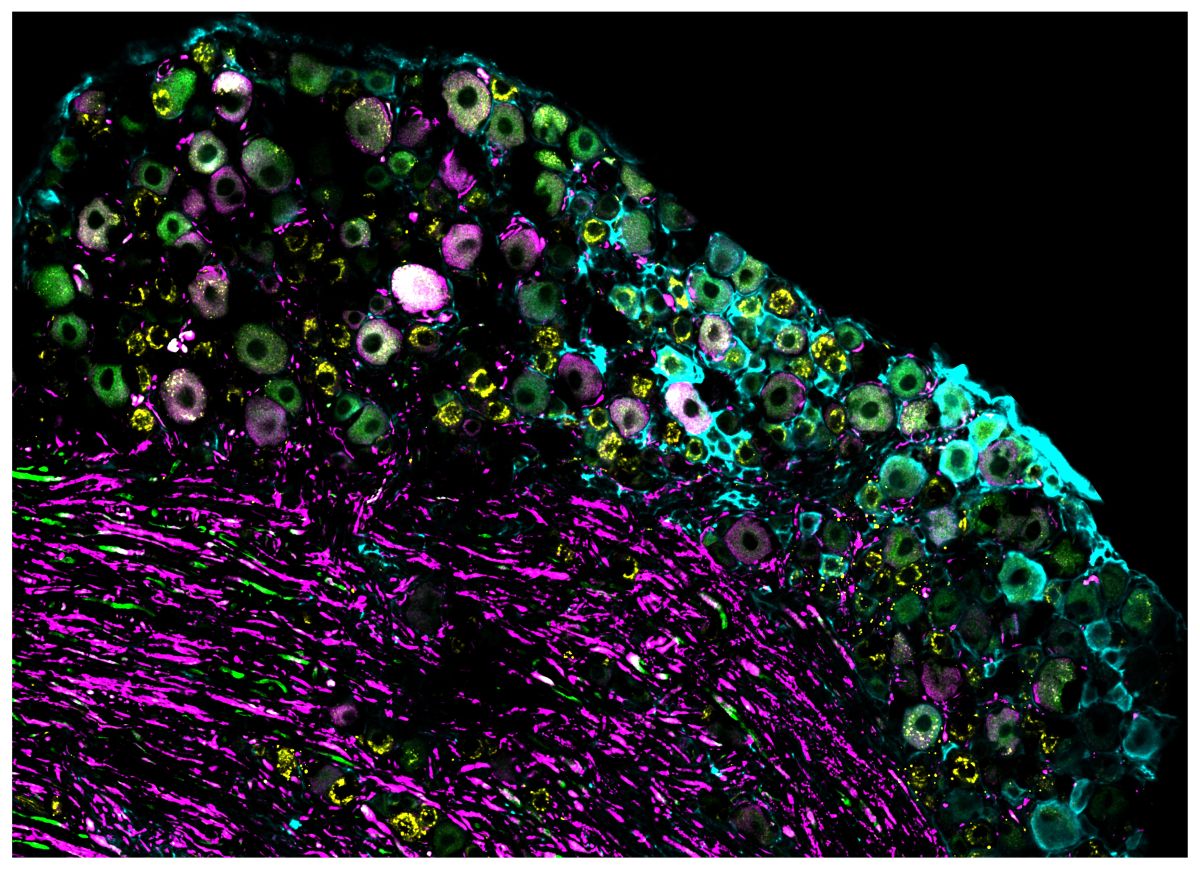
Researchers in the lab of James Poulet have uncovered how the nervous system senses cool and warm temperatures. The findings, published in “Neuron” challenge a long-standing view of temperature sensing and could guide future research into pain and sensory disorders.
Whether we hold a warm mug or step onto a cool floor, specialized nerve cells in the skin constantly report temperature to the brain. Scientists have long assumed that separate groups of sensory cells detect non-painful cool and warm temperatures. Now researchers led by Drs. Phillip Bokiniec and Clarissa Whitmire in the Neural Circuits and Behavior Lab of Dr. James Poulet at the Max Delbrück Center have found that this assumption is too simplistic.
“Rather than relying on separate “warm” and “cool” sensors, we found that the nervous system appears to use one population of cells that signals both directions of temperature change,” explains Bokiniec, who shares first authorship of the study with Whitmire. Bokiniec is a now researcher in the Sensory Neural Coding lab of Dr. Clarissa Whitmire at the Queensland Brain Institute.
Using advanced imaging in mice, the team report in “Neuron” that most temperature-sensitive nerve cells are activated by cooling, and merely reduce their activity when the skin warms. The researchers also showed that these cells react to the actual temperature of the skin rather than simply detecting how much it has changed. This finding reshapes scientists’ understanding of one of the body’s most fundamental senses.
“Scientists have known about these neurons for years,” notes Poulet, “but they were thought to be relatively rare. What surprised us was discovering that they make up most of the temperature-sensing cells.”
Imaging neurons in live mice
The researchers developed a method to image hundreds of temperature-sensing nerve cells in the spinal sensory ganglia of awake mice over time. They gently warmed and cooled the animals’ paws while recording the activity of individual neurons using two-photon microscopy. They also performed this experiment in anesthetized mice and found the same result. This proved that that the anesthetic itself did not affect their results.
The team then selectively blocked or activated temperature-sensitive ion channels. Blocking the protein TRPM8 — long known as the body’s main sensor for detecting cool temperatures — eliminated both the response to cooling and the dampening effect that warming has on these nerve cells. This showed that a single molecular sensor can generate signals for both cool and warm, challenging the traditional view that separate receptors are needed for each sensation.
The team also developed a computer model to test their hypothesis. It showed that simply changing the activity of a TRPM8 was enough to reproduce the different response patterns seen in the experiments.
Understanding sensory disorders
Temperature sensation is essential for everyday life, but it is also disrupted in many medical conditions, including neuropathic pain, diabetic neuropathy, chemotherapy-induced nerve damage and disorders that cause abnormal sensitivity to cold. “Understanding how healthy temperature sensing works is a prerequisite for understanding what goes wrong in disease,” says Whitmire.
The researchers next plan to investigate how these signals are processed in the spinal cord, how painful temperatures are encoded, and whether the same principles apply in humans.
Text: Gunjan Sinha
Figure: A cluster of nerve cells from a mouse that carries sensory information from the hind leg to the spinal cord. Some of these nerve cells detect temperature, while others respond to different sensations such as touch or pain. The different colors highlight specific groups of cells.
Further information
Research / 15.07.2026
Der Duft des Erfolgs
Ein einziger Geruchsstoff, produziert von der Königin, beugt Konkurrenzkämpfen im Nacktmull-Staat vor. Das berichtet ein Team um Gary Lewin in „Nature“. Der Duft der Königin stellt sicher, dass nur die Monarchin selbst sich fortpflanzen kann – auch wenn sie mal nicht vor Ort ist.
Man stelle sich das Szenario vor: Ein Staatsoberhaupt verströmt einen Duft, der dafür sorgt, dass mögliche Konkurrenz erst gar nicht auf dumme Gedanken kommt, sondern ruhig und pflichtbewusst der ihr zugeteilten Arbeit nachgeht. Klingt nach einer etwas düsteren Utopie? Im Nacktmull-Staat ist es die Realität.
Ein internationales Team um Professor Gary Lewin, Leiter der Arbeitsgruppe „Molekulare Physiologie der somatosensorischen Wahrnehmung“ am Max Delbrück Center in Berlin, hat herausgefunden, dass die Königin der in Kolonien lebenden Nacktmulle, einer afrikanischen Säugetierart, eine flüchtige Substanz namens Isopropylmyristat absondert. Sie bewirkt, dass alle anderen Weibchen der Gruppe unfruchtbar bleiben.
„Das funktioniert sogar dann, wenn die Königin selbst gar nicht anwesend ist, sondern die Tiere nur diesem Duftstoff ausgesetzt sind“, erklärt der Erstautor der Studie, Dr. Mohammed Khallaf aus Lewins Team. Veröffentlicht ist die Publikation, an der Arbeitsgruppen aus Berlin, Frankfurt, Jena, München und Paris sowie aus Ägypten, Südafrika, Tansania, Tschechien und den USA beteiligt waren, in der Zeitschrift „Nature“.
Für Menschen geruchlos, für Nacktmulle nicht
Seit rund einem Vierteljahrhundert erforscht Lewin die Biologie der Nacktmulle, die auch aus medizinischer Sicht äußerst interessant sind: Die Nagetiere, von denen am Max Delbrück Center derzeit rund 450 Exemplare ähnlich wie in ihrer Heimat in Tunnelsystemen leben, werden uralt, erkranken nicht an Krebs und empfinden wenig Schmerzen. Darüber hinaus zählen sie zu den ganz wenigen Säugetierarten, die eusozial sind, also wie Bienen oder Ameisen in festen Staaten leben – mit einer sich stetig fortpflanzenden Königin an der Spitze und vielen unfruchtbaren Arbeiter*innen, die zusammen Futter beschaffen, den Nachwuchs aufziehen und anderen Aufgaben, die der Gemeinschaft dienen, nachgehen.
„Für unsere aktuelle Studie wollten wir herausfinden, über welche biologischen Mechanismen die Königin ihre Alleinherrschaft aufrechterhält“, erklärt Lewin. „Wir hatten vermutet, dass Duftstoffe ähnlich wie bei Insekten eine wichtige Rolle spielen – auch weil wir festgestellt hatten, dass Nacktmulle mit ihrem Geruchssinn Tiere der eigenen und einer fremden Kolonie unterscheiden.“ Deshalb haben er und sein Team zunächst per Massenspektrometrie jene flüchtigen Substanzen charakterisiert, die ausschließlich die Königinnen im Unterschied zu den Arbeiter*innen verströmen.
Die Forschenden stießen auf eine bekannte Chemikalie namens Isopropylmyristat, die unter anderem in vielen Kosmetikprodukten enthalten ist – als Lösungsmittel und feuchtigkeitsspendende Substanz. Für Menschen ist sie nahezu geruchlos, für Nacktmulle offenbar nicht: „Mit elektrophysiologischen Methoden und funktionellem Ultraschall, der die Durchblutung und damit die Aktivität einzelner Hirnregionen erfasst, konnten wir nachweisen, dass ihre Riechrezeptoren die Substanz wahrnehmen und dass deren Signale im Geruchszentrum des Gehirns verarbeitet werden“, erläutert Khallaf. „Hochrangige Tiere mieden den Geruch zudem, wenn sie die Möglichkeit dazu erhielten – wahrscheinlich weil er sie an die Dominanz ihrer Königin erinnert.“
Der Duft der Königin beeinflusst die Hormone
Stirbt eine Nacktmull-Königin oder wird sie aus der Kolonie entfernt, kommt es innerhalb weniger Tage zu heftigen Kämpfen und neuen Sexualkontakten. Sobald das erste Weibchen trächtig ist, wird es zur neuen Königin und im Staat kehrt wieder Ruhe ein. „Wir haben in unseren Experimenten allerdings festgestellt, dass für die Harmonie in der Gruppe die Anwesenheit der Königin nicht zwingend notwendig ist“, sagt Lewin. „Es reicht aus, wenn wir dort täglich Isopropylmyristat versprühen.“ Ohne den Duft der Königin beginnen die Kämpfe nach kurzer Zeit erneut.
Ihre Wirkung entfaltet die Substanz auch in Zweiergruppen. „Bringt man ein Weibchen und ein Männchen einer Kolonie in einem Käfig zusammen, werden sie nach ein paar Tagen sexuell aktiv“, berichtet Khallaf. „Das passiert nicht, wenn sie jeden Tag Kontakt zur Einstreu und damit zum Geruch ihrer Königin haben. Erstaunlicherweise erwacht ihr sexuelles Interesse auch dann nicht, wenn wir täglich Isopropylmyristat in ihrem Käfig verteilen.“
Wie die Forschenden in weiteren Experimenten herausfanden, bewirkt die Substanz in den Nacktmullen einen Anstieg des Hormons Prolaktin, das bei Säugetieren die Fruchtbarkeit reduziert. Gleichzeitig hält sie den Progesteron-Spiegel auf einem niedrigen Niveau. Dieses Hormon erhöht die Fruchtbarkeit. „Beide Befunde erklären, warum Nacktmulle, die dem Duft der Königin ausgesetzt sind, sich nicht fortpflanzen“, sagt Lewin.
Unterschiedliche Arten, ähnliche Strategien
Die Wissenschaftler*innen konnten zudem zeigen, dass die Königin nur dann Isopropylmyristat produziert, wenn sie trächtig ist. „Kann sie sich nicht mehr fortpflanzen, steigen bei den anderen Tieren die Progesteron-Werte und die Prolaktin-Werte sinken“, berichtet Lewin. In der Kolonie komme es dann erneut zu Kämpfen um die Thronfolge.
„Der Gedanke, dass allein ein Geruch den Frieden sichern und Gewalt verhindern kann, mag an Science Fiction erinnern“, sagt Khallaf. „In der Nacktmull-Welt ist er verwirklicht.“ Das gesamte Team sei überrascht gewesen, dass ein so komplexes soziales System von einem einzigen chemischen Signal reguliert werde – und nicht wie bei den Insekten von einem Cocktail an Pheromonen. „Doch offenbar greift die Evolution auch bei extrem unterschiedlichen Arten gerne auf bewährte und dann noch vereinfachte Strategien zurück.“
Weitere Informationen
Nacktmulle: Berührung, Schmerz und seltsame Sinneswelt
Literatur
Mohammed Khallaf, Daniel Hart, Wenhan Luo, et al. (2026): „A queen odour mediates reproductive suppression in a eusocial mammal“. Nature, DOI: 10.1038/s41586-026-10772-5
Research, Innovation, Patient care / 14.07.2026
Tagesspiegel-Beitrag "Kinderstube für neue Krebstherapien: Es braucht mehr als einen 'Geistesblitz'"
Eine neue Serie im Tagesspiegel "Live aus der Krebsforschung" startet mit einem Beitrag über die Immunbiologin Uta Höpken und den Mediziner Arnim Rehm, die am Max Delbrück Center an der Immunabwehr von Krebs arbeiten. Ihre neuartige Blutkrebstherapie, die auf fast zwanzig Jahren biomedizinischer Grundlagenforschung beruht, wird jetzt an der Charité erstmals an Patienten getestet.
Beide sind Gründer von CARTemis Therapeutics, einem Spin-off des Max Delbrück Centers auf dem Campus Berlin-Buch.
Hier geht es zum Beitrag:
Kinderstube für neue Krebstherapien: Es braucht mehr als einen "Geistesblitz"
Die Serie „Live aus der Krebsforschung“ ist ein Gemeinschaftsprojekt des Ressorts Gesundheit & Wissenschaft des Tagesspiegels und der Medizinischen Klinik für Hämatologie, Onkologie und Tumorimmunologie der Charité Universitätsmedizin Berlin und wurde als „science-media-tandem“ von der Stiftung Charité finanziell gefördert.
Research, Innovation, Patient care, Education / 09.07.2026
Einladung zu „Musik trifft Wissenschaft“
Der MDC-Freundeskreis lädt alle herzlich ein zur Veranstaltung „Musik trifft Wissenschaft“ am 15. Juli, 17 Uhr im MDC.C.
Im musikalischen Teil werden für uns zwei junge Talente spielen, Paul und Michael Afonin, 22 und 16 Jahre alt. Paul Afonin begann schon mit fünfeinhalb Jahren Klavier zu spielen und studiert derzeit im vierten Semester Klavier mit Schwerpunkt Soloklavier in Rostock. Sein jüngerer Bruder, Michael Afonin, ist Violinist und besucht das Musikgymnasium Carl Philipp Emanuel Bach in Berlin. Die Brüder werden uns Werke von u.a. von van Beethoven, Brahms und Wieniawski präsentieren. Das Konzert bietet beiden Solisten die Möglichkeit, ihre Virtusität zu demonstrieren, mit der sie bereits beachtliche Erfolge bei verschiedenen Musikwettbewerben erspielen konnten.
Im wissenschaftlichen Teil erfahren wir von Professor Johannes Huppa „Wie T-Zellen Krebs aufspüren“
Der ausgewiesene Experte für T-Zell-Erkennung will mit seinem Forschungsteam die Mechanismen der immunologischen Unterscheidung zwischen körperfremd und körpereigen im Detail aufklären, um insbesondere die Therapien gegen Krebs effektiver zu machen, und um die Behandlung von Autoimmunerkrankungen zu verbessern. Seit September 2024 hat Johannes Huppa die Professur für Tumorimmunologie an der Charité – Universitätsmedizin Berlin und damit verbunden die Leitung des Instituts für Immunologie am Campus Berlin Buch übernommen. Er forscht am Max Delbrück Center und im Deutschen Konsortium für Translationale Krebsforschung (DKTK).
Der Eintritt ist frei, Ihre Spenden gehen zugunsten des MDC-Freundeskreises und der Durchführung weiterer musikalischer Veranstaltungen im Stadtteil Berlin-Buch.
Patient care / 09.07.2026
Das war „Tür auf – KLINIKUM hautnah“ im Helios Klinikum Berlin-Buch
Am Samstag, den 04. Juli 2026, fand zum ersten Mal das neue Format „Tür auf – KLINIKUM hautnah“ im Helios Klinikum Berlin-Buch statt. Unter dem Motto „Einblicke. Begegnungen. Gesundheit.“ öffnete das Klinikum seine Türen und lud kleine und große Besucher:innen herzlich ein, das Klinikum ganz nah kennenzulernen. Den zahlreichen Interessierten wurde ein kostenloses, abwechslungsreiches und informatives Programm geboten.
Vergangenen Samstag hat das Helios Klinikum Berlin-Buch von 10:00 bis 14:00 Uhr alle Interessierten zum neuen Format „Tür auf – KLINIKUM hautnah“ eingeladen. Das Motto „Einblicke. Begegnungen. Gesundheit.“ spiegelte sich in dem abwechslungsreichen Programm mit vielen informativen und spielerischen Angeboten für alle großen und kleinen Besucher:innen wider.
So konnten diese auf der Gesundheitsmeile verschiedenste Fachbereiche eines modernen Krankenhauses kennenlernen, sich informieren und mehr über innovative Gesundheitsversorgung erfahren. Die Besucher:innen kamen mit Expert:innen ins Gespräch und ließen beispielsweise ihr eigenes Blutdruckmessgerät professionell überprüfen, informierten sich über Augenerkrankungen oder schauten sich an, wie ein Inkubator auf der Frühchen-Station eingesetzt wird. Prof. Dr. med. Henning T. Baberg, Ärztlicher Direktor und Chefarzt der Kardiologie und Nephrologie, sagte: „Der Tag war für uns eine wunderbare Gelegenheit, mit vielen gesundheitsinteressierten Besucher:innen ins Gespräch zu kommen und Einblicke in unsere medizinische Arbeit zu geben. Das große Interesse und positive Feedback haben uns sehr gefreut.“
Darüber hinaus erhielten alle Interessierten einen intensiven und spielerischen Einblick in den OP-Alltag. Mit einigen Mitmachaktionen wie dem Nähen oder der Reanimation zeigte das OP-Team, was im Operationssaal passiert. Einen besonderen Blick hinter die Kulissen ermöglichte außerdem auch das neue Ambulante OP-Zentrum: Hier waren die Türen geöffnet und die Besucher:innen konnten einmal selbst auf dem OP-Tisch probeliegen, das Ultraschallgerät ausprobieren oder den neuen Aufwachraum besichtigen. Darüber hinaus konnte sich ein intensivmedizinisches Stationszimmer der Wach- und Intensivstation angeschaut werden. Für diejenigen, die es etwas aktiver mögen, gab es die Möglichkeit, den Rauschparcours mit der Promille-Brille zu durchlaufen: Diese simuliert den Rausch wie unter Alkohol oder anderen Drogen. Damit war es für die vielen Mutigen gar nicht so einfach, den Parcours erfolgreich zu meistern.
Die beliebtesten Programmhighlights bei den kleinen Gäst:innen waren das Kuscheltierröntgen und die Teddy- und Puppenklinik. Beim Kuscheltierröntgen warfen kleine und große Besucher:innen einen Blick ins Innere ihrer kuscheligen Lieblingsbegleiter:innen. In der Teddy- und Puppenklinik haben kleine Nachwuchschirurg:innen ihre Patient:innen mit viel Geschick und Spaß versorgt. Für werdende Mütter gab es außerdem die Gelegenheit zum Babybauch-Bemalen in entspannter Atmosphäre.
Die aufregende Kinder-Detektei der Dermatologie zum Thema Sonnenschutz führte die kleinen Gäst:innen auf Rätsel-Reise durch das Klinikum. Auf diejenigen, welche das richtige Lösungswort herausbekamen, warteten spannende und sommerliche Preise. Besonders gefragt: Das Maskottchen Heli, das fröhlich alle Kinder begrüßte und für Umarmungen, High-Fives und Fotos zu haben war. Auch Seifenblasenkunst, Ballonkunst und zwei herrliche Clowns machten gute Laune. Zudem war Radio Teddy war vor Ort und sorgte in diesem Jahr mit einer großen Hüpfburg für die Kinder für noch mehr Unterhaltung.
„Wir freuen uns über das rege Interesse an uns und unserem Klinikum. Besonders die interaktiven Mitmachprogrammpunkte für Familien und Kinder fanden viel Anklang. Solche Veranstaltungen zeigen, wie wichtig persönliche Begegnungen vor Ort sind und bestätigen uns darin, auch künftig transparent und nahbar zu bleiben. Unser herzlicher Dank gilt unseren Mitarbeitenden, die mit großem Engagement zum Gelingen dieses Tages beigetragen haben“ sagte Klinikgeschäftsführerin Carmen Bier.
Über das Helios Klinikum Berlin-Buch
Das Helios Klinikum Berlin-Buch ist ein modernes Krankenhaus der Maximalversorgung mit über 1.000 Betten in mehr als 60 Kliniken, Instituten und spezialisierten Zentren sowie einem Notfallzentrum mit Hubschrauberlandeplatz. Jährlich werden hier mehr als 55.000 stationäre und über 144.000 ambulante Patienten mit hohem medizinischem und pflegerischem Standard in Diagnostik und Therapie fachübergreifend behandelt, insbesondere in interdisziplinären Zentren wie z.B. im Brustzentrum, Darmzentrum, Hauttumorzentrum, Perinatalzentrum, der Stroke Unit und in der Chest Pain Unit. Die Klinik ist von der Deutschen Diabetes Gesellschaft als „Klinik für Diabetiker geeignet DDG“ zertifiziert. Zudem ist die Gefäßmedizin in Berlin-Buch dreifach durch die Fachgesellschaften der DGG (Deutsche Gesellschaft für Gefäßchirurgie und Gefäßmedizin), der DGA (deutsche Gesellschaft für Angiologie) und der DEGIR (deutsche Gesellschaft für interventionelle Radiologie) als Gefäßzentrum zertifiziert. Gelegen mitten in Berlin-Brandenburg, im grünen Nordosten Berlins in Pankow und in unmittelbarer Nähe zum Barnim, ist das Klinikum mit der S-Bahn (S 2) und Buslinie 893 oder per Auto (ca. 20 km vom Brandenburger Tor entfernt) direkt zu erreichen.
Fresenius Helios ist der führende private Gesundheitsdienstleister in Europa und versorgt mit rund 140 Kliniken und zahlreichen ambulanten Einrichtungen jährlich rund 27 Millionen Menschen. Zusammen mit Fresenius Kabi, Anbieter von Gesundheitsprodukten für kritisch und chronisch Kranke, gehört Fresenius Helios zum Gesundheitskonzern Fresenius. Mit seinen rund 130.000 Mitarbeitenden der Helios Gruppe in Deutschland sowie Quirónsalud in Spanien und Lateinamerika erzielte Fresenius Helios 2025 einen Gesamtumsatz von mehr als 13,5 Milliarden Euro.
In Deutschland betreibt Helios mehr als 80 Kliniken, rund 200 Medizinische Versorgungszentren (MVZ), sechs Präventionszentren und 30 arbeitsmedizinische Zentren. Helios behandelt im Jahr 2025 rund 5,6 Millionen Menschen in Deutschland, davon mehr als 4 Millionen ambulant. Seit seiner Gründung setzt Helios auf messbare, hohe medizinische Qualität und Datentransparenz und ist bei über 90 Prozent der Qualitätsziele besser als der bundesweite Durchschnitt. In Deutschland beschäftigt Helios rund 80.000 Mitarbeitende und erwirtschaftete im Jahr 2025 einen Umsatz von rund 8,1 Milliarden Euro. Helios steht mit 35 eigenen Bildungszentren für Aus-, Fort- und Weiterbildung im Gesundheitswesen. Sitz der Unternehmenszentrale ist Berlin.
Quirónsalud verfügt über 57 Kliniken, davon sieben in Lateinamerika, rund 130 ambulante Gesundheitszentren sowie über 300 Einrichtungen für betriebliches Gesundheitsmanagement. Jährlich werden hier rund 22 Millionen Patient:innen behandelt, davon mehr als 20 Millionen ambulant. Quirónsalud beschäftigt rund 50.000 Mitarbeitende und erwirtschaftete 2025 einen Umsatz von mehr als 5,4 Milliarden Euro.
www.helios-gesundheit.deResearch, Innovation, Patient care / 07.07.2026
A Leap into the World of Big Pharma
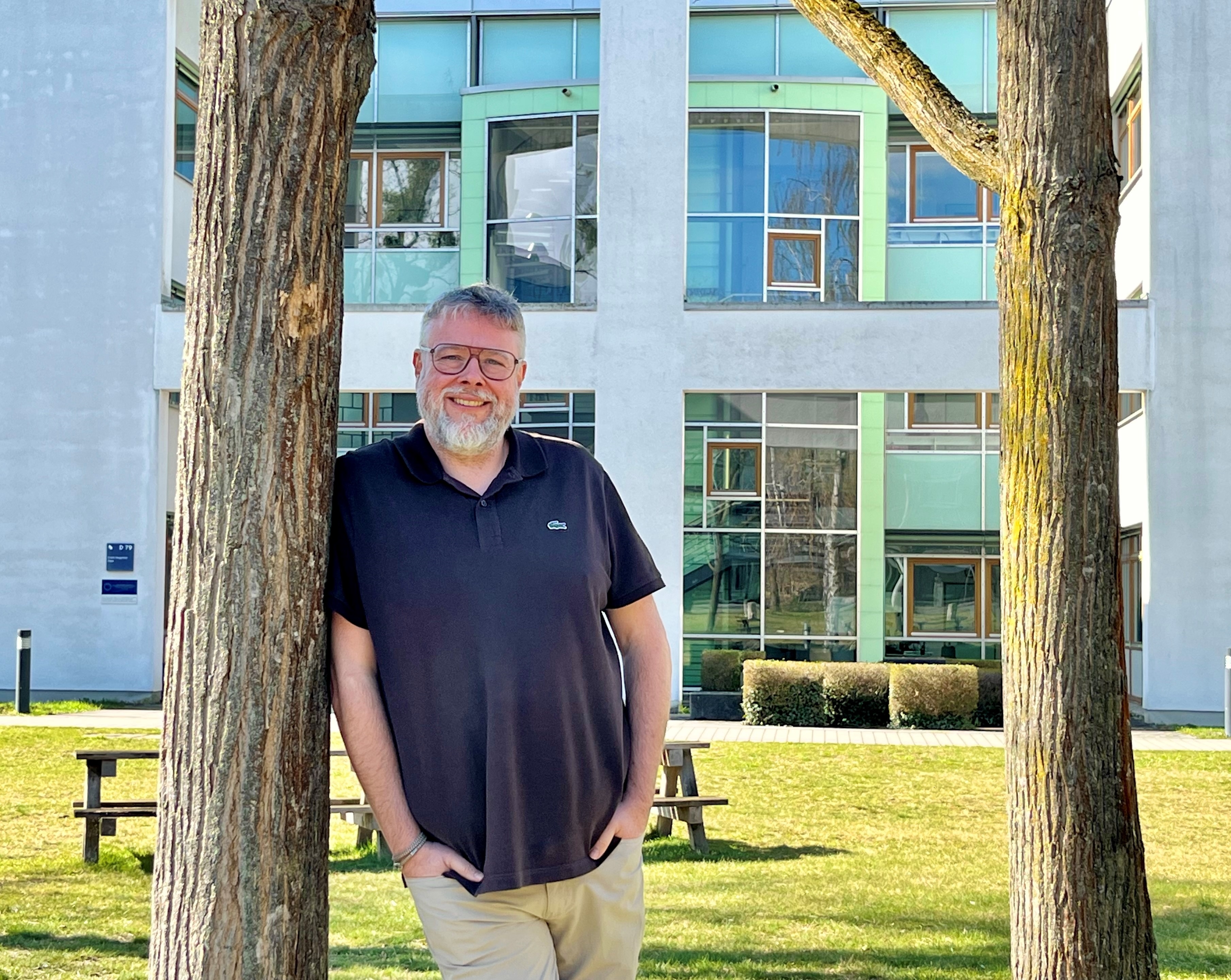
The Successful Transformation of a Startup: An Interview with Dr. Christian Regenbrecht, Vice President of Translational Oncology at GSK and Founder of CELLphenomics
Your startup, CELLphenomics, has been successfully conducting pharmacological research on patient-derived tumor organoids at the Berlin-Buch campus for more than ten years. It has been part of GlaxoSmithKline (GSK) since 2025. What was the background to this?
3D cell culture models, also known as organoids, are becoming increasingly sophisticated and reliable for testing therapeutic compounds. In certain cases and when supported by robust data, regulatory authorities are even willing to forgo animal testing. These models play a key role in making new, better drugs available more quickly. Our startup has advanced organoid research and earned an international reputation. We were the first commercial biobank in Germany to receive ISO certification. We cleared this hurdle with such flying colors that we have since been helping to shape, as part of the ISO commission, how pharmaceutical research with organoids will be conducted in the future.
We had already carried out joint projects with GSK. They were impressed by our research, the high quality of our data, and the volume of data and models we produced. The rule is: The higher the data quality, the higher the predictive value, and the better the foundation for machine learning. They wanted to bring that expertise into their company.
What motivated you to sell?
GSK’s corporate culture was a good fit for us, and ultimately, the deciding factor for me was that together we could have a far greater impact. We share their commitment to putting patients first and providing them with the best possible medications as quickly as possible.
Now we not only have greater resources at our disposal, but we’re also getting much more of a hearing from regulatory agencies like the FDA and EMA. Another very important point: Our entire team remained intact under the new structure. All 18 of us have good, secure jobs.
How did the transition to becoming part of GSK go?
It wasn’t easy at all to preserve the core and identity of CELLphenomics—that is, the reason why people enjoy coming to work here—while still adopting GSK’s corporate culture. It involved many small details, such as strict occupational safety requirements or the shorter work hours typical in England. Overall, there’s a much greater need for coordination in an international pharmaceutical company. They look very closely at whether things are actually needed to address the company’s most pressing issues.
Many things are becoming easier within GSK’s organizational structure: Thanks to legally sound contracts with international partners, for example, we can use tissue from all over the world to grow organoids for our projects.
We’ve expanded, upgraded our labs, and acquired a lot of new laboratory equipment. This allows us to conduct even better research, offer higher throughput, and deliver even better quality. GSK’s strong structure enables continuity—we’re working at full capacity, but no longer partially overburdened as we were in the startup phase.
Has your research changed?
Yes, I would definitely say so. GSK has many collaborations and partnerships. We are now part of a transnational tumor network in which leading scientists in Tokyo, Oxford, and Cambridge discuss joint projects and research questions, evaluate data, and design new experiments. We benefit enormously from this.
How are you settling into your new role?
I have time again to read papers, think about the best possible solution to a scientific question, and develop exciting projects.
Because GSK’s strong support team backs us up in every way, I don’t have to worry as much about things like tax returns, legal issues, or getting the best offers from manufacturers. I was even able to take three weeks of vacation.
ASC Oncology was your second startup, which offered personalized drug testing on tumor organoids.
We no longer help individual patients, but rather a group of individuals. As part of clinical development, we can contribute our expertise in a much more structured way and ensure that active ingredients reach the market faster.
Looking back at your early days?
In 2014, we were a very small startup in a “Shared Lab.” How unlikely was the transformation into something much bigger? Many startups fail during this early growth phase in today’s increasingly complex, globalized world—and no one is to blame for that.
We’ve always been very well supported—even through the straightforward, quick solutions provided by campus management.
Text and Photo: Christine Minkewitz / Campus Berlin-Buch GmbH
Dieses Interview erschien zuerst im Standortjournal buchinside 02/2026.
Research, Innovation, Patient care / 26.06.2026
Weichen stellen und Synergien fördern
Interview mit Prof. Dr. Christopher Baum, Vorsitzender des BIH-Direktoriums und Vorstand des Translationsforschungsbereichs der Charité
Was zeichnet das Berlin Institute of Health in der Charité (BIH) aus?
Eindeutig unser Fokus auf die medizinische Translation: Unsere Mission ist, Erkenntnisse aus der biomedizinischen Forschung in neue Ansätze zur personalisierten Vorhersage, Prävention, Diagnostik und Therapie zu übertragen und umgekehrt Beobachtungen im klinischen Alltag noch zielgerichteter in Forschungsideen und Innovationen zu überführen. Ziel ist es, einen relevanten medizinischen Nutzen für Patient:innen und Bürger:innen zu erreichen.
Das BIH hat verschiedene Standorte, darunter auch in Berlin-Buch. Wie funktioniert die Kooperation an den einzelnen Standorten?
Anfangs wurden mit BIH-Mitteln an den drei großen Klinikstandorten der Charité, also Benjamin Franklin, Virchow und Mitte sowie am Standort Buch strukturelle Voraussetzungen für die translationale klinische Forschung verbessert, zum Beispiel Clinical Research Units, Biobanken und Datenräume eingerichtet. Buch ist für uns sehr wichtig als exzellentes wissenschaftliches Ökosystem und Interaktionsraum. Hier gibt es einen riesigen Schatz an hervorragender Wissenschaft mit starker Translationskultur und mit dem Experimental and Clinical Research Center (ECRC) auch schon vor Gründung des BIH eine eigene Translationseinrichtung. In Buch bestand bereits eine Kooperationswelt, die durch die Präsenz des BIH am Standort ergänzt wurde. Den Auftrag des BIH sehe ich darin, Lücken zu schließen und den Spirit in Richtung produkt- und nutzenorientierter Wissenschaft zu stärken. Idealerweise sind wir in der gesamten Wertschöpfungskette verknüpft und schauen dann, wie wir gemeinsam mehr erreichen können. Ein Beispiel wäre das Spin-off MyoPax von Max Delbrück Center und Charité, dessen Ausgründung wir über unser SPARK-BIH-Programm gefördert und begleitet haben.
Wie verhält es sich mit der privilegierten Partnerschaft mit dem Max Delbrück Center?
Zu Beginn bestand diese Partnerschaft vor allem in den Fokusbereichen vaskuläre Biomedizin und Single-Cell-Analytik. Inzwischen sind die Forschungsthemen erweitert worden. Privilegierte Partnerschaft heißt für mich, dass man sich strategisch abstimmt und idealerweise Infrastrukturen, wissenschaftliche Themen und auch Personalfragen so gestaltet, dass eine größtmögliche Synergie entsteht, ohne die jeweilige Autonomie der Einrichtungen infrage zu stellen. Wir gestalten eine Partnerschaft auf Augenhöhe.
Ein schönes Beispiel ist die Ganzgenomsequenzierung, die wir gemeinsam in die Regeldiagnostik überführt haben. Das wäre ohne die bioinformatische Expertise, die in Synergie von MDC und BIH entwickelt wurde, nicht möglich gewesen. In der Umsetzung war dann die enge Anbindung an die Diagnostikbereiche der Charité, an das Zentrum für seltene Erkrankungen
Charité und BIH haben einen gemeinsamen Technologietransfer. Wie könnte man die Brücke zum Geschäftswissen der vielen Unternehmen im Biotechpark bauen? Denn letztlich brauchen wir Innovationen am Markt.
Unsere Mission ist primär, Patientennutzen zu entfalten, nicht nur bei einzelnen Betroffenen als Beweis des Prinzips, sondern möglichst skalierbar und standortunabhängig. Marktfähigkeit ist für mich nur ein Indikator für Nutzen; dazu kommt die Herausforderung, dass ein Produkt nicht zu teuer sein darf, weil sonst das solidarische Gesundheitssystem an seine Grenzen stößt. Gen- und Zelltherapien sind dafür ein Beispiel. Kosteneffizienz wird also auch zum Innovationstreiber. In Buch gibt es enorm viele Expert:innen, die grundlegende Technologien weiterentwickeln oder solche hervorgebracht haben. Diese frühen Innovationen, die das Potenzial haben, Plattformtechnologien zu werden, müssen wir noch mehr in den Fokus rücken. Dazu gehören beispielsweise neue Gen-VektorFamilien oder grundlegend neue Arten von Immuntherapien.
Mit dem GeneNovate Investors‘ Day als einer Maßnahme der Nationalen Strategie für gen- und zellbasierte Therapien hat das BIH deutschlandweit Ressourcen gebündelt. Wie ist es gelungen, dies nach Berlin zu holen?
Wir haben mit vielfältigen Akteuren überlegt, wie wir Investorenformate für die regulatorisch und technologisch unter besonderen Herausforderungen stehende Gen- und Zelltherapie besser etablieren können. Beim ersten GeneNovate Investors‘ Day 2025 war die Nachfrage von internationalen Investor:innen, Start-ups und Politik weitaus höher als erwartet – sicher auch, weil wir dort forschungs- und wirtschaftspolitische Fragen diskutiert haben, darunter die Verbesserung der Rahmenbedingungen für Investor:innen. Die präsentierenden Start-ups mussten sich erstmals nicht gegen Defense-Tech oder andere Bereiche von Biotech behaupten.
Wo sehen Sie den stärksten Hebel, um Ausgründungen aus dem BIH weiter zu verstärken und zu beschleunigen?
Ausgründungen sind ein wichtiger Indikator, darüber hinaus sehen wir uns auch in anderen Dimensionen als Ökosystemspieler. Charité, MDC und BIH haben gemeinsam großes Potenzial, werthaltige Firmen und neue Produktideen hervorzubringen, und dabei sollten wir uns noch mehr gegenseitig unterstützen. Captain T Cell und der Anschub von T-knife wurden beispielsweise vom BIH gefördert. Da wir den Auftrag haben, auch national zu agieren, entwickeln wir gemeinsam mit anderen Playern in Deutschland Formate, um bundesweit innovationsorientierte Akteure und Projekte zu fördern. Im Rahmen der Nationalen Strategie für gen- und zellbasierte Therapien haben wir zum Beispiel ein Programm für Postdocs aufgelegt, mit dem wir an Standorten wie München oder Mainz Entrepreneurship-Trainings gestalten. Dieses Jahr haben wir 200 Teilnehmende an neun Standorten und rechnen in den nächsten fünf Jahren mit mindestens 1.000 Trainees. Das Programm soll helfen, Innovationen besser in die Validierung, in klinische Studien und damit natürlich in den Markt zu bekommen sowie eine überregional vernetzte Community aufzubauen.
Das Agieren über Grenzen hinweg hat große Vorteile. Wichtig ist sicher auch der Schulterschluss zu erfahrenen Unternehmen, so dass Gründungsprojekte eine schnellere Lernkurve bekommen.
Genau, es ist vor allem sehr wichtig, dass wir dies zusammen mit anderen Standorten in Deutschland und auch in Europa angehen. Produkte im Gesundheitsbereich müssen von Anfang an im internationalen Markt konkurrenzfähig sein und dort verschiedene Marktanforderungen erfüllen.
Wir streben an, dass wir Berlin mit Standorten wie München, Heidelberg, Kopenhagen, Leuven, Barcelona, London oder Paris verknüpfen, damit Start-ups durch eine Reihe strukturierter Angebote Impulse aus verschieden Ökosystemen aufnehmen, sowie Märkte und Wachstumschancen eruieren. Das kann ein im eigenen Saft verharrendes Ökosystem nie bieten.
Start-ups müssen relativ schnell die richtigen Partner finden, etwa für die Analytik oder um klinische Studien anzugehen, und das funktioniert am besten in einem kuratierten Netzwerk.
Start-ups agieren häufig aus der eigenen, anfangs segmentalen Betrachtung ihrer Welten. Das war einer der Gründe, warum wir jetzt einen Online-Atlas für Gen- und Zelltherapie aufgelegt haben, um Kontakte zu erleichtern. Darin kartieren wir die Akteure über alle Gebiete hinweg: Forschung, Entwicklung, Good Laboratory Practice und Good Manufacturing Practice, Start-ups, Industrie, Investoren, Patientenvertretungen – eine Heatmap der Akteure in Deutschland zu diesem Thema, unter anderem als Grundlage für produktspezifische Vernetzung. Translation braucht den Weg heraus aus den vertrauten Nischen.
Seit einem Jahr gibt es den BIH Clinical Incubator (CLIC). Welchen Schwerpunkt hat dieser?
Wir sehen den Bedarf bei akademischen Projekten, die kurz vor der Gründung sind und zunächst Raum und fachlichen Input für den nächsten Schritt brauchen. Inhaltlich geht es hier nicht nur um Gen- und Zelltherapie, sondern allgemein um personalisierte, regenerative Therapieansätze.
Auch CLIC versteht sich als Mitgestalter des Ökosystems. In ein paar Jahren wird der Inkubator dann in engem Wechsel mit dem Berliner Zentrum für Gen- und Zelltherapie (BC GCT) wirken.
Mit BioLabs haben Sie einen sehr guten Partner gefunden, der Start-ups auch die Möglichkeit zu internationalen Gastaufenthalten in anderen BioLabs geben kann.
Ja, mit Paris haben wir bereits eine sehr gute Wechselwirkung, München und Heidelberg sind im Aufbau. Aber es gibt auch andere Player wie das Innovation Institute der Novo Nordisk Stiftung. Über das ARC SHEBA Medical Center in Tel Aviv (ARC steht für Accelerate Redesign Collaborate) erschließen wir gerade weitere Räume.
Weitere wichtige Impulsgeber für unser Innovationsgeschehen sind unter anderem Spark Stanford und die European University Hospital Alliance (EUHA), über die wir mit anderen Innovationszentren der Universitätsmedizin verbunden sind.
Wo steht Berlin in fünf Jahren?
Es wird uns hoffentlich gelungen sein, ein Ökosystem aufzubauen, in dem die Akteure sichtbar die Synergie entfalten, die wir erreichen möchten. Ein Ökosystem, das mit klar verteilten Domänen Freiräume für Synergien zwischen den Einrichtungen lässt. Wir wollen Berlin als starken Partner in starken Netzwerken entwickeln und nicht gegen andere, sondern mit anderen zum Erfolg zu führen. Unser Ziel ist ein konzertanter Ansatz. Da ist es vielleicht ein schönes Beispiel, dass die Charité gerade eine Kooperation mit den Berliner Philharmonikern beginnt
Interview: Dr. Christina Quensel / Campus Berlin-Buch GmbH
Das Interview erschien zuerst im Standortjournal buchinside 2/2026.
Innovation / 24.06.2026
Alithea Bio Scores Double Victory at VivaTech 2026 for Breakthrough in Preclinical Safety
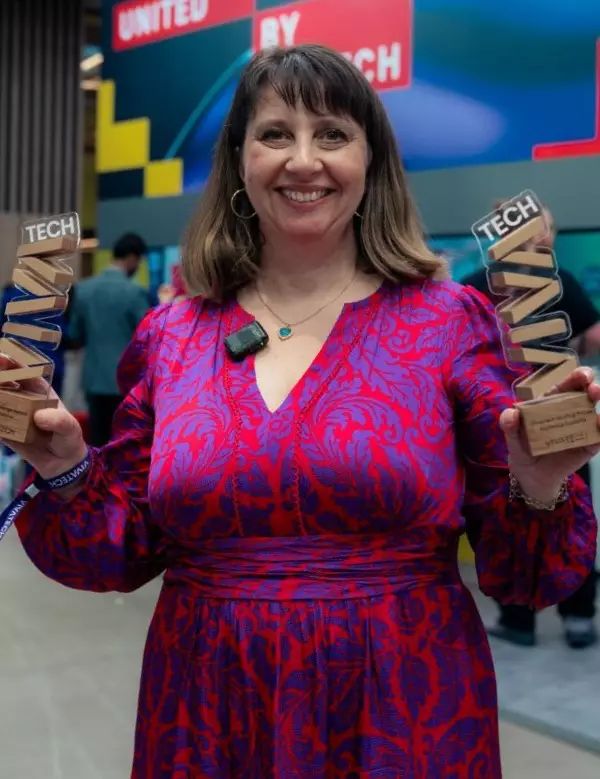
PARIS / BERLIN / FREIBURG — 23.6.2026
Deep-tech biotech innovator Alithea Bio has achieved a spectacular double victory at VivaTech 2026, Europe’s largest startup and tech event, taking home both the coveted “Tech for Change” Jury Prize and the Audience Favorite Award. Selected by an elite panel of global investors and corporate leaders—and backed by overwhelming public support—the awards recognize Alithea Bio’s pioneering work in eliminating toxicity risks at the preclinical stage to dramatically increase clinical trial success rates.
Historically, promising cancer therapies and vaccines fail during human trials due to unforeseen toxicities and adverse immune reactions that standard models miss. Alithea Bio’s proprietary platform, HLA-Compass AI, solves this multi-billion-dollar bottleneck during preclinical development by mapping complex Human Leukocyte Antigen (HLA) interactions. Unlike purely digital AI startups, Alithea Bio utilizes a unique hybrid model—combining its own active wet lab with an advanced computational engine to accurately predict and filter out toxicity risks long before an asset ever enters human clinical trials.
The company’s commercial traction matches its scientific breakthrough. Fully bootstrapped to date, Alithea Bio amassed 22 million proprietary datapoints and generated €1.6M in revenue in 2025 through active preclinical validation partnerships with global pharmaceutical leaders.
“Sweeping both the jury and audience awards at VivaTech is an incredible validation of our mission, our impact and our scalable commercial model. Too many life-saving therapies are derailed late in development because traditional preclinical models fail to predict human toxicity. HLA-Compass isn’t just about saving pharma companies millions in failed trials; it’s about ensuring that only the safest, most precise assets advance to human clinical trials. The crowd and the jury both sent a clear message: the industry is ready for this change,” says Fanny Giannou, CEO of Alithea Bio.
The double accolade comes at a pivotal moment of global scaling for Alithea Bio. The company is currently expanding its strategic partnerships with global pharmaceutical leaders and launching an institutional Seed funding round to transition its proven data-service capabilities into a highly scalable software platform while expanding its footprint into the US market.
For more information about Alithea Bio and the HLA-Compass platform, visit www.alithea-bio.com or contact news@alithea-bio.com.
About Alithea Bio
Alithea Bio is a Freiburg/Berlin-based biotechnology company dedicated to transforming the safety and predictability landscape of preclinical oncology and vaccine therapeutics. By utilizing advanced predictive modeling driven by a 22-million node wet-lab and AI hybrid data engine, Alithea Bio enables pharmaceutical developers to identify and mitigate toxicity risks at the preclinical stage, ensuring safer, more effective treatments successfully advance through clinical pipelines to reach patients worldwide.
Media Contact
Fanny Giannou
CEO, Alithea Bio
news@alithea-bio.com
Innovation / 24.06.2026
Eckert & Ziegler SE Annual General Meeting Approves Significantly Higher Dividend
The Annual General Meeting of Eckert & Ziegler SE (ISIN DE0005659700) today approved the proposal of the Executive Board and Supervisory Board and resolved to pay a dividend of € 0.22 per share (previous year: € 0.17) for the 2025 fiscal year. As in previous years, the Annual General Meeting was held as an in-person event, right next to the Eckert & Ziegler SE headquarters in Berlin. In total, 55.37 % of the company’s share capital was represented. The Annual General Meeting endorsed the members of the Executive Board and the Supervisory Board of Eckert & Ziegler SE for the 2025 fiscal year and approved all items on the agenda by a large majority.
The detailed voting results of the Annual General Meeting and the CEO’s presentation are available on the Eckert & Ziegler SE website:
https://www.ezag.com/investors/annual-general-meeting/
About Eckert & Ziegler
Eckert & Ziegler SE with more than 1.000 employees is a leading specialist for isotope-related components in nuclear medicine and radiation therapy. The company offers a broad range of services and products for the radiopharmaceutical industry, from early development work to contract manufacturing and distribution. Eckert & Ziegler shares (ISIN DE0005659700) are listed in the TecDAX index of Deutsche Börse.
Contributing to saving lives.
Research / 23.06.2026
ERC Advanced Grants awarded to two Berlin researchers
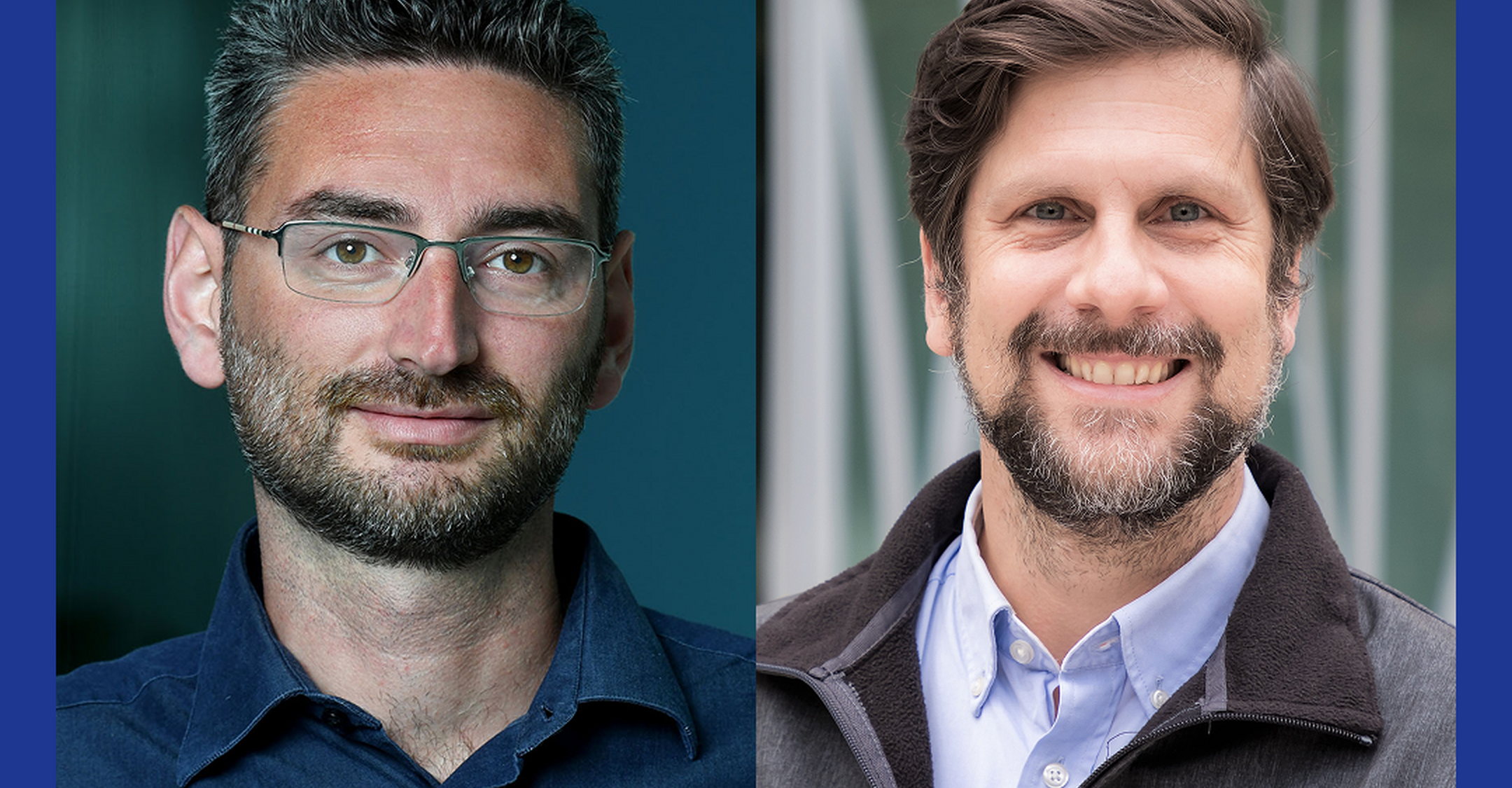
ERC Advanced Grants awarded to two Berlin researchers
Uwe Ohler and Gaetano Gargiulo have been awarded prestigious ERC Advanced Grants. With funding of €2.5 million each, they will spend the next five years investigating how protein synthesis is regulated and identifying vulnerabilities in pediatric brain tumors.
Two Max Delbrück Center scientists have secured prestigious European Research Council (ERC) Advanced Grants, one of Europe’s highest honors for established researchers: Dr. Uwe Ohler, Group Leader of the Computational Regulatory Genomics lab, and Dr. Gaetano Gargiulo, Group Leader of the Molecular Oncology lab.
The ERC supports ambitious projects by outstanding researchers who have already achieved significant success in their fields. Recipients receive up to €2.5 million over five years to pursue promising research ideas. This year only 319 researchers were selected from 3,329 who applied from across Europe.
Designing RNA with precision
Ohler won funding for project TRANS-DECODE. With his team, he will investigate how cells regulate translation — the process by which cells use the messenger RNA transcripts of our genetic material — to produce proteins. “Many genetic diseases are not caused by changes in protein-coding genes but by errors in translation,” says Ohler. “We want to better understand this finely tuned process in which regulatory regions in messenger RNA play an important role, and develop molecular tools that allow us to intervene in a more targeted way.”
The Ohler lab will combine machine learning — a type of artificial intelligence (AI) — with advanced molecular biology techniques. These methods enable researchers to measure the activity of thousands of regulatory RNA segments simultaneously, modify them in very specific ways, and generate snapshots of all proteins produced in a cell.
The team will use explainable AI (XAI) to find regulatory elements hidden within messenger RNA and to understand how manipulating them affects translation. “With XAI, we can ensure that the models’ predictions remain transparent and understandable to us,” explains Ohler. For their experiments, the researchers will use both human cells and zebrafish, which serve as a vertebrate model.
“With TRANS-DECODE, we not only want to unravel the molecular logic of translation step by step, we also want to identify new ways to correct defects in regulatory RNA segments that contribute to human disease,” says Ohler. “Our long-term goal is to rationally design RNA molecules for both therapeutic and synthetic biology applications, such as developing better vaccines.”
Avatars of brain tumors
Gargiulo will use his grant to create highly realistic models of pediatric brain tumors in a project called MOIRA. He and his team plan to replicate in detail the transformation of a healthy, maturing brain cell into a tumor cell within a brain organoid — a type of miniature organ. These tumor avatars will help his team better understand how these cancers develop and identify potential treatment strategies.
The grant marks Gargiulo’s fourth ERC award. He won a Starting Grant in 2016, which he used to begin creating models of brain tumors. This was followed by two Proof of Concept grants in 2022 and 2024 that helped his team further develop a new technology called synthetic genetic tracing. The method uses artificial DNA molecules, called reporter genes, to visualize specific cellular activities within tissues.
In MOIRA, these two fields of research are now being brought together: Gargiulo and his colleagues aim to develop reporter genes that turn on as soon as a cell activates a tumor-like program. “In human brain organoids, the reporter genes will help us determine which cells exhibit characteristics of brain tumors, which type of brain tumor they resemble, and when these changes occur,” explains Gargiulo. His team plans to purify the cells and use them to develop models that, step by step, increasingly resemble a real tumor. The project will combine synthetic biology with organoid research and AI-supported validation.
“With MOIRA, we want to reconstruct exactly how pediatric brain tumors arise,” says Gargiulo. “If we succeed in creating faithful tumor avatars, we can say that we have truly come much closer to understanding these diseases. In addition, our models will allow us to systematically search for tumor vulnerabilities — and thus identify potential targets for new drugs.”
Text: Anke Brodmerkel
Further information
Computational Regulatory Genomics
Photo left side: Gaetano Gargiulo © David Ausserhofer, Max Delbrück Center
Photo right side: © Felix Petermann, Max Delbrück Center
Living, Education / 17.06.2026
Pankower Frauenpreis 2026 an Ursula Eva Rosito verliehen
Der diesjährige Pankower Frauenpreis wurde an Ursula Eva Rosito verliehen. Sie erhielt den Preis im Rahmen einer feierlichen Zeremonie am Montag, dem 15. Juni 2026 im BVV-Saal im Bezirksamt Pankow. Mit diesem Preis wird ihr außergewöhnliches und unermüdliches Engagement für verschiedene marginalisierte Frauengruppen im Bezirk Buch und dessen vielfältige Herausforderungen in besonderer Weise gewürdigt.
Ursula Eva Rosito
Ursula Eva Rosito ist Soziologin und ausgebildete systemische Beraterin. Sie verantwortet seit vielen Jahren das Projekt „Frauen in Buch“ im Bürgerhaus Buch. Dort unterstützt sie Menschen bei beruflicher Neu- und Umorientierung, bei der Vereinbarkeit von Erwerbsarbeit und Familie sowie in der Prävention und Intervention bei häuslicher Gewalt. Mit ihrer Arbeit eröffnet sie Zugänge zum Arbeitsmarkt, stärkt individuelle Kompetenzen und fördert gesellschaftliche Teilhabe. Besonders migrantische Frauen* profitieren von ihrem Verständnis für sprachliche, kulturelle und strukturelle Hürden in Deutschland. Durch ihre eigene Migrationsgeschichte bringt sie eine besondere Perspektive in ihre Arbeit ein und ist für FLINTA-Personen, Seniorinnen sowie Frauen und Mädchen im Sozialraum Buch eine verlässliche Ansprechpartnerin und wichtige Stütze.
„Zusammenhalt entsteht nicht von allein. Jemand muss Menschen zusammenbringen. Jemand muss zuhören. Jemand muss da sein. Ursula Eva Rosito tut genau das“, würdigte Dr. Oliver Jütting, Vorsteher der Bezirksverordnetenversammlung Pankow, die Preisträgerin in seiner Laudatio.
Ehrung für gleichstellungspolitisches Engagement im Bezirk
Der Pankower Frauenpreis ehrt seit 2020 Einzelpersonen, Frauenprojekte, Initiativen oder Unternehmen in Pankow, die sich im Bezirk für die Rechte von Frauen und Mädchen einsetzen und die Geschlechterdemokratie fördern. Ausgezeichnet wird das besondere gleichstellungspolitische Engagement, welches beispielsweise auf die Einhaltung und Förderung der Rechte von Frauen und Mädchen abzielt, marginalisierte Frauengruppen unterstützt oder innovativ-nachhaltige Gleichstellungsprojekte entwickelt.
Der Preis wurde von der Bezirksverordnetenversammlung Pankow initiiert. Bisherige Preisträgerinnen sind Renate Laurentius (2020), Raja Al Khlefawi (2021), Christina „Tina“ Pfaff (2023), Malalai Murr (2024) sowie Alexandra Torres (2025). Im Jahr 2022 konnte der Preis aufgrund der Haushaltssperre im Land Berlin nicht verliehen werden.
Über die Vergabe des Pankower Frauenpreises entscheidet eine für die Dauer der laufenden Wahlperiode eingesetzte Jury. Der Preis ist mit 1.000 Euro dotiert.
Kontakt:
Gleichstellungsbeauftragte im Bezirksamt Pankow – Ulrike Spieler
Tel.: (030) 90295 2305, E-Mail: gleichstellung@ba-pankow.berlin.de,
www.berlin.de/ba-pankow/gleichstellung
Research / 12.06.2026
Die neue Ausgabe des Standortjournals buchinside ist erschienen
Liebe Leserinnen und liebe Leser,
unser Auftrag am Berlin Institute of Health in der Charité (BIH) ist klar: Wir wollen medizinische Erkenntnisse schneller zu den Patientinnen und Patienten bringen. Translation bedeutet für uns aber noch mehr, als Forschungsergebnisse in die Anwendung zu bringen – sie ist ein wechselseitiger Prozess, in dem klinische Erfahrungen auch neue Forschung inspirieren. Dieses Zusammenspiel ermöglicht echten medizinischen Fortschritt.
Als überwiegend bundesfinanzierte Einrichtung innerhalb der Charité – Universitätsmedizin Berlin verstehen wir uns als integrativer Akteur, der Brücken baut: zwischen Disziplinen, Institutionen und Standorten. Gerade Berlin-Buch zeigt, wie wertvoll gewachsene Strukturen sind: Hier treffen exzellente Grundlagenforschung, Bioinformatik und klinische Expertise aufeinander. Solche Konstellationen sind entscheidend, um Innovationen wirksam voranzubringen. Unsere Partnerschaft mit dem Max Delbrück Center steht exemplarisch für dieses Prinzip. Strategische Abstimmung, geteilte Infrastrukturen und komplementäre Kompetenzen ermöglichen Synergien, ohne die Eigenständigkeit der Partner einzuschränken.
Gemeinsam treiben wir Themen wie molekulare Medizin, datengetriebene Forschung, neue diagnostische Verfahren und regenerative Therapien voran. Dabei verstehen wir uns als Teil eines größeren Innovationsökosystems. Wir schaffen Programme, Räume und Netzwerke, die es ermöglichen, Ideen in tragfähige Anwendungen zu überführen – von der frühen Validierung bis zur klinischen Umsetzung. Entscheidend ist, dass Innovationen nicht nur technologisch überzeugen, sondern auch skalierbar und finanzierbar sind. Nur so können sie breiten Nutzen entfalten.
Berlin hat das Potenzial, sich als internationaler Knotenpunkt für biomedizinische Innovation zu etablieren. Dafür setzen wir auf Zusammenarbeit – regional, aber vor allem auch national und international. Unser Ziel ist ein abgestimmtes Zusammenspiel starker Partner: ein konzertanter Ansatz, bei dem unterschiedliche Kompetenzen zusammenwirken und mehr erreichen als jeder für sich allein.
Diese Ausgabe der buchinside stellt neben der Arbeit des BIH auch einen neuen Schwerpunkt des Max Delbrück Center vor: Mit zwei von Helmholtz geförderten Projekten fokussiert es künftig auf Bioengineering, eine Kombination von Biomedizin, Ingenieurwesen und künstlicher Intelligenz. Auf diese Weise sollen schneller präzisere und wirksamere Therapien ermöglicht werden. Der Bioengineering-Hub wird Teil des neuen Center for AI-Accelerated Molecular Medicine am Max Delbrück Center sein.
Wie erfolgreich das Ökosystem in Buch arbeitet, zeigt der neue, vielversprechende Therapieansatz gegen Mukoviszidose, den Forschende des Leibniz-Forschungsinstituts für Molekulare Pharmakologie und der Charité – Universitätsmedizin Berlin entwickelt haben. Auch die Spin-offs erzielen
beachtliche Erfolge – Tubulis mit einem milliardenschweren Exit, T-knife mit einer klinischen Studie seiner „supercharged TCells“ und CELLphenomics als Teil von GSK am Zukunftsort Buch.
Prof. Dr. Christopher Baum
Vorsitzender des BIH-Direktoriums,
Vorstand des Translationsforschungsbereichs
der Charité – Universitätsmedizin Berlin
Innovation / 11.06.2026
Eckert & Ziegler and DC Pharma Open Commercial Medical Isotope Production Site in Jintan
Eckert & Ziegler SE (ISIN DE0005659700, TecDAX) today officially opened the new medical isotope production site of its joint venture Qi Kang Medical Technology (Changzhou) Co., Ltd. (QKM) in the Jintan district of Changzhou, China. With the opening, Eckert & Ziegler and its Chinese partner DongCheng Pharma (DC Pharma) take a decisive step toward local supply of medical isotopes for cancer diagnostics and therapy in the growing Chinese market. Production will start with Germanium-68 (Ge-68), the parent isotope used to produce Gallium-68 (Ga-68), a crucial isotope for diagnostic imaging.
Around 60 invited guests attended the opening ceremony, including representatives of both joint venture partners, as well as government officials. To support production, the company acquired and successfully installed a cyclotron in late 2025. The facility offers 9,500 m² of usable floor space, and production is scheduled to begin in early 2027. In a planned second phase, the site will also become the first in China dedicated to the commercial production of Actinium-225 (Ac-225), a key isotope for next-generation targeted cancer therapies.
"The opening of our site in Jintan is an important milestone for our growth strategy in China and for Eckert & Ziegler's position as a global supplier of vital radioisotopes," said Dr. Harald Hasselmann, CEO of Eckert & Ziegler SE. "Producing Ge-68 locally gives clinicians across China a reliable domestic supply of the parent isotope behind the Ga-68 generators that power modern PET diagnostics. This reflects the kind of integrated, end-to-end capability we have built over decades."
“For China, the Jintan site marks a turning point," said Zhigang Luo, Group CEO of DC Pharma. "With local production of Ge-68 and, in the next phase, Ac-225, we are bringing a steady supply of key medical isotopes to Chinese patients and strengthening the resilience of the entire nuclear medicine value chain. Together with Eckert & Ziegler, we are laying the foundation for a new generation of precision diagnostics and therapies in China."
Eckert & Ziegler reliably supplies Gallium-68, Lutetium-177, Yttrium-90, and Actinium-225 to leading pharmaceutical companies and research institutions worldwide. With expertise in radioisotope production as well as global logistics and CDMO services, the company is committed to continuously supporting the development and delivery of innovative radiopharmaceuticals.
About Qi Kang Medical Technology (Changzhou) Co., Ltd. (QKM)
Qi Kang Medical Technology (Changzhou) Co., Ltd. (QKM) is a 50:50 joint venture between Eckert & Ziegler SE and DongCheng Pharma headquartered in the Jintan district of Changzhou, China. QKM operates a state-of-the-art production site for cyclotron-based medical isotopes including Germanium-68 and is committed to establishing the first commercial Actinium-225 production in China. The venture is dedicated to supplying the Chinese radiopharmaceutical market with key radioisotopes for cancer diagnostics and therapy.
About Eckert & Ziegler
Eckert & Ziegler SE, with more than 1,000 employees, is a leading specialist in isotope-related components for nuclear medicine and radiation therapy. The company offers a broad range of services and products for the radiopharmaceutical industry, from early development work to contract manufacturing and distribution. Eckert & Ziegler shares (ISIN DE0005659700) are listed in the TecDAX index of Deutsche Börse.
Contributing to saving lives.
About DongCheng Pharma
Yantai Dongcheng Pharmaceutical Group Co., Ltd. (DC Pharma), founded in 1998 and headquartered in Yantai, China, is one of the country's leading pharmaceutical groups and a recognized leader in nuclear medicine in China. The group develops, manufactures and sells biochemical active pharmaceutical ingredients, finished dosage forms, nuclide drugs and health products for therapeutic areas including oncology, cardiovascular, urology and orthopedics, and exports its products to more than 40 countries. DC Pharma is listed on the Shenzhen Stock Exchange (002675.SZ).
Source: Pressemitteilung Eckert & Ziegler SE
Eckert & Ziegler and DC Pharma Open Commercial Medical Isotope Production Site in Jintan
Research / 09.06.2026
Das war die LNDW 2026!
Rund 30.000 Wissbegierige bei der LNDW 2026 in Berlin! Wir sagen Danke!
Am 6.6. faszinierte die Lange Nacht der Wissenschaften rund 30.000 Besuchende mit Experimenten, Wissenschaftsshows, Vorträgen, Laborführungen und vielen anderen Formaten. Ein eindrucksvoller Beleg für das enorme Interesse an und die Bedeutung der Forschung und Wissenschaft in der Stadt.
Die Senatorin Dr. Ina Czyborra zeigte sich erfreut über die positive Resonanz und das lebhafte Interesse an Wissenschaft:
„Volle Häuser, neugierige Fragen, überraschende Aha-Momente und leuchtende Augen bis weit nach Mitternacht – die Lange Nacht der Wissenschaften war mal wieder ein voller Erfolg. Die vielen spannenden Experimente und persönlichen Begegnungen mit Forschenden zeigen einmal mehr, wie viel Begeisterung und Innovationskraft in Berlin steckt – eine echte Inspiration für alle Generationen. Besonders freut mich, dass hier oft der Funke überspringt: Denn hier werden auch Berufswünsche geboren, Talente entdeckt und die Ideen von morgen angestoßen.“
Dr. Quensel unterstreicht die Bedeutung des direkten Dialogs zwischen Forschenden und Öffentlichkeit:
„Die Lange Nacht der Wissenschaften in Berlin ist das größte Wissenschaftsfestival in ganz Deutschland. Fast 60 Einrichtungen und unzählige Forschende, v. a. junge Wissenschaftlerinnen und Wissenschaftler, wirken daran mit. Sie suchen den Dialog und zeigen, wie ihre Arbeit die Zukunft für uns alle prägen kann. Wissenschaft erlebbar, anfassbar und mitmachbar, für jeden eine tolle Gelegenheit, sich von der Begeisterung und Entdeckungsfreude nicht nur anstecken zu lassen, sondern auch diese mit in den Alltag zu nehmen. Ich freue mich sehr, dass das bei den Berlinerinnen und Berlinern jedes Jahr aufs Neue auf so viel Enthusiasmus trifft. Wir hatten rund 30.000 Besucher*innen – das ist nicht selbstverständlich. Wie kann besser Rückhalt für die Wissenschaft entstehen als in direkten Begegnungen?“
In allen Einrichtungen war die Lust auf Wissenschaften sowohl bei den Gästen als auch bei den Vertreterinnen und Vertretern der Einrichtungen zu spüren. Wir freuen uns schon auf die nächste LNDW.
Fotos der Veranstaltung finden Sie hier.
Ein besonderer Dankgilt allen teilnehmenden Einrichtungen, den engagierten Wissenschaftler:innen und unseren Partnern, die die LNDW erst zu dem machen, was sie ist.
Die nächste Lange Nacht der Wissenschaften ist für den 19. Juni 2027 vorgesehen.
www.langenachtderwissenschaften.de
Living, Education / 30.05.2026
Sommerferientag mit dem Gläsernen Labor
Einen Tag lang Neues ausprobieren, experimentieren und gemeinsam kochen: Der Freundeskreis des Max Delbrück Center lädt Bucher Kinder auf den Campus Berlin-Buch ein
Ferien ohne Koffer? Das ist möglich im Gläsernen Labor. Gefördert durch den Freundeskreis des Max Delbrück Center, bietet das Schülerlabor ein Extraprogramm für Kinder aus dem Ort, deren Familien nicht ohne Weiteres verreisen können. Unterhaltsam experimentiert und gekocht wird zum Thema Herz- und Lungengesundheit.
Herz gegen Lunge
Schülerinnen und Schüler der Klassenstufe 5 – 6 sind am 10. Juli 2026 eingeladen, zum Herz-Kreislaufsystem und zur Lunge zu experimentieren. Am Vormittag geht es darum zu erfahren, wie das Herz aufgebaut ist, wie der Blutkreislauf funktioniert und wie Bewegung, gute Ernährung und Achtsamkeit den Körper fit halten. Was gute Ernährung ausmacht wird nicht nur theoretisch besprochen, sondern bei der Zubereitung des Mittagessens ausprobiert. Am Nachmittag testen die Kinder und Jugendlichen ihr Lungenvolumen, lernen, wie die Lunge funktioniert und experimentieren mit Einzellern, welche Wirkung Rauch entfaltet. Sie bauen Vapes auseinander und diskutieren, ob diese eine Alternative zur Zigarette sind.
Quelle: Gläsernes Labor
Sommerferientag mit dem Gläsernen Labor
Research, Innovation, Patient care / 29.05.2026
Wo die Medizin von morgen entsteht: Bettina Jarasch besucht den Campus Berlin-Buch
Bettina Jarasch, die Berliner Spitzenkandidatin für BÜNDNIS 90/DIE GRÜNEN, besuchte heute den Wissenschafts- und Biotechcampus am Zukunftsort Berlin-Buch.
Erfolgreicher BiotechPark mit internationaler Strahlkraft
Im neuen Gründerzentrum BerlinBioCube informierte sich die Politikerin über die Entwicklung des Start-up-Ökosystems am Campus Berlin-Buch, das aus der engen Verflechtung von Wissenschaft und Wirtschaft entstanden ist. Dr. Christina Quensel und Dr. Ulrich Scheller, Geschäftsführung Campus Berlin-Buch GmbH, gaben einen Überblick über den BiotechPark mit über 70 Unternehmen, die sich auf internationalen Märkten mit molekularen Diagnostikverfahren, Medizintechnik, therapeutischen Wirkstoffen sowie Dienstleistungen für Forschung und Pharmabranche positionieren.
Frau Jarasch besuchte die Forschungsräume des Pharmaunternehmens GSK, das sich durch die Übernahme des erfolgreichen Campus-Start-ups CELLphenomics im BiotechPark angesiedelt hat. Dessen Forschung zu patientenabgeleiteten Tumor-Organoiden wird seit 2025 unter dem Dach von GSK mit größerer Wirkung fortgesetzt, um Krebspatienten schnellstmöglich mit den bestmöglichen Medikamenten zu versorgen.
Spitzenforschung für die Medizin von morgen
Anschließend führte das Programm ans Max Delbrück Center. Kirstin Bodensiek, Administrative Vorständin stellte die Mission der biomedizinischen Einrichtung vor, in der Grundlagen- und klinischer Forschung auf einzigartige Weise verbunden sind. Rund 1.600 Mitarbeitende aus 65 Nationen legen hier die Grundlagen für die Medizin von morgen. Karsten Hönig und Dr. Philipp Mertins gaben einen Einblick in das neue Demonstratorlabor am Max Delbrück Center, das als spannendes Testfeld der Helmholtz-Gemeinschaft für nachhaltigen Laborbetrieb dient.
Prof. Volker Haucke erläutere die Arbeit des benachbarten Leibniz-Forschungsinstitut für Molekulare Pharmakologie (FMP), das grundlegende biologische Mechanismen in Zellen und Geweben untersucht und neuartige Wirkstoffe und Wirkmechanismen zur Behandlung, Prävention oder Diagnose von Krankheiten identifiziert.
Gute Rahmenbedingungen für Innovation schaffen
Frau Jarasch zeigte sich beeindruckt vom internationalen Wissenschaftscampus, der erfolgreiche Spin-offs wie T-knife Therapeutics, TRYPTO Therapeutics oder Tubulis hervorgebracht hat. In den Gesprächen wurde erörtert, welche Rahmenbedingungen Forschende brauchen, um exzellent arbeiten zu können - nicht nur am Standort Buch, sondern überall in der Stadt. Wie kann interdisziplinäre Zusammenarbeit, die für wissenschaftlichen Fortschritt essenziell ist, vereinfacht werden - ohne bürokratische Hürden und lange Wege? Welches sind wichtige Voraussetzungen, um als Start-up zu wachsen?
Als wichtige Punkte für die Entwicklung des Campus wurden benannt: attraktiver Wohnraum am Standort, eine verbesserte Verkehrsanbindung und vereinfachte Genehmigungsverfahren für Forschung und Entwicklung.
Vielen Dank für den Besuch und das Interesse an der Entwicklung unseres Zukunftsortes!
www.campusberlinbuch.deResearch, Innovation, Patient care, Education / 28.05.2026
Virtual Reality, Videomapping und eine begehbare Vene
VR-Exkursionen zu Mikroplastik im Gehirn, eine begehbare Vene oder das Labor als Escape-Room: Mit rund 70 Angeboten ist das Max Delbrück Center bei der Langen Nacht der Wissenschaften dabei. Die Forschenden zeigen allen Interessierten vor Ort, wie ihre Arbeit die Medizin von morgen prägen wird.
Der Countdown bis zur Langen Nacht der Wissenschaften läuft! Ab 17 Uhr öffnen am 6. Juni das Max Delbrück Center auf dem Campus Buch und das MDC-BIMSB in Mitte ihre Labore und Gebäude für Gäste jeden Alters.
Einige Höhepunkte des Programms:
Die begehbare Vene – Die Venen transportieren sauerstoffarmes Blut zurück zum Herzen, meist gegen die Schwerkraft. Ähnlich wie die Arterien können sie verstopfen. Aber wie sieht eine Vene aus? Gemeinsam mit Expert*innen können Gäste ein sechs Meter langes begehbares Venenmodell erkunden und sich dabei über unsere Forschung informieren. Max Delbrück Center, Campus Buch, Foyer des MDC.C, 16:00 bis 23:00 Uhr.
Vom Modell zum Menschen – Was passiert während einer klinischen Studie? Wie schlägt man die Brücke zwischen experimenteller und klinischer Forschung? Diese Fragen beantworten Wissenschaftler*innen aus der AG Dechend / Müller allen Interessierten am Beispiel der Herz-Kreislauf-Erkrankungen. An ihrem Stand können Gäste unter anderem mittels Virtual Reality das Herz erkunden. Max Delbrück Center, Foyer des MDC.C, 17:00 bis 22:00 Uhr.
Escape-Room – Wie ist es, als Molekularbiolog*in in einem Labor zu arbeiten? Wir laden Sie ins Landthaler-Labor ein und machen daraus einen Escape-Room. Bei diesem immersiven Erlebnis erfahren Gäste mehr über unsere experimentellen Methoden und arbeiten als Team zusammen, um einem unbekannten Virus seine Geheimnisse zu entlocken. Max Delbrück Center, MDC-BIMSB, Anmeldung am Infopunkt im Erdgeschoss, 17:00, 18:30, 20:00 und 21:30 Uhr (DE und EN).
Expeditionen ins Gehirn
Mikroplastik ist praktisch überall. Doch was passiert, wenn es ins Gehirn gelangt? Das ist eine von vielen Fragen, die am Max Delbrück Center mithilfe von Hirn-Organoiden, Einzelzelltechnologien und aufwendigen lichtmikroskopischen Aufnahmen bearbeitet werden. Während der Langen Nacht wird das Thema bei zwei Angeboten angerissen:
Mini-Gehirne und Big Data – Organoide bilden die zelluläre Komplexität menschlicher Organe in der Petrischale in 3D nach: Die Organoid-Technologieplattform und die AG Rajewsky untersuchen Organoide und 3D-Zellkulturen aus Tumorgewebe mit räumlicher Transkriptomik und bioinformatischen Werkzeugen. So können sie Krankheitsmechanismen oder auch die Auswirkungen von Mikroplastik aufdecken. Max Delbrück Center, MDC-BIMSB, Anmeldung am Infopunkt im Erdgeschoss, 17:00, 19:00 und 21:30 Uhr (DE).
Eintauchen in die Lichtmikroskopie – Gäste können lichtmikroskopische Aufnahmen unter anderem zu aktueller Mikroplastik-Forschung anschauen. Und zwar nicht in 2D am Bildschirm: Vielmehr tauchen sie mit Virtual-Reality-Brillen tief in die Bilder ein und betrachten Nerven- und andere Zellen aus völlig neuen Blickwinkeln. Max Delbrück Center, MDC-BIMSB, Treppenhaus, 17:00 bis 22:30 Uhr (DE und EN).
Spaghetti im Gehirn – Was geht in unserem Gehirn vor sich, wenn wir an Alzheimer erkranken? Die AG Birol zeigt, wie die Forschenden den Ausbruch und das Fortschreiten neurodegenerativer Erkrankungen anhand von Gehirn-Organoiden besser verstehen wollen – und dabei mitunter auf Spaghetti-ähnliche Proteine stoßen. Gäste haben die Möglichkeit, Neuronen unter dem Mikroskop zu betrachten und deren Aktivität mit eigenen Augen zu verfolgen. Max Delbrück Center, MDC-BIMSB, Anmeldung am Infopunkt im Erdgeschoss, 17:30 und 19:00 Uhr (EN).
Unter dem Sternenhimmel
Pubquiz mit Tom & Darren – Das vielfältige Quiz zum Mitmachen: Gäste spielen in kleinen Teams miteinander und stellen sich Fragen zu Alltags‑, Allgemein- und Spezialwissen. Max Delbrück Center, Campus Buch, Wiese am blauen Bären, 22:15 bis 23:15 Uhr (DE).
Kunst und Kultur über den Dächern Berlins – Wer zwischendurch auf andere Gedanken kommen will, ist auf der Dachterrasse des MDC-BIMSB richtig: Von 20 bis 22 Uhr legt dort DJ d0erte elektronische Musik auf. Und von 21 bis 23 Uhr zeigt Alexandra Huchet (onetwothreesun) ihre abstrakte Videomapping-Kunst, auch mit wissenschaftlichen Bildern. Max Delbrück Center, MDC-BIMSB, Dachterrasse, 20:00 bis 23:00 Uhr.
Tickets: Der Berlin-weite Eintritt kostet 7,50 Euro. Kinder unter sechs Jahren haben wie immer freien Eintritt.
Standorte: Campus Berlin-Buch, Robert-Rössle-Straße 10, 13125 Berlin. MDC-BIMSB, Hannoversche Straße 28, 10115 Berlin.
Weitere Informationen
27.05.2026
Spaß mit Experimenten, Labor zum Anfassen und Staunen bei der Zaubershow für Kinder
Faszination Naturwissenschaften: Zur Langen Nacht der Wissenschaften am 6. Juni lädt das Gläserne Labor auf dem Campus Berlin-Buch gemeinsam mit dem Forschergarten, Partnerschulen und Stiftungen Familien mit Kindern zum Mitmachen ein.
Was bedeutet eigentlich Vortexen und wie funktioniert eine Pipette? Wer gern einmal Labortechniken ausprobieren möchte, ist im Open Lab herzlich willkommen. In Experimentierkursen und Mitmachexperimenten erfahren die Teilnehmenden unter anderem, wie das Immunsystem funktioniert, wie sich die seltene Schmetterlingskrankheit anfühlt, welche Chemie in Geheimtinte steckt, wann sich Schiffe versenken lassen und wie es den Flimmerhärchen der Lunge beim Rauchen geht. Zwei Experimentalshows werden das Publikum verzaubern, ganz neu ist Oliver Grammels anziehende Zauberei mit Physik.
Highlights aus dem Programm:
Open Lab: Das Labor zum Anfassen & Probieren
Sie waren noch nie in einem Forschungslabor? Dann ist diese Tour genau das Richtige: Gemeinsam mit Wissenschaftler:innen besuchen Sie eines unserer Forschungslabore und probieren typische Arbeitsschritte wie Pipettieren, Vortexen, Zentrifugieren und vieles mehr. Vor Ort können Sie mit unseren Forschenden ins Gespräch kommen, mehr über ihre Forschungsthemen und Experimente erfahren – und verstehen, warum Rückschläge im Forschungsalltag keine Seltenheit sind.
Erwin-Negelein-Haus (D79), Erdgeschoss, Leibniz-Forschungsinstitut für Molekulare Pharmakologie & Gläsernes Labor, ohne Anmeldung, durchgängig geöffnet
→ MITMACHEXPERIMENTE
Dein Körper. Deine Fragen. Unsere Forschung.
Wie funktioniert das Immunsystem? Was passiert im Gehirn beim Lernen? Und warum sind manche Erkrankungen so selten, dass kaum jemand von ihnen gehört hat? Das Deutsche Zentrum für Kinder- und Jugendgesundheit (DZKJ) lädt Kinder, Jugendliche und ihre Familien ein, Gesundheitsforschung hautnah zu erleben. An sieben Mitmach-Stationen warten spielerische Aktionen für alle Altersgruppen. Lösen Sie alle sieben Aufgaben und freuen Sie sich über eine kleine Überraschung!
Erwin-Negelein-Haus (D79), Erdgeschoss, für Grundschulkinder, Deutsches Zentrum für Kinder- und Jugendgesundheit (DZKJ), Stempelstation für Forscherdiplom, ohne Anmeldung, 17:00 bis 22:00 Uhr
Rauchende Wimpertierchen
Was passiert mit den Flimmerhärchen in der Lunge, wenn wir rauchen? Dies können Sie in einem anschaulichen Versuch im Gläsernen Labor herausfinden.
Max Delbrück Communications Center (MDC.C), ab 12 Jahren, Gläsernes Labor, Anmeldung am Infopunkt im MDC.C., 18:00, 19:30 Uhr
Gesundes Herz und gesunde Gefäße – gute Durchblutung!
Finde heraus, wie oft dein Herz in einer Minute schlägt, wie hoch dein Blutdruck ist und welche Menge an Sauerstoff in deinem Blut vorhanden ist. Mikroskopiere einen Blutausstrich und schau dir das schlagende Herz von Wasserflöhen an!
Experimentierhalle in der Mensa, Haus 14, für Grundschüler und deren Eltern, Partnerschule Robert-Havemann-Gymnasium, Stempelstation für Forscherdiplom, 16:00 – 22:00 Uhr
Abenteuer Mikrokosmos
Entdecke faszinierende Pflanzenwelten unter dem Mikroskop beim künstlerischen Zeichnen-Workshop mit Illustratorin und Künstlerin Yi Meng Wu.
Gläsernes Labor (A13), Dachgeschoss, ab 6 Jahren, 17:30 – 19:30 Uhr
Seltene Erkrankungen selbst erleben
Zahlreiche Erkrankungen sind für Betroffene mit großen Einschränkungen verbunden. Finden Sie hautnah heraus, wie sich die Schmetterlingskrankheit anfühlt und erfahren Sie mittels einer Simulation, wie sich die Sehleistung bei z.B. „grünem Star“, „grauem Star“ sowie Netzhautablösung verändert. Wir zeigen, mit welchen Beeinträchtigungen viele Menschen leben müssen und was es für den Alltag bedeutet.
Erwin-Negelein-Haus (D79), Erdgeschoss, Berliner Sparkassenstiftung Medizin, Stempelstation für Forscherdiplom, 17:00 bis 22:00 Uh
Schiffe versenken
Wie viel Ladung kann ein Schiff eigentlich tragen – und warum geht es nicht sofort unter? Hier testet ihr verschiedene Schiffsformen und untersucht, welche Bauweise besonders viel Gewicht aushält, bevor sie sinkt. Spielerisch experimentiert ihr mit Wasser, Gewichten und unterschiedlichen Rumpfformen – und entdeckt dabei spannende physikalische Phänomene.
Kommt vorbei, probiert es aus und werdet selbst zu kleinen Schiffbauingenieur:innen!
Experimentierhalle in der Mensa, Haus 14, für Grundschulkinder, Partnerschule Käthe-Kollwitz Gymnasium Berlin, 16:00 bis 20:00 Uhr
Das Geheimnis der wandernden Farben
Entdeckt spielerisch ein spannendes wissenschaftliches Prinzip: Durch das Zusammenspiel von Feuchtigkeit und Zucker entstehen faszinierende Muster und Farben. Experimentiert selbst und findet heraus, wie sich Zucker verhält, wenn er mit Wasser in Berührung kommt – und lasst kleine Kunstwerke entstehen.
Experimentierhalle in der Mensa, Haus 14, für Grundschulkinder, Forschergarten & Gläsernes Labor, 16:00 bis 22:00 Uhr
→ SCIENCE ENTERTAINMENT
Rettungsmission im All
Qualm, Laser, Schnee: Ein Potpourri von Experimenten erwartet Groß und Klein bei der Experimentalvorlesung des Schülerforschungszentrum Pankow am Robert-Havemann-Gymnasium.
Experimentierhalle in der Mensa, Haus 14, für die ganze Familie, ohne Anmeldung, 17:00, 19:00 Uhr
Wissen-schafft-Spaß – Mag(ie)netisch: Phantastische Physik - anziehende Zauberei
Metall bremst sich wie von selbst, Dinge schweben, Kräfte wirken ohne Berührung. Magie? …oder doch Physik? Zauberkünstler und Biochemiker Oliver Grammel bietet in seiner überraschenden und lehrreichen Show Wissenschaftsspaß für alle.
Max Delbrück Communications Center (MDC.C) (C83), Axon 1, für die ganze Familie, ohne Anmeldung, 17:30, 19:00, 20:30 Uhr
Zum gesamten Programm des Gläsernen Labors: https://www.glaesernes-labor.de/de/lndw-2026
Research / 26.05.2026
Wie die Vielfalt der Blutstammzellen entsteht
Im Knochenmark gibt es verschiedene Stammzellen, aus denen Blut- und Immunzellen hervorgehen. Wie und wodurch sie sich voneinander unterscheiden, erläutert ein Team um Simon Haas jetzt in „Nature Cell Biology“. Die Erkenntnisse sollen helfen, Stammzelltherapien, etwa gegen Blutkrebs, zu verbessern.
Gemeinsame Pressemitteilung des Max Delbrück Center und des Berlin Institute of Health in der Charité (BIH)
Tag für Tag produziert der Körper eine riesige Zahl von Blut- und Immunzellen, die uns gesund und am Leben halten. Sie alle entwickeln sich aus Blutstammzellen im Knochenmark. Schon lange ist bekannt, dass sich diese Stammzellen voneinander unterscheiden – zum Beispiel durch ihre Teilungsrate oder die Zelltypen, die bevorzugt aus ihnen hervorgehen. Wie genau diese Vielfalt entsteht und wofür sie wichtig ist, war bisher unklar.
Ein Team um drei Forscher aus Heidelberg und den Berliner Biowissenschaftler Professor Simon Haas liefert jetzt in „Nature Cell Biology“ erstmals eine schlüssige Erklärung für das beobachtete Phänomen. Demnach existieren im Knochenmark keine festen Untergruppen von Blutstammzellen.
Stattdessen verändern sich alle Stammzellen entlang eines vorgezeichneten Weges: von einem langsamen, hochpotenten Zustand hin zu einem schnelleren und aktiveren Zustand mit einem begrenzteren Entwicklungspotenzial. „Ein besseres Verständnis für das Verhalten der Stammzellen kann dazu beitragen, dass Therapien mit ihnen, zum Beispiel gegen Leukämien, effektiver werden“, sagt Haas.
Biologische Experimente und mathematische Modelle
Der Wissenschaftler leitet eine Arbeitsgruppe im gemeinsamen Forschungsfokus „Single-Cell-Ansätze für die personalisierte Medizin“ des Berlin Institute of Health in der Charité (BIH), des Max Delbrück Center und der Charité – Universitätsmedizin Berlin und ist außerdem Professor für Einzelzelltechnologien und Präzisionsmedizin am Precision Healthcare University Research Institute (PHURI) der Queen Mary University London. Sein Labor ist am Berliner Institut für Medizinische Systembiologie des Max Delbrück Center (MDC-BIMSB) angesiedelt.
Haas ist einer von vier Letztautoren der aktuellen Studie. Gemeinsam mit Dr. Michael Milsom vom Deutschen Krebsforschungszentrum (DKFZ) und dem Heidelberg Institute for Stem Cell Technology (HI-STEM) war er insbesondere für den experimentellen Teil der Studie verantwortlich. Die beiden anderen Letztautoren, Dr. Dr. Daniel Hübschmann vom Nationalen Centrum für Tumorerkrankungen (NCT) Heidelberg, vom DKFZ und der Universität Heidelberg sowie Professor Thomas Höfer vom DKFZ, haben die mathematischen Modellierungen vorgenommen, mit deren Hilfe das Team seine Erkenntnisse ebenfalls gewonnen hat.
Entwicklung entlang einer gemeinsamen Linie
„Um herauszufinden, wodurch die Vielfalt der Blutstammzellen entsteht, haben wir mehr als tausend dieser Zellen einzeln isoliert, sie jeweils mit einem fluoreszierenden Protein markiert und dann in Mäuse transplantiert“, erklärt Dr. Florian Grünschläger, ehemaliger Doktorand im Labor von Haas und einer von drei Erstautor*innen der Studie. „So konnten wir ihre weitere Entwicklung im Körper der Tiere nachverfolgen und beobachten, welche Blut- und Immunzellen wann und in welchen Mengen jeweils aus ihnen hervorgehen.“
Durch die Kombination hochauflösender Einzelzelltechnologien und mathematischer Modellierung entdeckten die Forschenden ein überraschendes Muster: Alle Blutstammzellen entwickeln sich entlang einer gemeinsamen Linie. Anfangs teilen und verwandeln sie sich nur langsam, mit der Zeit werden sie schneller und aktiver. Während sie diesen Weg beschreiten, ändert sich nicht nur die Geschwindigkeit der Blutbildung, sondern auch die Art der Blut- und Immunzellen, die sich vorrangig aus ihnen entwickeln. Umkehren können die Stammzellen auf ihrem Weg nicht.
Ein Wettbewerb der Blutstammzellen
„Eine zentrale Erkenntnis unserer Studie ist zudem, dass die Stammzellen nicht isoliert agieren“, sagt Dr. Esther Rodríguez Correa, eine weitere Erstautorin und ehemalige Doktorandin im Labor von Milsom. „Stattdessen konkurrieren langsame und schnelle Zellen miteinander, um die verschiedenen reifen Blut- und Immunzellen zu produzieren.“ Welche Zellen das im Einzelnen sind, wird zum einen vom Entwicklungsstadium der jeweiligen Stammzelle bestimmt, zum anderen aber auch vom aktuellen Bedarf.
„Der Wettbewerb der Stammzellen entscheidet zusammen mit mehreren Rückkopplungssignalen des Körpers, zum Beispiel in Form von Zytokinen, über das Endergebnis“, erklärt Haas. „Er stellt sicher, dass das richtige Gleichgewicht zwischen den unterschiedlichen Blut- und Immunzellen aufrechterhalten wird und dass der Körper gleichzeitig schnell auf Stress, beispielsweise eine Infektion oder einen größeren Blutverlust, reagieren kann.“
Haas und seine Kolleg*innen gehen davon aus, dass sich viele der an Mäusen gewonnenen Erkenntnisse auf den Menschen übertragen lassen. „Auf jeden Fall erklären sie zahlreiche Beobachtungen im menschlichen Blut- und Immunsystem“, sagt der Forscher. „Wenn wir detaillierter verstehen, wie die blutbildenden Stammzellen im Körper agieren, können wir ihr Verhalten auch in Patientinnen und Patienten besser vorhersagen und steuern“, ist sich Haas sicher. Stammzelltherapien und Knochenmarktransplantationen, die schon lange bei Leukämien und anderen Blutkrankheiten im Einsatz sind, könnten so verfeinert und wirksamer werden.
Text: Anke Brodmerkel
Weitere Informationen
- AG Haas (MDC-BIMSB)
- AG Haas (BIH)
- Single-Cell-Ansätze für die personalisierte Medizin
- Wie Immunzellen kommunizieren
Literatur
Esther Rodríguez Correa, Florian Grünschläger, Tamar Nizharadze, et al. (2026): „A kinetics-based model of haematopoiesis reveals extrinsic regulation of skewed lineage output from stem cells“. Nature Cell Biology, DOI: 10.1038/s41556-026 – 01958‑0
Bild: Mikroskopische Aufnahme einer Knochenmarkbiopsie: Zwischen den Knochenbälkchen (rosa) und den Fettzellen (weiß) sind die Stamm- und Vorläuferzellen sowie reife Blut- und Immunzellen (alle violett gefärbt) zu sehen. (© Dr. Jana Ihlow, Charité – Universitätsmedizin Berlin)
Research, Innovation, Patient care / 22.05.2026
Berlin honors outstanding deep-tech companies—including MyoPax
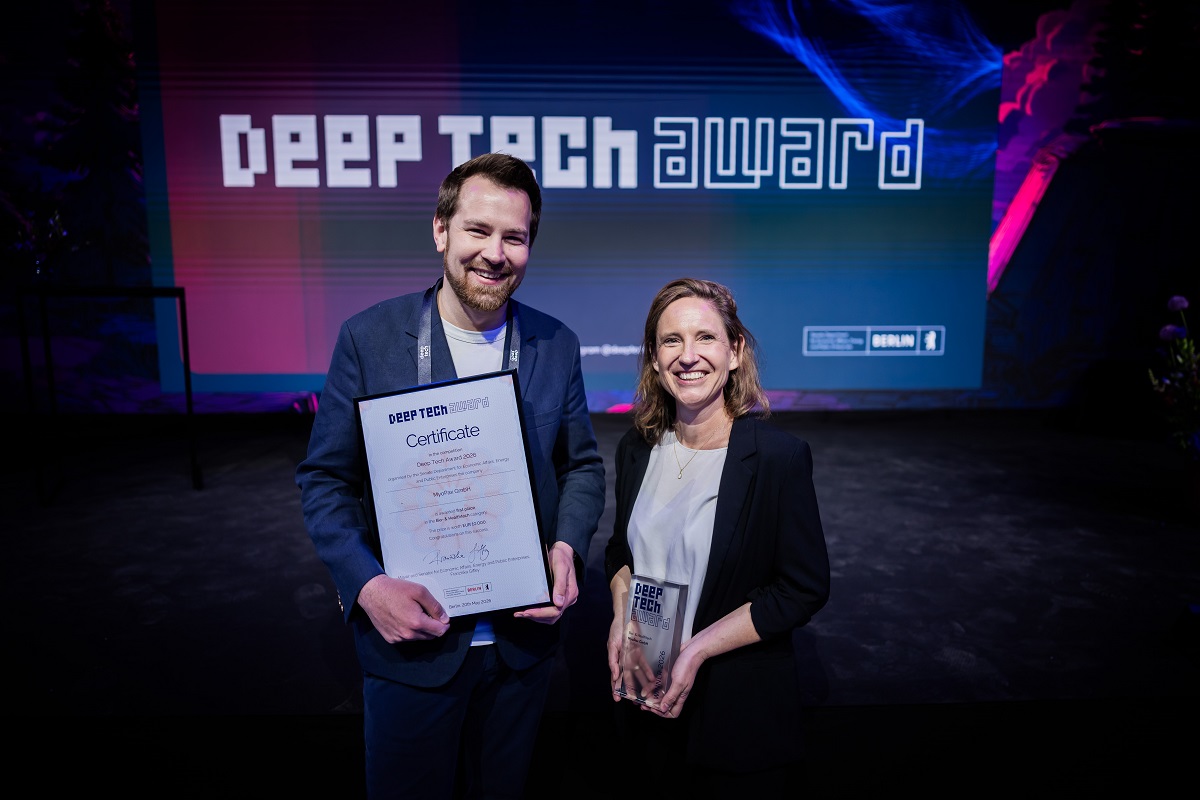
This year, for the first time, a Deep Tech Award was presented in the Bio & Health Tech category. The winner is MyoPax, a spin-off of the Max Delbrück Center and Charité–Universitätsmedizin Berlin.
AI-powered fact-checking to combat disinformation, novel cell therapies for muscle tissue regeneration, sustainable 3D printing, and decentralized satellite communications: On the evening of Wednesday, May 20, 2026, the Senate Department for Economic Affairs, Energy and Public Enterprises presented the Deep Tech Award to five outstanding Berlin-based companies. For the eleventh consecutive year, the administration is thus recognizing technological, research-based innovations from Berlin that stand out for their practical application, societal relevance, and added value. The awards ceremony, attended by Senator for Economic Affairs Franziska Giffey and Permanent Secretary for Economic Affairs Michael Biel, took place for the first time as part of the Deep Tech Momentum conference at Wilhelm Studios in Berlin.
Franziska Giffey, Mayor and Senator for Economic Affairs, Energy and Public Enterprises: “We want to make Berlin the number one hub for innovation in Europe. The companies honored today are turning cutting-edge technological research into practical applications and offering solutions to current challenges. In doing so, they impressively demonstrate the immense innovative potential that Berlin possesses. With the Deep Tech Award, we recognize the courage and excellence of our founders. Through our new partnership with the Deep Tech Momentum conference, we are also creating a platform that connects Berlin’s brightest minds even more closely with industry partners and international investors. In doing so, we are ensuring sustainable growth and technological sovereignty for Berlin as a hub.”
The Deep Tech Award offers a total prize pool of 50,000 euros and is presented in five categories: “Advanced Manufacturing,” “Bio- & Healthtech,” “Artificial Intelligence,” “Quantum Technologies, Photonics & Microelectronics,” and “Web3 & Distributed Ledger Technologies (DLT).” From over 84 applications, expert juries selected five winning companies, each of which will receive prize money of 10,000 euros.
With the Deep Tech Award being integrated into Deep Tech Momentum for the first time, the prize is being positioned even more strongly on the international stage. The conference is considered one of Europe’s leading platforms for connecting deep-tech startups with companies and investors. The new partnership underscores the award’s mission to not only honor Berlin’s most innovative technology companies but also to connect them even more closely with the European innovation ecosystem. In this context, the special “Deep Tech Award for Breakthrough Momentum” was also presented for the first time this year. It is aimed at European startups curated by Deep Tech Momentum that combine excellent scientific innovation with exceptional scaling potential.
The winners of the 2026 Deep Tech Award at a glance:
Deep Tech Star in the “Advanced Manufacturing” category: Endless Industries GmbH
Endless Industries is revolutionizing the manufacturing of fiber-reinforced composites—materials in which carbon fibers are embedded in a binding resin—with a 3D printing solution. This makes it possible to replace complex and expensive manufacturing processes and reduce waste. Website:
www.endless.industries
Deep Tech Star in the “Bio- & Healthtech” category: MyoPax GmbH
MyoPax’s work focuses on innovative cell therapies and gene corrections for the regeneration of muscle tissue. In doing so, the company specifically targets severe muscle injuries and diseases, offering patients promising new treatment options. Website
: www.myopax.com
Deep Tech Star in the “Artificial Intelligence” category: Gretchen AI GmbH
Gretchen AI develops state-of-the-art AI to detect deepfakes and fake news and can reconstruct their dissemination history. This enables the Berlin-based company to help major media organizations conduct fact-checks up to six times faster while maintaining the same level of reliability—a crucial contribution to safeguarding the public information space.
Website: www.gretchen-ai.com
Deep Tech Star in the “Quantum Technologies, Photonics & Microelectronics” category: Xavveo GmbH
Xavveo develops photonic radar sensors that set new standards in fields such as navigation and measurement technology, for example in environmental sensing for automobiles. The technology enables unprecedented precision and has the potential to fundamentally replace existing sensor solutions across a wide range of industries.
Website: www.xavveo.com
Deep Tech Star in the “Web3 & Distributed Ledger Technologies (DLT)” category: Decen Space UG
The startup Decen Space is developing a decentralized coordination network consisting of software and hardware components for the secure and efficient synchronization of data streams between satellites and ground stations. This solution enables higher data transfer rates at significantly lower costs and also allows satellite operators more contact time with their satellites. Website
: www.decenspace.com
Deep Tech Star of the Special Prize “Deep Tech Award for Breakthrough Momentum”: Six Robotics AS
Six Robotics AS is a Norwegian company specializing in the development of autonomy software for fleets of unmanned aerial vehicles. The software is based on innovative swarm intelligence algorithms and real-time mission control architectures that ensure a high degree of autonomy and efficiency for the aircraft. This enables the company’s drones to coordinate and execute missions as intelligent teams. As a result, the use of networked autonomous systems in modern defense operations is being advanced. Website: www.sixrobotics.com
For more information about Deep Tech Berlin and the Deep Tech Award, please visit: www.berlin.de/deeptech/
Source: Press release of the Senate Department for Economic Affairs, Energy and Public Enterprises
Innovation / 22.05.2026
Eckert & Ziegler Receives “Best Managed Companies Award” Once Again
Eckert & Ziegler SE (ISIN DE0005659700) has won the “Best Managed Companies Award” for the third time in a row. With this honor, Deloitte Private, UBS, Frankfurter Allgemeine Zeitung, and the Federation of German Industries (BDI) recognize excellently managed medium-sized companies.
“Good corporate leadership is of central importance, especially in economically challenging times. The Best Managed Companies Award is a well‑deserved recognition for companies that successfully combine responsibility, foresight, and sustainable action,” says Tobias Vogel, CEO of UBS Europe SE.
“This award is both recognition and motivation for us. It confirms that we are on the right path with a clear strategy in the growing nuclear medicine market—together with a fantastic team around the world,” added Dr Dirk W. Becker, a member of the Group Executive Committee of Eckert & Ziegler SE, who accepted the corporate trophy on behalf of the company at the awards ceremony in Frankfurt am Main.
The award is the result of a comprehensive, multi-stage application process in which companies are assessed for their excellence in the core areas of strategy, productivity and innovation, culture and commitment as well as finance and governance. A consistently high level of performance in all four categories is a prerequisite for selection. The final decision is made by an independent jury made up of renowned experts from business, science and the media.
About Eckert & Ziegler.
Eckert & Ziegler SE with more than 1,000 employees, is a leading specialist for isotope-related components in nuclear medicine and radiation therapy. The company offers a broad range of services and products for the radiopharmaceutical industry, from early development work to contract manufacturing and distribution. Eckert & Ziegler shares (ISIN DE0005659700) are listed in the TecDAX index of Deutsche Börse.
Contributing to saving lives.
Living, Patient care, Education / 21.05.2026
Die Roadshow des Helios Clusters Berlin-Brandenburg hat begonnen
Mit großem Interesse ist die gemeinsame Roadshow der drei Helios Kliniken des Clusters Berlin-Brandenburg, bestehend aus dem Helios Klinikum Berlin-Buch, dem Helios Klinikum Emil von Behring und dem Helios Klinikum Bad Saarow, gestartet. Mitarbeitende des Helios Klinikums Emil von Behring läuteten die Tour durch die Region ein. Im Shoppingcenter Das Schloss in Berlin-Steglitz informierten sie über medizinische Angebote sowie berufliche Perspektiven und boten Besucher:innen Mitmachaktionen wie unter anderem ein Speeddating mit dem Leitungsteam, das Zunähen von Schnitten mit dem Team der Klinik für Allgemein-, Viszeral und Minimalinvasive Chirurgie sowie eine Teddyklinik für Kinder.
Im Zeitraum vom 20. Mai bis 20. Juni 2026 laden Mitarbeitende des Helios Klinikums Berlin-Buch, Helios Klinikums Emil von Behring und des Helios Klinikums Bad Saarow Interessierte in insgesamt fünf Shoppingcentern ein, Gesundheit aktiv in den eigenen Alltag zu integrieren, Vorsorge neu zu entdecken und sich über Karriere- sowie Ausbildungsmöglichkeiten bei Helios auszutauschen.
Unter dem Motto „Finde, was zu dir passt. Für deine Gesundheit. Für deine Karriere“ erwartet die Besucher:innen ein abwechslungsreiches Programm mit Einblicken in unterschiedliche medizinische Fachbereiche und den Klinikalltag. Das Informationsangebot richtet sich dabei gleichermaßen an Patient:innen, Bewerber:innen und Interessierte. Vor Ort stehen Fachkräfte aus verschiedenen Bereichen für Fragen und persönliche Gespräche zur Verfügung. So etwa Pflegekräfte, Ärzt:innen, Therapeut:innen, Hebammen und Mitarbeitende aus dem Recruiting. Ergänzt wird das Angebot durch wechselnde Themenschwerpunkte und Mitmachaktionen für die ganze Familie rund um Gesundheit, Prävention und medizinische Versorgung.
Erst shoppen, dann bei Deutschlands größtem privaten Klinikbetreiber durchstarten: Die Roadshow findet stets während der Öffnungszeiten des jeweiligen Centers statt.
Die Termine im Überblick:
1. Das Schloss in Berlin-Steglitz vom 20. bis 23. Mai 2026 mit dem Helios Klinikum Emil von Behring
2. Rathaus Center Pankow vom 27. bis 30. Mai 2026 mit dem Helios Klinikum Berlin-Buch
3. A10 Center Wildau vom 03. bis 06. Juni 2026 mit dem Helios Klinikum Bad Saarow
4. Linden-Center vom 10. bis 13. Juni 2026 mit dem Helios Klinikum Berlin-Buch
5. Stern-Center Potsdam vom 17. bis 20. Juni 2026 mit dem Helios Klinikum Emil von Behring
An ausgewählten Nachmittagen erwarten die Besucher:innen in den Centern zudem besondere Programmpunkte aus verschiedenen medizinischen Fachrichtungen, darunter Kinder- und Jugendmedizin, Pflege, Geburtshilfe oder moderne diagnostische und therapeutische Verfahren. Nach dem erfolgreichen Start der Roadshow in Berlin-Steglitz geht es ab dem 27. Mai 2026 mit dem Team des Helios Klinikums Berlin-Buch im Rathaus Center Pankow weiter.
Die genauen Termine und Standorte sowie weitere Informationen werden fortlaufend auf der Landingpage der Roadshow veröffentlicht.
Über Helios
Helios verbessert mit dem Clusteransatz die medizinische Qualität für Patienten, indem Kompetenz gebündelt und das Netzwerk intensiviert wird. Zum Cluster Berlin-Brandenburg gehören das Helios Klinikum Berlin-Buch, das Helios Klinikum Emil von Behring und das Helios Klinikum Bad Saarow.
Das Helios Klinikum Berlin-Buch ist ein Krankenhaus der Maximalversorgung mit über 1.000 Betten, mehr als 60 Kliniken, Instituten und spezialisierten Zentren. Schwerpunkte sind zertifizierte Zentren für Brust-, Darm- und Hauttumore, Frühgeborene und akute Gefäßerkrankungen. Das Klinikum ist zudem als "Klinik für Diabetiker geeignet DDG" ausgezeichnet.
Das Helios Klinikum Emil von Behring ist mit über 500 Betten eines der größten Krankenhäuser mit qualifizierter Schwerpunktversorgung im Berliner Südwesten. Insbesondere die Klinik für Orthopädie und Unfallchirurgie steht für moderne, innovative und patientenorientierte Versorgung auf höchstem Niveau.
Das Helios Klinikum Bad Saarow ist mit rund 630 Betten ein Krankenhaus der qualifizierten Regelversorgung und zählt zu den modernsten Kliniken der Region. Mit 19 Fachabteilungen, mehreren Instituten, einer Zentralen Notaufnahme und zertifizierten Zentren bietet es umfassende Diagnostik und Therapie.
In Deutschland betreibt Helios mehr als 80 Kliniken, rund 200 Medizinische Versorgungszentren (MVZ), sechs Präventionszentren und 30 arbeitsmedizinische Zentren. Helios behandelt im Jahr 2025 rund 5,6 Millionen Menschen in Deutschland, davon mehr als 4 Millionen ambulant. Seit seiner Gründung setzt Helios auf messbare, hohe medizinische Qualität und Datentransparenz und ist bei über 90 Prozent der Qualitätsziele besser als der bundesweite Durchschnitt. In Deutschland beschäftigt Helios rund 80.000 Mitarbeitende und erwirtschaftete im Jahr 2025 einen Umsatz von rund 8,1 Milliarden Euro. Helios steht mit 35 eigenen Bildungszentren für Aus-, Fort- und Weiterbildung im Gesundheitswesen. Sitz der Unternehmenszentrale ist Berlin.
Fresenius Helios ist der führende private Gesundheitsdienstleister in Europa und versorgt mit rund 140 Kliniken und zahlreichen ambulanten Einrichtungen jährlich rund 27 Millionen Menschen. Zusammen mit Fresenius Kabi, Anbieter von Gesundheitsprodukten für kritisch und chronisch Kranke, gehört Fresenius Helios zum Gesundheitskonzern Fresenius. Mit seinen rund 130.000 Mitarbeitenden der Helios Gruppe in Deutschland sowie Quirónsalud in Spanien und Lateinamerika erzielte Fresenius Helios 2025 einen Gesamtumsatz von mehr als 13,5 Milliarden Euro.
Quirónsalud verfügt über 57 Kliniken, davon sieben in Lateinamerika, rund 130 ambulante Gesundheitszentren sowie über 300 Einrichtungen für betriebliches Gesundheitsmanagement. Jährlich werden hier rund 22 Millionen Patient:innen behandelt, davon mehr als 20 Millionen ambulant. Quirónsalud beschäftigt rund 50.000 Mitarbeitende und erwirtschaftete 2025 einen Umsatz von mehr als 5,4 Milliarden Euro.
Living / 20.05.2026
Frühlingskonzert und Ehrung für Professor Heinz Bielka
Der Freundeskreis des Max Delbrück Center lud zum klassischen Konzert auf dem Campus ein und eröffnete anschließend eine neue Galerie für Ehrenplaketten von CAMPUSart
Junge, musikalisch hochbegabte Musikerinnen und Musiker haben, unterstützt durch ihre Lehrerin, die Klavierprofessorin Prof. Galina Iwanzowa-Bielka, am 13. Mai ein weiteres Mal bei einem Konzert auf dem Campus ihr breites Repertoire klassischer Musik dargeboten. Die meisten der jungen Talente sind bereits Preisträger verschiedener internationaler Wettbewerbe.
Schon seit mehr als einem Jahrzehnt verfolgen wir die Entwicklung von Schülerinnen und Schülern der beliebten Pianistin aus Buch. Wir sehen ihnen beim Großwerden zu und bestaunen ihre musikalische Entwicklung über die vielen Jahre, vom schüchternen Kind, das mit seinen kleinen Händen schon beachtlich über die Klaviertasten wirbelt, bis zu den jungen Erwachsenen, die von Jahr zu Jahr virtuoser geworden sind. Man ist gerührt und voller Begeisterung. Da der Kirchturm inzwischen fertiggestellt ist, der über die Jahre das Spendenanliegen von Prof. Heinz Bielka und seiner Frau Prof. Galina Iwanzowa war, gehen die Spenden der treuen Zuhörerschaft dieses Mal an das Ronald McDonald Haus am Helios Klinikum in Buch, zugunsten von Familien schwerkranker Kinder. Ein Teil davon soll weitere Veranstaltungen des MDC-Freundeskreises finanzieren.
Im Anschluss an das Konzert sind die Besucher ein paar Schritte um das Haus herumgegangen, um gemeinsam mit dem Freundeskreis die erste Ehrenplakette in der geplanten Galerie für Wissenschafts-Persönlichkeiten zu enthüllen, die sich für den Campus Berlin-Buch, für Medizin und Wissenschaft sowie für unseren Stadtteil verdient gemacht haben.
Die Galerie wurde am Walter-Friedrich-Haus (Haus 27), nahe dem Eingangsbereich mit der Freitreppe, eröffnet. Die erste Ehrenplakette ist Herrn Prof. Dr. Heinz Bielka (1929-2020) gewidmet. Professor Bielka hat von 1953 bis zu seinem Tode auf dem Campus Buch als Krebsforscher gearbeitet und sich als Chronist des Campus, von Berlin-Buch sowie durch seinen beständigen Einsatz für den Stadtteil, darunter für die Wiedererrichtung des Kirchturms der Schlosskirche, große Verdienste erworben.
Die hier entstehende Galerie ist Teil des Projektes „CAMPUSart“, das verschiedene Rundgänge zur Wissenschaftsgeschichte, zur Botanik oder auch zu Skulpturen anbietet sowie auch Ausstellungen, wie zu der Künstlerin Jeanne Mammen, eine Mikroskopausstellung und das Campusmuseum. Broschüren für diese Rundgänge findet man im Café Max im Torhaus, und auch wochentags zu den Arbeitszeiten im Infozentrum des Gläsernen Labors auf dem Campus. Alle Exponate, die im Rahmen von CAMPUSart zu sehen sind, auch die neue Plakette, sind mit einem QR-Code versehen, der dann ausführliche Informationen dazu auf das Smartphone gibt, sodass man den Rundgang oder einen einfachen Spaziergang jederzeit auch allein starten kann.
Text: Michaela Langer
Quelle: Bucher Bote
CAMPUSart
Patient care, Education / 20.05.2026
Einladung zum Tag der offenen Tür - „Room of Horror“ statt Langeweile
Wer glaubt, Gesundheitsberufe bestünden nur aus Teetrinken und Händchenhalten, sollte sich am 18. Juni warm anziehen. Die Akademie der Gesundheit e.V. öffnet am Campus Berlin-Buch ihre Tore und zeigt, dass Ausbildung auch „Room of Horror“, OP-Action und High-Tech-Simulation bedeuten kann.
Was macht eigentlich eine ATA im OP, außer cool auszusehen? Wie fühlt es sich an, mit 80 Jahren durch einen Parkour zu navigieren? Und wer gewinnt die Reanimations-Challenge? Antworten auf diese Fragen gibt es am 18. Juni 2026 von 11:00 bis 17:00 Uhr live vor Ort.
Erleben. Ausprobieren. (Vielleicht auch kurz Gruseln.)
Die Akademie, die seit 30 Jahren Profis für den Gesundheitsmarkt schmiedet, gewährt am Tag der offenen Tür einen exklusiven Blick in den Maschinenraum der modernen Ausbildung. An über 20 Mitmach-Stationen können Besucher selbst Hand anlegen:
• Chirurgie für Anfänger: Am Laparoskopie-Trainer echtes OP-Feeling schnuppern.
• Der „Room of Horror“: Pflegesimulation mal ganz anders – Fehler finden, bevor es brenzlig wird.
• Teddy-Klinik: Für die Kleinsten (und alle, die ihren Kuschelbären verarzten wollen).
• Check-up: Blutdruck- und Blutzuckermessungen für alle, die wissen wollen, ob der Power-Level noch im grünen Bereich ist.
Karrierekick inklusive
Für alle, die nicht nur zum Gucken kommen, stehen unsere Bildungsberater bereit. Ob Pflegefachkraft, Physiotherapie oder die spannenden medizinisch-technischen Berufe – wir zeigen, wie Ausbildung heute funktioniert: modern, interaktiv und garantiert ohne Staubschicht.
Der Eintritt ist frei – die Neugier ist Pflicht!
Wann: 18. Juni 2026, 11:00 – 17:00 Uhr (Schulklassen bereits ab 11:00 Uhr)
Wo: Akademie der Gesundheit e.V., Campus Berlin-Buch, Schwanebecker Chaussee 4 E-H, 13125 Berlin
Living / 19.05.2026
Baumaßnahmen an der Park-and-Ride-Anlage Pankow-Heinersdorf abgeschlossen
Die Park-and-Ride-Anlage (P+R) am Bahnhof Pankow-Heinersdorf ist nach umfangreichen Neubau- und Sanierungsmaßnahmen wieder vollständig nutzbar. Das Straßen- und Grünflächenamt Pankow hat die Arbeiten mit einem Investitionsvolumen von rund 550.000 Euro Ende April 2026 abgeschlossen. Finanziert wurde das Projekt mit Unterstützung der Senatsverwaltung für Mobilität, Verkehr, Klimaschutz und Umwelt.
Im Rahmen der Maßnahme wurden zahlreiche schadhafte Bereiche der Parkflächen sowie angrenzende Gehwege grundlegend saniert. Der Neubau des Gehwegs entlang der Pasewalker Straße sowie einer neuen Gehwegvorstreckung in der Straße Am Feuchten Winkel erhöhen nicht nur die Attraktivität zur Nutzung der Park-and-Ride-Anlage, sondern tragen auch maßgeblich zur Steigerung der Verkehrssicherheit bei.
Auch die Beschilderung der Anlage wurde umfassend erneuert und optimiert. Sie erleichtert Kraftfahrern die Orientierung bei der Anfahrt zu den Stellflächen und bietet zugleich ein übersichtliches Leitsystem für Fußgänger durch eine gezielte Wegweisung zu den Zugängen des S-Bahnhofs. Dabei wird gezielt auf die Differenzierung der Barrierefreiheit der unterschiedlichen Zugänge (Treppe oder Aufzug) geachtet.
Darüber hinaus wurden die Stellplätze unterhalb der Autobahnbrücke markiert. Dadurch wird der ruhende Verkehr besser geordnet, die vorhandenen Flächen können effizienter genutzt und ungewollte Wendemanöver reduziert werden.
Ute Bonde, Senatorin für Mobilität, Verkehr, Klimaschutz und Umwelt:
„Moderne Mobilität braucht starke Verknüpfungspunkte. Mit der Sanierung der Park-and-Ride-Anlage in Pankow-Heinersdorf schaffen wir bessere Bedingungen für alle, die flexibel zwischen Auto, S-Bahn und Fußverkehr wechseln. Die Investition stärkt nicht nur die Verkehrssicherheit und Barrierefreiheit vor Ort, sondern ist auch ein weiterer Schritt hin zu einem vernetzten, klimafreundlichen und alltagstauglichen Mobilitätssystem für Berlin.“
Manuela Anders-Granitzki, Bezirksstadträtin für Ordnung und Öffentlicher Raum:
„Mit der Sanierung der Park-and-Ride-Anlage verbessern wir nicht nur die Verkehrssicherheit vor Ort, sondern stärken auch die Verknüpfung verschiedener Mobilitätsangebote im Bezirk. Die neue Wegeführung, die auf Barrierefreiheit ausgerichtete Beschilderung und die bessere Ordnung der Stellflächen machen die Anlage für die Nutzer deutlich attraktiver und sicherer.“
Die P+R-Anlage Pankow-Heinersdorf ist ein zentraler Knotenpunkt für Pendler und Besucher. Die nun abgeschlossenen Arbeiten unterstreichen das Engagement von Bezirksamt und Senatsverwaltung für eine zukunftsfähige Verkehrsinfrastruktur.
Living / 18.05.2026
Pankow macht sich Klimafit! Online-Beteiligung bis 14. Juni und 2. Öffentliche Werkstatt am 4. Juni
Das Bezirksamt Pankow lädt zur weiteren Mitwirkung an der Erarbeitung des bezirklichen Klimaanpassungskonzepts (KLAK) ein.
Der Klimawandel ist auch in Pankow deutlich spürbar: Immer häufiger gibt es extreme Hitze im Sommer, lange Trockenzeiten und Starkregen. Diese Entwicklungen stellen den Bezirk und die Bürgerinnen und Bürger vor Herausforderungen. Mit dem Klimaanpassungskonzept (KLAK) sollen konkrete Lösungen entwickelt werden, um Pankow Schritt für Schritt besser auf diese Folgen vorzubereiten. Ziel ist es, grünere, kühlere und widerstandsfähige Stadträume zu schaffen und die Aufenthaltsqualität zu verbessern.
Ein wichtiger Teil des Konzepts ist die Öffentlichkeitsbeteiligung. In der ersten Phase Ende 2025 brachten die Beteiligten ihre Erfahrungen mit Hitze und Starkregen sowie Ideen und Hinweise zur Klimaanpassung ein. Jetzt geht die Beteiligung in die zweite Phase. Im Mittelpunkt stehen Maßnahmen, die das Stadt- und Quartiersklima verbessern, für Abkühlung sorgen und vor Überschwemmungen durch Starkregen schützen. Auch in der aktuellen Phase ist eine Beteiligung sowohl bei einer Präsenzveranstaltung als auch digital möglich:
2. Öffentliche Werkstatt am 4. Juni
Wann? Do., 04. Juni 2026, 16:00 – 18:00 Uhr
Wo? Ökomarkt am Kollwitzplatz, Wörther Straße, 10435 Berlin
Das Bezirksamt präsentiert sich mit einem Mitmach-Stand auf dem Ökomarkt am 04.06.2026. Dort können sich Interessierte über die bisherigen Ergebnisse informieren und konkrete Maßnahmenvorschläge kennenlernen. Interessierte können abstimmen, welche Vorschläge Sie für besonders wichtig halten und eigene Ideen einbringen. Alle sind herzlich eingeladen, vorbeizukommen und sich zu beteiligen.
2. Online-Beteiligung vom 18. Mai bis 14. Juni
Zusätzlich besteht die Möglichkeit, vom 18. Mai - 14. Juni 2026 an der Online-Beteiligung teilzunehmen um Maßnahmenvorschläge zu verorten und zu priorisieren:
https://mein.berlin.de/projekte/klimaanpassungskonzept-pankow/
Das Klimaanpassungskonzept wird durch ein interdisziplinäres Team des Büros gruppe F | Freiraum für alle GmbH im Auftrag des Bezirksamtes Pankow erarbeitet.
Weitere Informationen gibt es auf der Seite des Umwelt- und Naturschutzamtes:
Mit freundlichen Grüßen,
Ulrike Plüschke
Bezirksamt Pankow von Berlin
Pressestelle
Rathaus Pankow
Breite Str. 24A-26
13187 Berlin
Raum 1.01
Tel.: 030 - 90 295 2211
E-Mail: ulrike.plueschke@ba-pankow.berlin.de
Schon abonniert? https://www.berlin.de/pankow-news
Innovation / 12.05.2026
Eckert & Ziegler with a Successful Start to the Year. 2026 Forecast Confirmed.
1st Quarter 2026:
- Sales of €72.9 million (previous year: €68.2 million)
- EBIT before special items of €16.0 million (previous year: €16.2 million)
- Net income of €10.4 Mio. (previous year: €9.7 million)
Forecast 2026:
- Sales of around €320 million (confirmed)
- EBIT before special items of around €80 million (confirmed)
Eckert & Ziegler SE (ISIN DE0005659700, TecDAX) increased its sales in the first quarter of 2026 by 7% to €72.9 million compared with the same period last year. Due to a slightly weaker product mix in the Isotope Products segment during the first two months of the year, adjusted Group EBIT decreased by 2% to €16.0 million. Net income increased by 7% to €10.4 million, or €0.17 per share.
Sales in the Medical segment were significantly higher in the first three months of the year at €41.5 million compared to the previous year (€34.4 million). The pharmaceutical radioisotope business remains the most important revenue driver. In particular, the development of sales of generators and in the Contract Manufacturing & Development (CDMO) segment is worth noting.
The Isotope Products segment generated sales of €31.5 million, which was €2.3 million, or approximately 7%, lower than in the first three months of the previous year. A strong fourth quarter of 2025 was followed by a subdued start to the year, which regained significant momentum in March.
The forecast for fiscal year 2026, published on 26 March 2026, remains unchanged. The Executive Board continues to anticipate revenue of approximately €320 million and adjusted EBIT of approximately €80 million.
The complete quarterly report can be viewed here: https://www.ezag.com/Q12026en
About Eckert & Ziegler.
Eckert & Ziegler SE with more than 1,000 employees is a leading specialist for isotope-related components in nuclear medicine and radiation therapy. The company offers a broad range of services and products for the radiopharmaceutical industry, from early development work to contract manufacturing and distribution. Eckert & Ziegler shares (ISIN DE0005659700) are listed in the TecDAX index of Deutsche Börse.
Contributing to saving lives.
Research / 06.05.2026
Wie Entzündungszellen das Herz erneuern
Das Herz von Zebrafischen kann sich nach einer Verletzung vollständig regenerieren. Präzise Entzündungssignale von Immunzellen setzen den Prozess in Gang, berichten Forschende des Max Delbrück Center jetzt in „Nature Communications“. Das Wissen könnte zu neuen Therapien des Herzinfarkts führen.
Wird das menschliche Herz durch einen Infarkt geschädigt, bildet sich um die betroffenen Bereiche mit der Zeit festes Narbengewebe. Dieses verringert die Pumpkraft des Herzens und erhöht das Risiko für Herzschwäche und Herzrhythmusstörungen. Das Herz von Zebrafischen hingegen kann sich nach einer Verletzung vollständig regenerieren. Forschende um Janita Mintcheva, Doktorandin in der Arbeitsgruppe „Quantitative Entwicklungsbiologie“ von Professor Jan Philipp Junker am Max Delbrück Center, zeigen jetzt in „Nature Communications“, dass eine fein abgestimmte Entzündungsreaktion den Heilungsprozess anstößt.
Mithilfe eines Verfahrens, das neu entstehende RNA in einzelnen Zellen analysiert, fand das Team heraus, dass bestimmte Immunzellen, die Makrophagen, nach einer Verletzung mit als erste reagieren: Sie senden Entzündungssignale, die die Regeneration in Gang setzen. Auslöser dieses Prozesses ist jedoch nicht nur die Entzündung an sich. Auch der genaue Zeitpunkt und die Stärke der Signale sind entscheidend: Erst sie schaffen die Voraussetzung dafür, dass das Gewebe weiter heilt.
„Bekannt war bereits, dass eine Störung dieser frühen Reaktion auf eine Verletzung des Herzens die Regeneration des Gewebes beeinträchtigt“, erklärt Mintcheva. Man habe also schon gewusst, wie entscheidend der Zeitraum für den Heilungsprozess sei. „Es war aber nicht klar, was genau in dieser frühen Phase geschieht“, erläutert die Forscherin.
Neue Genaktivitäten in einzelnen Zellen erkennen
Um das herauszufinden, wandten die Wissenschaftler*innen eine Methode an, die als „In-vivo-Einzelzell-RNA-Metabolismus-Markierung“ bezeichnet wird. Mit ihr lassen sich neu produzierte RNA-Moleküle in einzelnen Zellen lebender Tiere markieren und so die Aktivität von Genen als deren Reaktion auf eine Schädigung des Gewebes identifizieren.
Mintcheva und ihre Kolleg*innen analysierten Tausende von Zellen aus Zebrafischherzen in den ersten sechs Stunden nach einer Verletzung. Dabei stellten die Forschenden fest, dass Makrophagen – und möglicherweise auch Neutrophile, eine andere Art von Immunzellen – zu den ersten Reagierenden gehörten und schnell in einen proinflammatorischen Zustand übergingen.
Als das Team die Entzündungsreaktionen der Makrophagen gezielt dämpfte, wuchsen die Blutgefäße schneller und mehr Herzmuskelzellen traten in eine Proliferationsphase ein – beides Prozesse, die für die Regeneration des Herzens erforderlich sind. „Das war völlig unerwartet“, sagt Mintcheva. „Frühere Studien hatten nahegelegt, dass eine Modulation der Entzündung in Zebrafischherzen, sei es durch Verstärkung oder Dämpfung, die Regeneration grundsätzlich beeinträchtigt. Jetzt konnten wir zeigen, dass die gezielte Unterdrückung der entzündlichen Signale speziell in Makrophagen die Heilung fördert – was darauf hindeutet, dass diese Zellen bei dem Prozess eine Schlüsselrolle spielen.“
Ein Fine-Tuning der Entzündung für die Herzreparatur
Die Ergebnisse zeigen, dass es vermutlich zu einfach gedacht ist, Entzündungen entweder als nützlich oder als schädlich zu betrachten. Denn offenbar ist ihre Rolle differenzierter: Zu starke oder zu schwache Entzündungen können die Regeneration beeinträchtigen, während genau abgestimmte Reaktionen sie allem Anschein nach fördern.
„Wir waren überrascht, dass sich die Herzregeneration, die bei Zebrafischen ohnehin schon sehr effizient ist, durch die gezielte Beeinflussung von Entzündungssignalen weiter verbessern lässt“, sagt Junker, der Letztautor der Studie ist. „Indem wir bestimmte Zelltypen gezielt ansprechen, könnten wir die Heilung des Gewebes in eine vorteilhafte Richtung lenken.“
Junkers Arbeitsgruppe erforscht seit vielen Jahren, wie Zebrafische ihre Organe regenerieren und wie sie sich bei dieser Fähigkeit vom Menschen unterscheiden, dessen Selbstheilungskräfte deutlich geringer sind. „Nun wäre es interessant zu untersuchen“, sagt Mintcheva, „ob wir auch bei Säugetieren die Regeneration des Herzens nach einem Infarkt fördern können, indem wir die Immunreaktionen in bestimmten Zellen kontrolliert beeinflussen.“
Text: Gunjan Sinha
Weitere Informationen
- AG Junker
- Die Reparaturtricks des Zebrafischs
- Porträt über Jan Philipp Junker
Literatur
Janita Mintcheva, Tzu-Lun Tseng, Pinelopi Goumenaki, et al. (2026): „In vivo single-cell RNA metabolic labeling resolves early transcriptional responders in the regenerating zebrafish heart.“ Nature Communications, DOI: 10.1038/s41467-026 – 72781‑2
Living, Education / 06.05.2026
Kleine Partikel ganz groß
Die Thementage „Unsichtbare Welten“ im Zeiss Großplanetarium nahmen im April Mikroplastik in den Fokus. Mit dabei: das Max Delbrück Center und das Gläserne Labor
Zum zweiten Mal veranstaltete die Stiftung Planetarium Berlin im Zeiss Großplanetarium die Thementage Unsichtbare Welten. Statt wie sonst mit Teleskopen in den Weltraum zu blicken, erkundeten die Besucher und Besucherinnen bei dieser Veranstaltung mit Mikroskopen den Mikrokosmos. Mit dabei war wieder der Campus Buch, mit Experimentierstationen im Foyer und Live-Beiträgen im Kuppelsaal.
Plastik im Kopf?
Wir leben in einer Plastikwelt. Kein Lebensbereich kommt ohne Kunststoffe aus, zu zahlreich die Vorteile, zu vielseitig die über 16.000 Varianten. Doch nicht alles wird recycelt, ein Großteil landet in der Natur. Statt zu verrotten, wird Plastik mit der Zeit in immer kleinere Fragmente zerrieben, zerrissen und zerbrochen. Aus Makro- wird Mikroplastik. Doch es bleibt Plastik. Die winzigen Teilchen lassen sich überall finden, Untersuchungen zufolge auch in unseren Körpern. Was tun sie da? Beeinflussen die winzigen Partikel Mensch und Natur? Wenn ja, wie?
International arbeiten viele Institutionen mit Hochdruck daran, diesen drängenden Fragen zu beantworten. So wird am Max Delbrück Center erforscht, ob mikroskopische Kunststoffteile in menschliche Gehirnzellen eindringen können und was sie dort bewirken. Im Rahmen der Berlin Brains Vortragsreihe präsentierten sechs Forschende des Max Delbrück Center, Paula Leupold, Georg Braune, Ivanna Kupryianchyk-Schulz, Robert Zinzen, Yi-Ming Zhang und Florian Bartsch, ihre Arbeit im Kuppelsaal des Planetariums in aufwendigen 360° Fulldome Visualisierungen. Ihr Beitrag zeigte: Zellen können unter Laborbedingungen Partikel aufnehmen und verpacken sie in kleine Bläschen. Gesundheitliche Schäden konnten bislang nicht festgestellt werden, doch die Forschung steht noch am Anfang.
Komm und sieh selbst
Andere Fragen konnten sich Gäste unter Anleitung selbst beantworten: Wie können Plastikarten getrennt werden und wo lassen sich die mikroskopischen Fragmente finden? Das Team des MINT-Schülerlabors des Campus Buch half, vorbereitete und selbst mitgebrachte Proben professionell zu untersuchen. Die Experimentierstationen des Gläsernen Labors wurden über die drei Tage begeistert von Jung und Alt genutzt.
Dabei wurden auch Präparate für eine weitere Veranstaltung im Kuppelsaal erstellt. Bei der "Mega-Mikroskopie" führte die Leiterin des Gläsernen Labors, Claudia Jacob, gemeinsam mit dem Initiator der Veranstaltung, Jochen Müller, das Publikum in die Welt der Kunststoffe durch alle Größenordnungen, von Makro bis Nano. Als ein Highlight der Thementage mikroskopierte Jochen Müller live an zwei von Zeiss zur Verfügung gestellten Mikroskopen, wobei das Bild eindrucksvoll in die Kuppel projiziert wurde.
Gleich ob Einzelpersonen, Familien oder Schulklassen, das Interesse war groß, auch die eigenen Objekte gemeinsam auf der größten Leinwand Berlins zu bestaunen oder zu erkennen, was dort vergrößert dargestellt wurde.
Mit ihren interaktiven Angeboten konnten die teilnehmenden Einrichtungen beim Publikum das Bewusstsein für die jetzt schon offenkundigen Folgen von Mikroplastik oder die möglichen Risiken in Mensch und Natur schärfen. Neben dem Gläsernen Labors waren dies: das Freilandlabor Marzahn, die Berliner Mikroskopische Gesellschaft, die deutsche Meeresstiftung und das Bundeinstitut für Risikobewertung.
Text: Dr. Jochen Müller für die buchinside 2/26
Research, Innovation, Patient care, Education / 22.04.2026
First Joint Career Day Brings Science and Industry Together
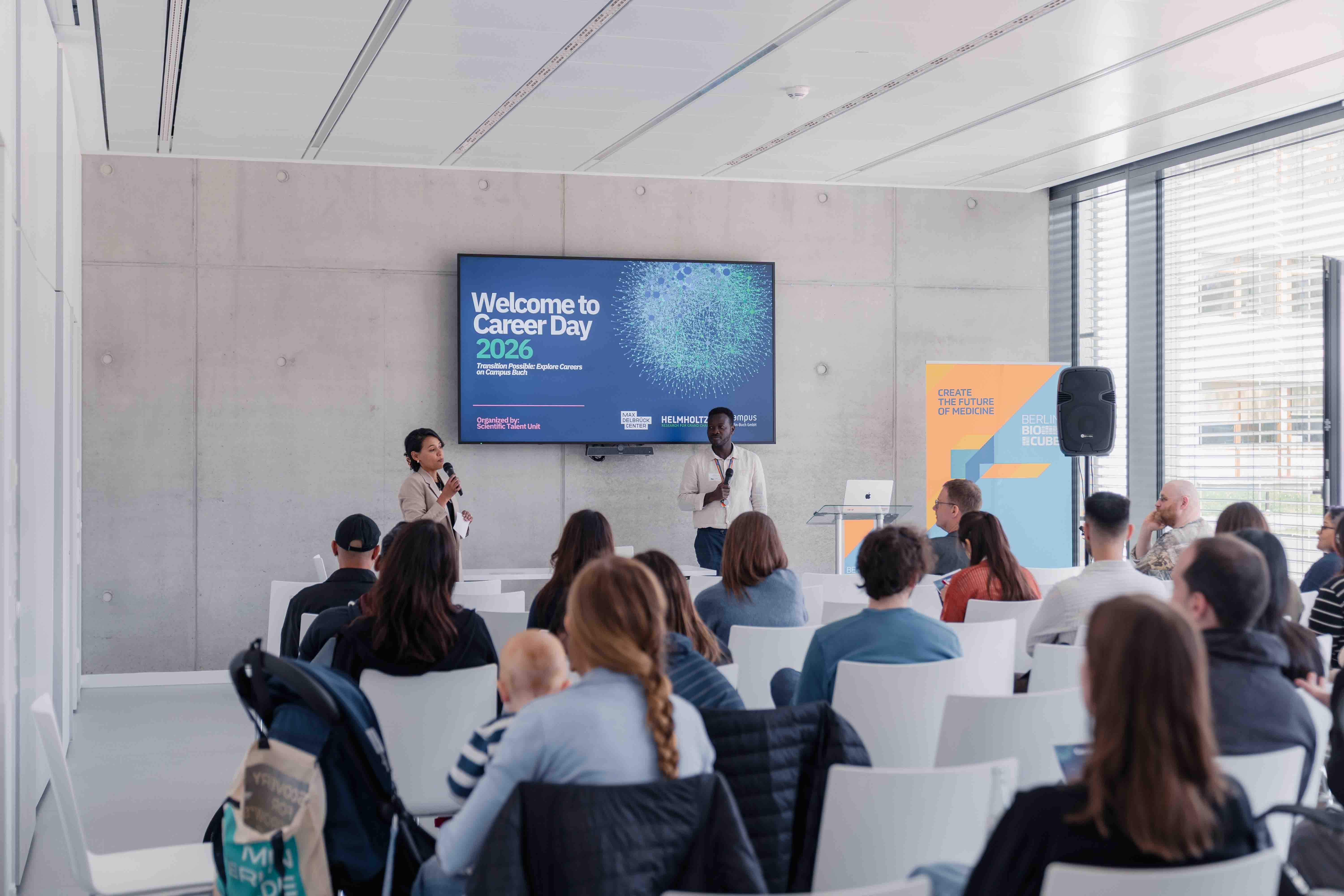
The Max Delbrück Center’s Career Day, held in cooperation with the operator of the Berlin-Buch Campus, offered young researchers insights into the working world of startups and biotech companies
April 16 was a packed day for participants in the Max Delbrück Center’s Career Day, titled “Transition Possible – Explore Careers Beyond R&D.” Numerous doctoral students and postdocs gained insights into potential careers outside the academic world.
The event was opened by biologist Lars Dittrich, who works as a science editor at MaiThink X. In the morning, there were virtual presentations across the Helmholtz Association on career paths outside of research. The speakers presented concrete entry-level and development opportunities and shared their experiences of transitioning from science to other professional fields.
In the afternoon, the Max Delbrück Center and Campus Berlin-Buch GmbH hosted an event at the BerlinBioCube startup center. Here, the Berlin BioScience Academy and the Innovation & Entrepreneurship Department of the Max Delbrück Center presented themselves. This was followed by lab tours at biotech companies and a workshop on the application process.
Pathways into the Biotech and Pharmaceutical Industries
How can you gain in-depth insights into the biotech and pharmaceutical industries without actually working in them? The Berlin BioScience Academy (BBA) offers exactly this opportunity. Its courses cover biotechnological and pharmacological processes, including Good Manufacturing Practice (GMP) and Good Clinical Practice (GCP). “Anyone considering a move into the industry or wanting to take the leap into a startup will gain an overview of the entire drug development process—from concept to market—in a very short time at the Biotech & Pharma Summer School,” said Dr. Uwe Lohmeier, who heads the BBA. Through its “Talk im Cube” event series, the BBA regularly brings together science and industry, offering panel discussions on topics such as financing strategies, female founders, CROs, and IP strategies in biotechnology. Here, too, participants have an easy opportunity to engage with biotech companies.
At the Max Delbrück Center, the Innovation & Entrepreneurship Department serves as a springboard for careers in spin-offs. Dr. Nevine Shalaby highlighted funding opportunities for future “sciencepreneurs” to develop innovative diagnostic or therapeutic approaches for practical application. The Innovation Office provides support through programs such as BOOST and PreGoBio to validate ideas and their basic feasibility, helps secure funding, offers mentoring, establishes contacts with industry and investors, and proactively supports business development.
How do biotech companies operate?
Over 50 biotech and medtech companies have set up their business in the BiotechPark Berlin-Buch, including numerous startups. Four of them opened their doors on Career Day to show participants how they work and what their mission is. T-knife, a spin-off of the Max Delbrück Center and Charité, introduced itself as a young biopharmaceutical company developing next-generation T-cell therapies to fight cancer.
CheckImmune, a spin-off of Charité, provided information about its work as an accredited specialized laboratory that supports the clinical development of new therapeutics through immunological studies, among other activities.
In the Biosynth laboratories, participants learned about the technologies used to develop and manufacture polymer-based excipients for drug delivery as well as bioconjugate drugs. Last but not least, the FyoniBio team presented its range of contract development and clinical laboratory services.
“There are surprisingly many different companies here,” said one participant, who could well imagine working at one of the biotech firms: “The labs in the BioCube are similar to those at research institutions, and the building feels very spacious, especially thanks to the large shared large common areas with a kitchen.” One of the participants noted with pleasant surprise how diverse the age range of employees in startups can be. Many found it fascinating to learn how the work culture in a startup functions and that the tasks there are different and more varied than in pure scientific research.
How successful is my application?
To wrap up the event, Career Day offered participants the chance to step into the shoes of a hiring manager during a group workshop. Anita Überheim, Head of Human Resources Europe at the global company Eckert & Ziegler SE, had the participants evaluate three anonymized CVs and cover letters and then explained which aspects matter in the selection process. She described how HR professionals proceed, how much time they have to review applications, which skills are important to mention, and what mistakes are common. Finally, the expert conducted a brief mock interview with one of the participants. During the joint evaluation with the audience, she explained how applicants should best communicate and respond. In addition to many helpful tips, a key insight for the young talents was this: It is not always necessary to meet 90 percent of the desired qualifications. What is far more important is that the person fits into the team and has the potential to continue developing.
The joint Career Day was very well received. “We are delighted to have had the opportunity to help organize this event. The Career Day offers concrete insights into the biotech industry and connects young talent with potential employers in the area, which is valuable for everyone involved,” says Dr. Ulrich Scheller, Managing Director of Campus Berlin-Buch GmbH.
Research, Patient care / 17.04.2026
A fundamentally new therapeutic approach to cystic fibrosis: Nanobody repairs cellular defect
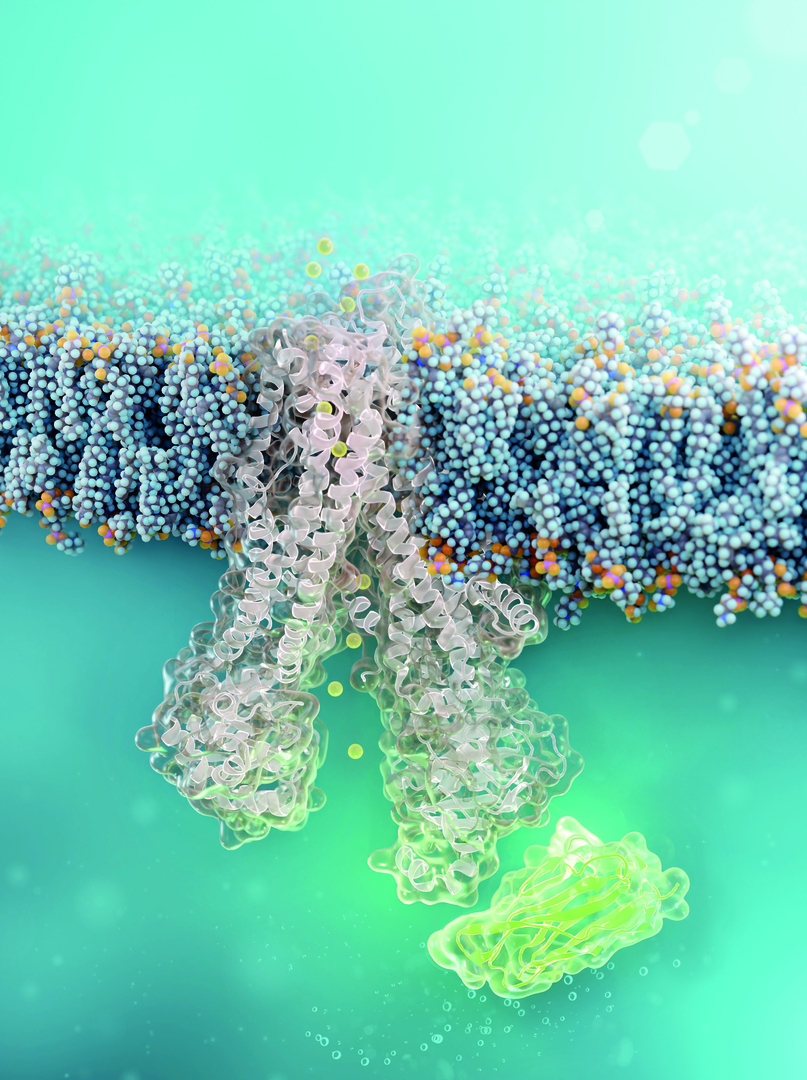
A tiny antibody component could fundamentally transform the treatment of cystic fibrosis: For the first time, researchers have succeeded in developing a so-called nanobody that penetrates directly into human cells and can repair the chloride channel most commonly affected in cystic fibrosis. The innovative therapeutic approach was developed in collaboration between teams from the Leibniz-Forschungsinstitut für Molekulare Pharmakologie (FMP) and Charité – Universitätsmedizin Berlin.The first authors of the study, which was recently published in the renowned journal Nature Chemical Biology, are Luise Franz (FMP) and Tihomir Rubil (Charité).
The clinical picture of cystic fibrosis—also known as CF—is caused by genetic defects in the so-called CFTR channel. This channel regulates water and salt transport in the lung mucosa and ensures the production of sufficiently fluid mucus.
In about 90 percent of cystic fibrosis patients, a mutation known as F580del is present in the CFTR channel, meaning that a single amino acid is missing at position 508 in its protein chain. This change causes CFTR to fold incorrectly and be broken down prematurely inside the cell, rather than functioning as a channel in the cell membrane of the airways. As a result, patients have thick mucus in their lungs, and pathogens can no longer be effectively cleared. The consequence is chronic infection and inflammation of the airways, leading to a progressive loss of lung function—in the worst-case scenario, this necessitates a lung transplant.
Professor Dr. Marcus Mall, Director of the Department of Pediatric Respiratory Medicine, Immunology and Critical Care Medicine at Charité, has, together with his team, made a significant contribution in recent years to noticeably improving the treatment of cystic fibrosis through therapy with three small-molecule drugs (CFTR modulators): With the help of the so-called triple therapy consisting of elexacaftor, tezacaftor, and ivacaftor (ETI), the function of the CFTR channel can be increased to about 50 percent of the normal level. However, chronic inflammation and infection of the lungs often persist, and there are also patients for whom this therapy is ineffective or whom cannot tolerate it.
An Antibody as a Repair Aid
There may be additional treatment options for this group in the future: The team led by chemist Professor Dr. Christian Hackenberger at the Leibniz-FMP has developed a new molecule in the lab that stabilizes the misfolded CFTR directly inside the cell. This is a nanobody—a tiny but stable antibody component that can bind precisely to defined surfaces of proteins. It is chemically modified with a “transport signal,” known as cell-penetrating peptides, which help it penetrate directly into the lung’s mucosal cells. There, the nanobody binds to the defective channel protein and helps it adopt the correct shape.
The researchers were able to demonstrate that the nanobody remained bound to the mutated CFTR channel in cells derived from cystic fibrosis patients for at least 24 hours. It did not damage the cells in the process. Functional studies also confirmed that the corrected channel once again transported chloride across the cell membrane.
Combination of triple therapy and nanobody
In combination with established ETI triple therapy, the nanobody demonstrates a pronounced synergistic effect in these cell cultures: While the ETI agents restored the function of the defective CFTR channel by about half on average, the channel activity could be increased to nearly 90 percent of normal levels through the additional administration of the nanobody.
The study thus demonstrates that exogenously administered cell-penetrating nanobodies can stabilize disease-relevant, misfolded proteins inside cells and restore their function. “In addition to the preclinical proof of concept for repairing the CFTR channel, this is the first example of a functional cell-permeable antibody: Until now, cell-permeable nanobodies have primarily been used to visualize intracellular target structures or for the targeted killing of cells,” says Prof. Dr. Christian Hackenberger.
“Since the nanobodies bind directly in the region of the F508del mutation, they enable even more targeted treatment of the maturation defect in CFTR channels,” says Prof. Dr. Marcus Mall. “This new mechanism of action allows CFTR function to be corrected significantly better in combination with existing CFTR modulators. Our results suggest that this new approach may even enable complete normalization of CFTR function. This would be another breakthrough for the treatment of cystic fibrosis.”
Thus, this work thus opens up new possibilities for further improving the treatment of cystic fibrosis—while also laying the groundwork for broader therapeutic applications.
Prospects beyond cystic fibrosis
However, key questions must still be resolved before the approach can be applied clinically to cystic fibrosis, such as developing a suitable formulation for inhalation and ensuring efficient penetration of the viscous CF mucus. Furthermore, it remains unclear how the nanobody acts within the body and how the immune system reacts to nanobody treatment. These challenges are currently being addressed within Collaborative Research Center 1449 “Dynamic Hydrogels at Biointerfaces,” within the framework of which the current results were also generated.
The approach of intracellular nanobody therapy could also be helpful beyond cystic fibrosis for other rare genetic diseases in which protein misfolding plays a role and for which there are currently few effective treatments.
About Cystic Fibrosis
Cystic fibrosis is one of the most common fatal hereditary diseases worldwide. As many as 8,000 children, teens, and adults are living with the disease in Germany today. An imbalance in salt and water levels in the body causes people with cystic fibrosis to produce thick, sticky secretions that harm organs such as the lungs and pancreas. This leads to progressive loss of lung function and shortness of breath, which still significantly lowers life expectancy despite advances in treatment. Some 150 to 200 children are born with this rare disease in Germany each year. A test for cystic fibrosis is part of routine screening for newborns.
Publication: Franz, L., Rubil, T., Balázs, A., Overtus, M., Kemnitz-Hassanin, K., Govaerts, C., Mall, M. A., & Hackenberger, C. P. R.. A cell-permeable nanobody to restore F508del cystic fibrosis transmembrane conductance regulator activity. Nature Chemical Biology 2026. doi: 10.1038/s41589-026-02199-w
Source: Joint Press Release from the Leibniz-Forschungsinstitut für Molekulare Pharmakologie and Charité – Universitätsmedizin Berlin
A fundamentally new therapeutic approach to cystic fibrosis: Nanobody repairs cellular defect
Education / 15.04.2026
Wie erforscht man Gesundheit?
Wie werden die Ursachen von Erkrankungen im Kindes- und Jugendalter erforscht? Was ist nötig, um innovative Therapien und Präventionsstrategien zu finden? Im Gläsernen Labor können Jugendliche selbst in die Rolle von Forschenden schlüpfen, dazu experimentieren und ein Forschungslabor auf dem biomedizinischen Campus Berlin-Buch besuchen.
Nach einem erfolgreichen Auftakt im Jahr 2025 fördert das Deutsche Zentrum für Kinder- und Jugendgesundheit (DZKJ) erneut zwei Projektwochen zu den Themen „Seltene Erkrankungen“ und „Immunsystem“. Für die Teilnehmenden fällt dadurch nur eine geringe Gebühr an. Geeignet sind die Projektwochen für Schüler:innen ab der 9. Klasse.
Das DZKJ ist eines der acht Deutschen Zentren für Gesundheitsforschung und wird vom Bildungsministerium für Forschung, Technologie und Raumfahrt gefördert. Das DZKJ setzt sich für die interdisziplinäre Erforschung von Ursachen häufiger und seltener Erkrankungen im Kindes- und Jugendalter ein und fördert die Entwicklung innovativer Therapien und Präventionsstrategien. In Berlin sind die Charité – Universitätsmedizin, das Max Delbrück Center und das Deutsche Rheuma-Forschungszentrum beteiligt. Eines der Anliegen des DZKJ ist es, Kinder und Jugendliche aktiv in die Forschung einzubeziehen, ihnen zu zeigen, wie wichtig sie ist und was die Forschenden antreibt.
Projektwoche „Seltene Erkrankungen“
Die Jugendlichen erarbeiten während der Projektwoche zu seltenen Erkrankungen, wie genetische Erkrankungen im Labor untersucht und diagnostiziert werden. Im molekularbiologischen Schülerlabor vertiefen sie ihr Wissen über die DNA und ihre Funktion als Informationsspeicher, gewinnen DNA aus Mundschleimhaut. Nach einer Einführung in die Methode der Polymerase-Kettenreaktion (englisch polymerase chain reaction, PCR) nehmen sie eigenständig unterschiedliche PCR-Analysen vor. Dabei lernen sie, wie sich Mutationen und damit mögliche Erbkrankheiten nachweisen lassen. Anhand einer fiktiven Familie wird die Vererbung einer genetischen Erkrankung entschlüsselt. Spannend wird auch das Experiment zur Sensitivität der PCR, das untersucht, wie stark eine DNA-Probe verdünnt werden kann, um noch zuverlässige Ergebnisse zu liefern.
Projektwoche „Immunsystem“
In dieser Projektwoche lernen die Jugendlichen Erkrankungen kennen, die durch Viren, Bakterien, Parasiten oder Allergene ausgelöst werden. Im Mittelpunkt steht, wie in diesem Fall das Immunsystem arbeitet, welche Funktion Antikörper haben und warum es bei Allergien zu Überreaktionen kommt. Im Labor werden die Zellen des Immunsystems aus einer winzigen Blutprobe unter dem Mikroskop betrachtet. Die Schüler:innen lernen immunologische Nachweisverfahren kennen, die auf Antigen-Antikörper-Wechselwirkungen beruhen. So wird beispielsweise an einem Allergie-Schnelltest das Prinzip des Lateral-Flow-Tests erklärt, und die Schülerinnen und Schüler können untersuchen, ob sie für Allergien typische IgE-Antikörper im Blut haben. An einem weiteren Versuchstag bestimmen die Jugendlichen ihren Titer gegen Tetanus, indem sie mit einem Tropfen Blut einen ELISA-Test (englisch enzyme-linked immunosorbent assay) durchführen. In einer abschließenden Reflexion diskutieren die Teilnehmenden, wie man das Immunsystem stärken kann und wie bedeutsam die Forschung in diesem Bereich ist.
Einige Arbeitsgruppen des Max Delbrück Centers sind an Forschungsprojekten des DZKJ beteiligt. Daher treffen sich die Gruppen aus den Projektwochen mit einer Forschenden, um Einblick in ihre Arbeit in diesen Projekten zu bekommen und besuchen ein Forschungslabor auf dem Campus.
Am Ende beider Projektwochen, die parallel in zwei Laboren durchgeführt werden, findet ein kleines Symposium statt, in dessen Rahmen die Schüler:innen ihre Poster mit ihren Ergebnissen der jeweils anderen Gruppe präsentieren. Geplant ist, dazu Forschende einzuladen, die ihre letzten Poster vorstellen und aus ihrem Forschungsalltag berichten.
Education / 15.04.2026
Von gesunder Ernährung bis zur Funktionsweise der Sinne
Das Gläserne Labor bietet 2026 in Kooperation mit der Grundschule Am Sandhaus erneut die Forscher-AG FIN an. Ermöglicht wird dies durch das Deutsche Zentrum für Kinder- und Jugendgesundheit
Die Arbeitsgemeinschaft (AG) „FiN – Fit in den Naturwissenschaften“ möchte Fünft- und Sechstklässler der Bucher Grundschule Am Sandhaus für naturwissenschaftliche Fragestellungen begeistern und ihre experimentellen Kompetenzen entwickeln. Themenschwerpunkt ist die Gesundheit von Heranwachsenden. In diesem Jahr wird die AG durch das Deutsche Zentrum für Kinder- und Jugendgesundheit (DZKJ) gefördert.
Im ersten Teil der AG erfahren die Kinder, wie Ernährung auf die Gesundheit wirkt. Sie beschäftigen sich mit gesunder Ernährung, ermitteln mit Labormethoden den Zuckergehalt von Lebensmitteln und setzen sich mit der Volkskrankheit Diabetes auseinander. Die AG wirkt auch in den Alltag hinein, denn die Kinder führen eine Woche gemeinsam mit ihrer Familie ein Ernährungstagebuch. Bei der Auswertung geht es darum zu vermitteln, wie eine ausgewogene Ernährung aussehen sollte und wie viele positive Effekte diese haben kann. Zum Abschluss wird gemeinsam gekocht – gesund und lecker.
Danach beschäftigt sich die AG mit dem Nervensystem und den Sinnen. Experimente vermitteln anschaulich die Funktionsweise der Nerven, ihr Zusammenspiel und die Bedeutung der Sinne für die Wahrnehmung. Wie ist das Gehirn aufgebaut, wie funktionieren die Augen und das Gehör? Für gesunde Menschen sind diese Fähigkeiten selbstverständlich, doch welche Einschränkungen ergeben sich bei neurologischen Erkrankungen? Dies testen die Kinder anschaulich mittels einer Prismenbrille beim Ballspielen.
„Wir freuen uns sehr, dass wir die AG bereits im zweiten Jahr bei uns im Schülerlabor anbieten können. Es ist eine ganz praktische Heranführung an eine bewusstere Wahrnehmung der Gesundheit, die zugleich erklärt, was Erkrankungen auslösen kann – und wie wichtig Prävention ist“, sagt Biologin Claudia Jacob, die die AG im Gläsernen Labor leitet.
Informationen zu Arbeitsgemeinschaften im Gläsernen Labor
News auf der Webseite des Gläsernen Labors
Von gesunder Ernährung bis zur Funktionsweise der Sinne
Innovation / 14.04.2026
Eckert & Ziegler: Metzler Initiates Coverage with a Buy Rating and a Price Target of € 21.00. Upside Potential: 41%
B. Metzler seel. Sohn & Co. AG (Bankhaus Metzler) has started research coverage of Eckert & Ziegler SE (ISIN DE0005659700), a leading supplier of isotope-based components for nuclear medicine and measurement technology, with a buy recommendation and a price target of € 21.00. This corresponds to an upside potential of 40.8% compared to the Xetra closing price of € 14.92 on April 13, 2026.
Bankhaus Metzler thus highlights the strong market position of Eckert & Ziegler SE, which is benefiting from rising demand for diagnostic and therapeutic radioisotopes in nuclear medicine.
About Eckert & Ziegler.
Eckert & Ziegler SE with more than 1,000 employees is a leading specialist for isotope-related components in nuclear medicine and radiation therapy. The company offers a broad range of services and products for the radiopharmaceutical industry, from early development work to contract manufacturing and distribution. Eckert & Ziegler shares (ISIN DE0005659700) are listed in the TecDAX index of Deutsche Börse.
Contributing to saving lives.
Quelle: https://www.ezag.com
Research, Patient care / 13.04.2026
First “protein map” of neurons that initiate pain
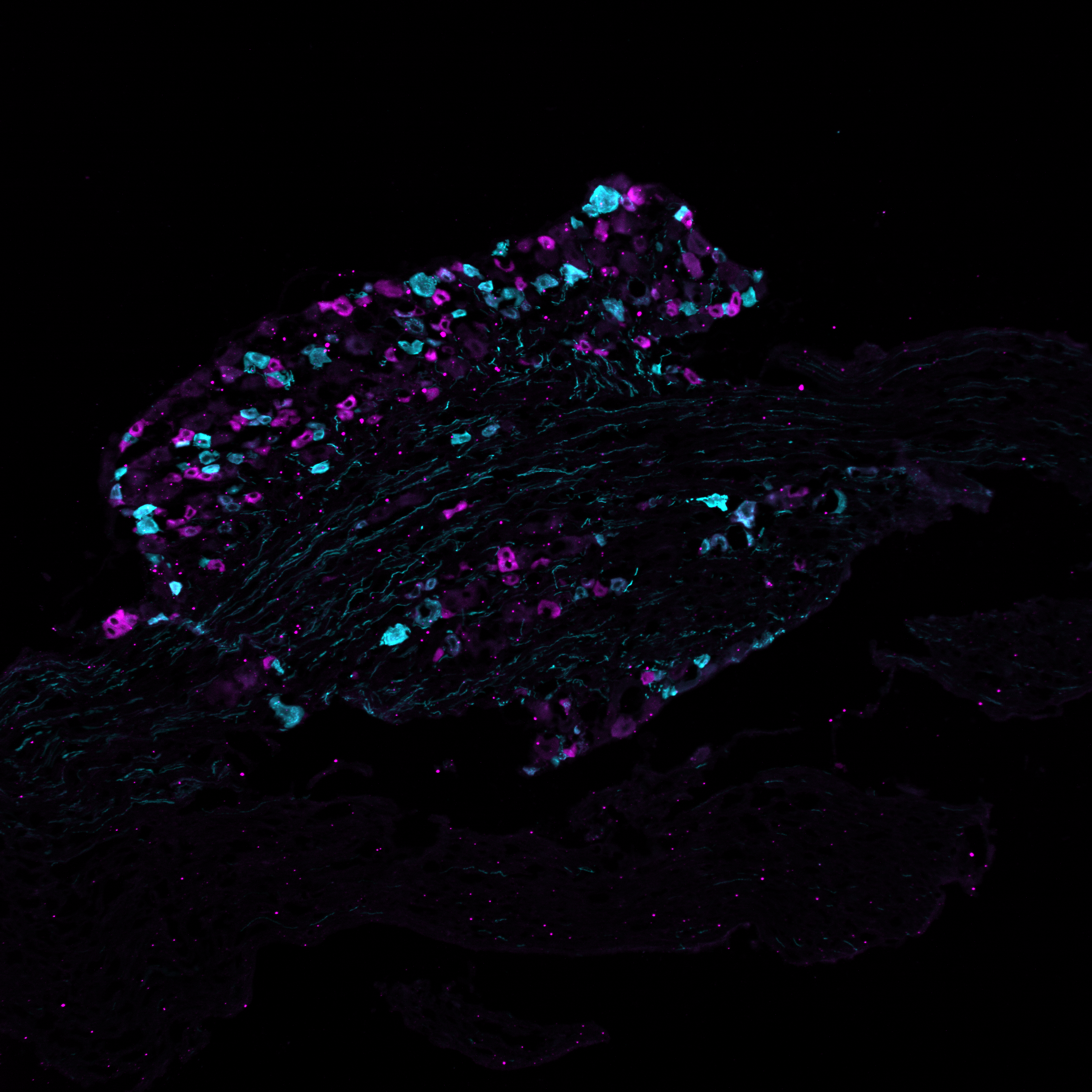
Helmholtz researchers have created the first detailed protein map of specific sensory neurons that trigger pain. Their study, published in “Nature Communications,” will help researchers better understand the molecular mechanisms of chronic inflammatory pain and identify new drug targets.
Joint press release by the Max Delbrück Center and the Helmholtz Centre for Infection Research
One in five people worldwide suffers from chronic inflammatory pain. Meanwhile, about two thirds of those affected find little relief from existing pain medications; new therapeutic approaches are urgently needed. “We first must understand precisely how sensory nerve cells trigger pain at the molecular level — in other words, which proteins are involved,” says Professor Gary Lewin, Group Leader of the Molecular Physiology of Somatosensory Perception lab at the Max Delbrück Center in Berlin.
To unravel these molecular processes, Lewin – who has been studying pain for four decades and recently discovered a previously unknown ion channel involved in pain perception – is working closely with systems biologist Dr. Fabian Coscia, Group Leader of the Spatial Proteomics lab at the same center. Coscia co-developed a method called Deep Visual Proteomics that makes it possible to determine the proteome — the complete set of proteins — of specific cells and to create maps detailing the spatial locations of individual proteins.
The researchers combined this technology with electrophysiological methods from Lewin’s group. This enabled them to first identify specific subtypes of pain neurons based on their function and then analyze their protein profiles. The result is a high-resolution molecular map of these nerve cells, which has been published in “Nature Communications.” The team also demonstrated how the technology can identify potential new drugs targets to treat chronic pain.
Dr. Sampurna Chakrabarti is the study’s first author and a former postdoctoral researcher in the Lewin lab who now heads the Pathways in Infection and Nociception group at the Helmholtz Centre for Infection Research in Braunschweig. Nociception refers to how our nerves respond to stimuli that trigger pain. Nerves in skin and other peripheral tissues – such as muscles and joints – that detect damaging stimuli are called nociceptors; they relay signals to the brain to initiate pain.
Undiscovered signaling pathways
All nociceptors are not alike. “Until now, only the transcriptome – that is, the RNA level information of the different subsets of nociceptors – was known,” says Chakrabarti. “However, the actual functional components of all cells are the proteins formed from these transcripts – and we have now examined them in greater detail for the first time in two subtypes of nociceptors.” Using an electrophysiological method known as the patch-clamp technique, the team first identified and characterized two nociceptor subtypes – peptidergic and non-peptidergic – in the spinal ganglia of mice. Each of these subtypes respond differently to similar stimuli and may initiate pain of different quality and duration.
The researchers used around 50 neurons of each subtype to generate a specific protein map for each of the two cell types. Deep Visual Proteomics combines mass spectrometry with microscopy, artificial intelligence and robotics. Coscia and his team have so far mainly used this methodology for proteome analyses of cancer cells. “We have now shown for the first time that it can also be applied to nerve cells,” he says.
The team measured more than 6,000 proteins in these 50 neurons. A comparison with existing RNA data revealed that the transcriptome and proteome of the cells differ significantly in some cases – an indication that key functional processes only become visible at the protein level. “We provide a unique molecular map of pain-initiating neurons,” says Coscia. “It enables the identification of signaling pathways in these cells that have so far remained hidden.”
In an additional step, Chakrabarti and her colleagues wanted to understand which proteins sensitize nerve cells, contributing to chronic pain. They isolated both types of nociceptors from mouse dorsal root ganglia and exposed them to a molecule called Nerve Growth Factor (NGF), which is known to trigger chronic pain both animals and humans, such as in arthritis. Using Deep Visual Proteomics, the researchers were able to precisely identify the proteins produced after the cells were exposed to NGF.
Reduced sensitivity to pain signals
Lewin and his team had already discovered that NGF plays an important role in chronic inflammatory pain more than 30 years ago. “In dogs and cats, pain can now be alleviated very effectively using antibodies that inhibit NGF,” says Lewin. “In humans, rare side effects have unfortunately prevented their use,” he adds. “But now we may have found an alternative approach: targeting a downstream protein responsible for NGF’s sensitizing effect.”
“We identified several proteins that were present in higher levels in a subset of nociceptors following treatment with NGF. The higher levels of these proteins could be linked to long term pain associated with inflammation,” says Chakrabarti. One of the proteins, an enzyme called B3GNT2, stood out in particular. “When we knocked out the corresponding gene in the cells, the inflammation-induced hyperactivity of nociceptors was reduced. Fewer cells responded to mechanical stimulus,” she says. In other words, the neurons had become less sensitive and would elicit much less pain.
In the future, the researchers plan to validate their findings in mice and humans. “More than 90 percent of all approved drugs now target proteins,” says Coscia. “This highlights how important it is to develop a better understanding of these molecules in order to identify new targets for more effective pain therapies and treatments for other neurological diseases.”
Text: Anke Brodmerkel
Further information
Molecular Physiology of Somatic Sensation
- Chakrabarti lab
- Profile of Gary Lewin
- Profile of Fabian Coscia
- Creating protein maps of tumors
- Understanding the roots of chronic pain
Literature
Sampurna Chakrabarti, Anuar Makhmut, Atena Mohammadi et al. (2026): “Deep visual proteomics uncovers nociceptor diversity and pain targets.” Nature Communications, DOI:10.1038/s41467-026 – 71418‑8
Innovation / 10.04.2026
Eckert & Ziegler Secures Patient Access to Critical Eye Cancer Treatment with MDR Certification for Ru-106 Eye Applicators
Eckert & Ziegler BEBIG GmbH, subsidiary of Eckert & Ziegler SE with focus on brachytherapy solutions for the treatment of eye tumors and prostate cancer, obtained the MDR certificate for its Ruthenium-106 (Ru-106) Eye Applicators from competent authorities. Eckert & Ziegler is the only global provider of these eye applicators. Therefore, this important milestone is a critical safeguard against treatment shortages.
The Medical Device Regulation (MDR) is a European Union directive (EU 2017/745) with the aim of improving the quality of medical devices and increasing patient safety. Obtaining this certification guarantees the long-term availability of Ru-106 Eye Applicators within the EU. These medical devices have been manufactured and internationally marketed by Eckert & Ziegler for more than 30 years. They are actively used in almost 50 countries and contribute several million euros in annual sales to the Eckert & Ziegler Group's earnings.
During an ophthalmic brachytherapy procedure, a small radioactive plaque containing Ru-106 is used to treat uveal melanoma in adults or retinoblastoma in children. The plaque is sutured to the wall of the eye, adjacent to the tumor, and left in place for several days until the required dose of radiation has been delivered. As an alternative to the removal of the affected eye, this treatment offers a chance for patients to conserve vision and quality of life.
"The dedication of our team to achieve MDR certification for a niche product like the Ru-106 Eye Applicators demonstrates our commitment to ensure the long-term availability of this vital form of therapy to treatment centers and patients," explained Katrin Antonenko, Managing Director of Eckert & Ziegler BEBIG GmbH. “The milestone furthermore marks the durable legacy of a product that started to pave the way for the sustainable and successful growth of the Eckert & Ziegler Group more than three decades ago. The experience gained during the successful approval process is expected to expedite additional projects.”
About Eckert & Ziegler
Eckert & Ziegler SE, with more than 1,000 employees, is a leading specialist in isotope-related components for nuclear medicine and radiation therapy. The company offers a broad range of services and products for the radiopharmaceutical industry, from early development work to contract manufacturing and distribution. Eckert & Ziegler shares (ISIN DE0005659700) are listed in the TecDAX index of Deutsche Börse.
Source: Press Release Eckert & Ziegler
Eckert & Ziegler Secures Patient Access to Critical Eye Cancer Treatment with MDR Certification for Ru-106 Eye Applicators
Research / 08.04.2026
Gilead acquires FMP and LMU Spin-off Tubulis and expands Oncology Pipeline with next-generation ADC
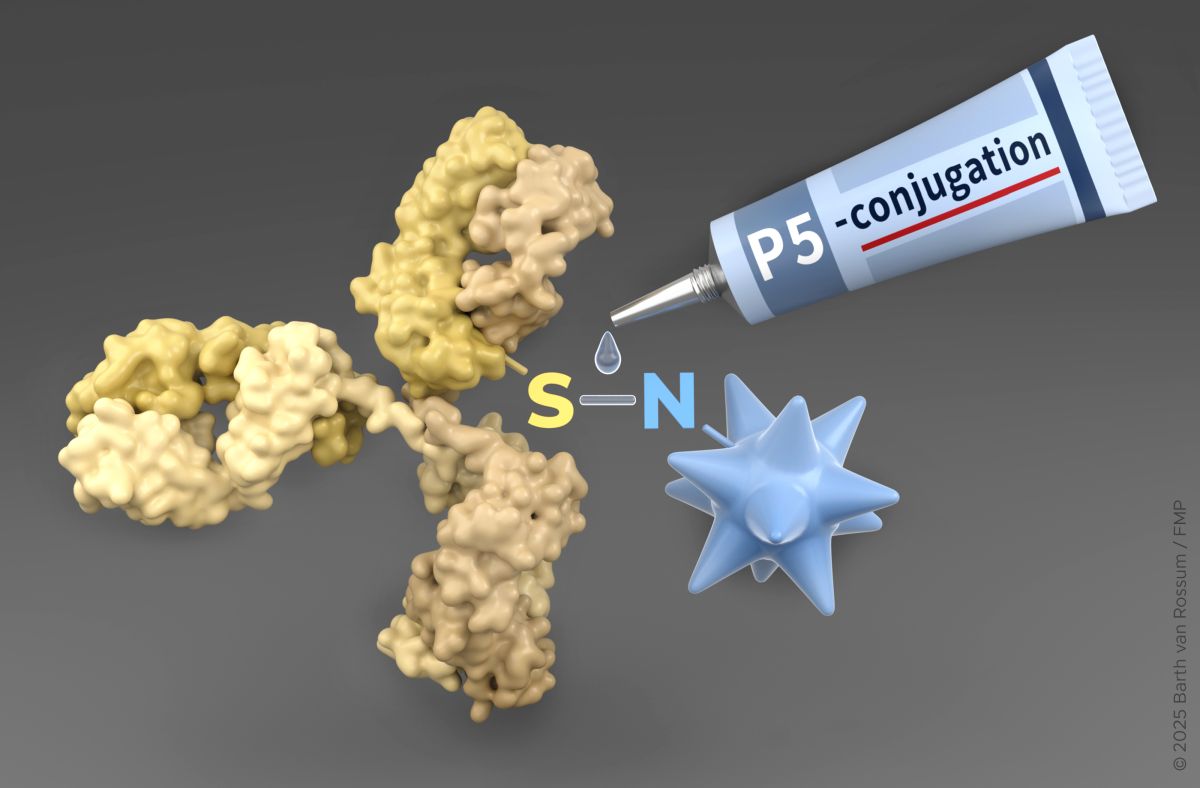
U.S. biopharmaceutical company Gilead has entered into a definitive agreement to acquire Tubulis GmbH. Tubulis was spun off in 2019 from the Leibniz Forschungsinstitut für Molekulare Pharmakologie (FMP) and LMU Munich and develops next-generation antibody-drug conjugates (ADCs) designed to deliver various active ingredients more selectively to tumors and maximize patient benefit. The transaction expands Gilead’s oncology pipeline with several innovative programs and platform technologies, some of which originated from academic research at the Leibniz Forschungsinstitut für Molekulare Pharmakologie (FMP) in Berlin.
The acquisition includes Tubulis’ lead product, TUB-040, a NaPi2b-targeted topoisomerase I inhibitor ADC currently in Phase 1b/2 clinical development for the treatment of platinum-resistant ovarian cancer and non-small cell lung cancer (NSCLC). Gilead will also acquire TUB-030, a 5T4-targeted ADC with promising early clinical data across various solid tumor types as well as Tubulis’ next-generation ADC platform and a promising early pipeline.
Dr. Dominik Schumacher, CEO and co-founder of Tubulis, also emphasizes the importance of combining scientific excellence with industrial development strength: „From the outset, we believed our conjugation technology platforms could have broad impact across the ADC field and the initial data from TUB-040 have reinforced that conviction,” said Dr. Dominik Schumacher, Chief Executive Officer and Co-founder of Tubulis. „Joining Gilead allows us to build on this foundation within an organization that brings deep scientific expertise, global development capabilities, and the scale needed to translate innovation into medicines for patients worldwide. Through our existing collaboration, Gilead has already seen the potential of our technologies and together, we are well positioned to accelerate the development of our ADC pipeline. I’m deeply grateful to the Tubulis team, our Board of Directors, investors, and partners for their commitment and helping make this milestone possible.”
P5 Conjugation Technology from FMP
A key role in Tubulis’ product development is played by the innovative P5 conjugation technology, a linker chemistry that enables the precise coupling of antibodies with highly potent active ingredients. It was developed through basic research by Prof. Dr. Christian Hackenberger, one of Tubulis’ co-founders, and his team at the Leibniz Forschungsinstitut für Molekulare Pharmakologie (FMP). Tubulis has further developed P5 technology for clinical research and application in collaboration with the research group led by Prof. Dr. Heinrich Leonhardt (Ludwig Maximilian University of Munich), a co-founder of Tubulis. “This successful technological development demonstrates the potential of interdisciplinary collaboration across departmental and institutional boundaries”, says Prof. Dr. Heinrich Leonhardt. This technology forms a central platform for stable and controlled drug delivery in the company’s ADC programs. „This acquisition not only underscores the success of our conjugation technology and the performance of the Tubulis team in improving cancer therapy with new ADCs. It also demonstrates the importance and impact of basic research at universities and research institutes for translational innovation", says Prof. Dr. Christian Hackenberger.
Upon completion of the transaction, Tubulis will operate as an independent ADC research organization within Gilead, with the Munich site serving as a hub for ADC innovations. The company will build on existing integrated capabilities in research, production, and clinical development to advance next-generation ADCs.
Gilead will acquire all of the outstanding equity of Tubulis for 3.15 billion US Dollars in upfront cash consideration on a cash-free, debt-free basis, plus up to 1.85 billion US Dollars in contingent milestone payments. The acquisition is expected to close in the second quarter of 2026. Closing of the transaction is subject to expiration or termination of certain regulatory filings and other customary closing conditions.
About Tubulis
Tubulis develops tailored antibody-drug conjugates (ADCs) with improved biophysical properties. In preclinical models, the ADCs have already demonstrated targeted and sustained accumulation in the tumor as well as long-lasting anti-tumor effects. The two most advanced programs in the growing pipeline are TUB-040 (targeting NaPi2b) and TUB-030 (targeting 5T4). Both programs are currently being investigated in clinical trials for cancers with high unmet medical needs. For more information, visit: www.tubulis.com
Source: Leibniz-Forschungsinstitut für Molekulare Pharmakologie
Gilead acquires FMP and LMU Spin-off Tubulis and expands Oncology Pipeline with next-generation ADC
Living / 31.03.2026
Spaziergänge im Pankower Norden mit Cordelia Koch: erste Tour startet am 11. April in Blankenburg
Die Bezirksbürgermeisterin Cordelia Koch lädt gemeinsam mit Wanderleiter Eckehard Heiber vom Sportverein Empor-Berlin alle Interessierten ein, den Pankower Norden bei vier Wanderung im April, Juni, August und September zu Fuß zu entdecken.
Der Bezirk hat mit der Entwicklung eines Freiraum- und Erholungskonzeptes die Grundlage für ein gutes Miteinander von Natur, Erholung, Tourismus und Gewerbe verabschiedet. Um die einzelnen Entwicklungsstufen und -regionen vorzustellen, werden an vier Samstagen in diesem Frühjahr und Sommer je eine Wanderung angeboten. Die Spaziergänge stehen jeweils unter einem Motto. Begleitet wird die Bezirksbürgermeisterin von Eckehard Heiber, der passionierter und erfahrener Wanderleiter sowie Initiator des jährlichen Wanderplanes für den SV-Empor-Berlin ist. Er wird entlang des Weges auf die Besonderheiten der Natur, auf die Stadtentwicklung im Kontext zur Geschichte als auch auf die architektonischen Kleinode hinweisen. Die Bezirksbürgermeisterin ergänzt mit Informationen aus dem Freiraum- und Erholungskonzept sowie zu politischen Themen entlang der Route. Cordelia Koch: „Zwischen Autobahn und Bahntrasse – einfach schön? Der Pankower Norden bietet reizvolle Wanderwege, die zu Spaziergängen abseits der Großstadt einladen.“
Wanderung am 11. April für von Blankenburg nach Weißensee
Die erste Wanderung steht unter dem Motto „Marder, Mörder, Gärtner oder Künstler“ und findet am Samstag, dem 11. April 2026 von 09:30 bis 12:30 Uhr statt. Treffpunkt ist auf dem Vorplatz des S-Bahnhofs Blankenburg. Die ca. acht Kilometer lange Route verläuft entlang der Anlage Blankenburg, des Mörderbergs zur Stadtrandsiedlung Malchow über den Sportkomplex Rennbahnstraße bis zur Kunsthalle am Hamburger Platz in Weißensee.
Weitere Termine:
· 20.06.2026: Entdeckungen in der Schönholzer Heide und in Wilhelmsruh
· 08.08.2026: „Ein Zipfel von Berlin“ – Wanderung in Buch
· 12.09.2026: „Von Mönchmühle nach Blankenfelde”
Die Wanderrungen finden jeweils von 9:30 bis 12:30 statt und sind auch für ältere oder nicht trainierte Menschen geeignet.
Anmeldung erforderlich
Wegen der begrenzten Zahl der Teilnehmenden wird um Anmeldung gebeten: per E-Mail an buergermeisterin@ba-pankow.berlin.de oder per Telefon: +49 30 90295-2301. Die Teilnahme an den Wanderungen kostenlos. Spenden zu Gunsten des Kinderhospizes Sonnenhof der Björn-Schulz-Stiftung werden gern entgegengenommen.
Weitere Informationen: https://www.berlin.de/ba-pankow/spaziergaenge
Living / 27.03.2026
Siegerentwurf für das Neue Stadtquartier Elisabeth-Aue
Das im November 2025 gestartete kooperative Werkstattverfahren für das Neue Stadtquartier Elisabeth-Aue ist am 26. März 2026 erfolgreich abgeschlossen worden. Die Jury hat aus vier Entwürfen den städtebaulichen Entwurf von Hosoya Schaefer Architects AG mit AgenceTer.de GmbH Landschaftsarchitekten ausgewählt, der bildet die Grundlage für die weiteren Planungsschritte.
Auf der rund 73 ha großen landeseigenen Fläche der Elisabeth-Aue soll ein gemischtes, ökologisches und nachhaltiges Stadtquartier der kurzen Wege entstehen. Geplant sind 5.000 neue Wohnungen sowie ergänzend Dienstleistungen, Einzelhandel, Büros, Schulen sowie weitere soziale und kulturelle Einrichtungen. Um einen qualifizierten städtebaulichen und freiraumplanerischen Entwurf für die Entwicklung des Neuen Stadtquartiers zu erarbeiten, wurde ein städtebaulich-freiraumplanerischer Realisierungswettbewerb nach RPW durchgeführt. Der anonyme Wettbewerb wurde gemeinsam von der Senatsverwaltung für Stadtentwicklung, Bauen und Wohnen und der Entwicklungsgesellschaft Elisabeth-Aue GmbH ausgelobt. Zwölf Planungsteams aus Deutschland und Europa haben sich beteiligt. Unter dem Vorsitz von Herr Prof. Kunibert Wachten bewertete das Preisgericht die zwölf eingereichten Wettbewerbsarbeiten und prämierte vier Entwürfe, die weiter vertieft werden sollen.
In der anschließenden kooperativen Werkstatt ab November 2025 wurden die vier Entwürfe basierend auf den Hinweisen der Jury und der Öffentlichkeit weiterentwickelt und konkretisiert.
Die Arbeiten wurden abschließend von der Jury vergleichend bewertet. Man hat sich für den Entwurf des Büros Hosoya Schaefer Architects AG mit AgenceTer.de GmbH Landschaftsarchitekten entschieden (siehe Lageplan und Fußgängerperspektive). Dieses Konzept zeigt besonders überzeugende Antworten zu den vielfältigen Anforderungen des Standorts auf und zeichnet sich durch eine hohe städtebauliche Qualität aus. Der Entwurf überzeugt durch vier grüne Anger-Kieze, die mit einem großzügigen Park verbunden sind. Damit wird im neuen Stadtquartier eine hohe Wohnqualität geschaffen.
Neben dem ausgewählten Entwurf, gab es weitere Entwürfe, die durch die Jury gewürdigt wurden.
Sie haben wertvolle Impulse für die Entwicklung des Standorts geliefert. Die Entwürfe sind von folgenden Teams erstellt worden:
- CITYFÖRSTER architecture+urbanism PartGmbB, arbos landscape GmbH, ARGUS Stadt und Verkehr Partnerschaft mbB
- Ortner & Ortner Baukunst Gesellschaft von Architekten mbH, capattistaubach urbane landschaften Landschaftsarchitekt und Architekten PartGmbH
- 03 Arch. GmbH, Kuehn Malvezzi Projects GmbH, ver.de Landschaftsarchitekten Stadtplaner Partnerschaftsgesellschaft mbB
Prof. Petra Kahlfeldt, Senatsbaudirektorin und Staatssekretärin für Stadtentwicklung:
„Ich freue mich sehr, dass mit dem ausgewählten Entwurf eine überzeugende Grundlage für die weitere Entwicklung der Elisabeth-Aue vorliegt. Der Siegerentwurf überzeugt mit einem qualitativ hochwertigen städtebaulichen und landschaftsplanerischen Konzept und meistert die planerischen Herausforderungen des Neuen Stadtquartiers. Das mehrstufige Verfahren hat besonders qualitätsvolle Beiträge hervorgebracht und es hat mir gezeigt, welches Potenzial in der Elisabeth-Aue liegt.“
Prof. Dipl-Ing. Kunibert Wachten, Vorsitzender der Jury:
„Alle vier Entwürfe haben sich intensiv mit der anspruchsvollen Aufgabenstellung auseinandergesetzt und individuell überzeugende städtebauliche und freiraumplanerische Lösungen für diese besondere Lage am Stadtrand entwickelt. Mit dem ausgewählten Siegerentwurf verfügen die Auslobenden nun über eine gestalterisch qualitativ hochwertige und technisch wie wirtschaftlich belastbare Grundlage für die nächsten Schritte in der Planung eines zukunftsweisenden Stadtquartiers.“
Kathrin Drogosch, Geschäftsführerin Entwicklungsgesellschaft Elisabeth-Aue GmbH:
„Mit dem ausgewählten Siegerentwurf liegt eine hervorragende Grundlage für die Realisierung von nachhaltigem und bezahlbarem Wohnraum vor. Es entsteht ein gemischtes, grünes und innovatives Stadtquartier eingebettet in eine besondere landschaftliche Kulisse.“
Öffentliche Veranstaltung und Präsentation des Siegerentwurfs
Zur Abschlussveranstaltung und Präsentation des Siegerentwurfs am 14.04.2026 ist die Öffentlichkeit herzlich eingeladen. In der Veranstaltung wird das Planungsteam den Siegerentwurf vorstellen. Zudem wird ein Ausblick auf die weiteren Schritte im Planungsprozess gegeben. Fragen und Anregungen aus der Stadtgesellschaft sind ausdrücklich erwünscht.
Wann: 14.04.2026, 18:00-20:30 Uhr (Einlass ab 17:00 Uhr)
Wo: SchuleEins, Berliner Straße 120, 13187 Berlin (Eingang über Hadlichstraße)
Die Veranstaltung ist kosten- und barrierefrei. Wegen begrenzter Plätze kann der Einlass kann nur mit Anmeldung garantiert werden: https://eveeno.com/elisabethaue.
Research / 27.03.2026
Friedrich Stolz Award for the Tubulis Team
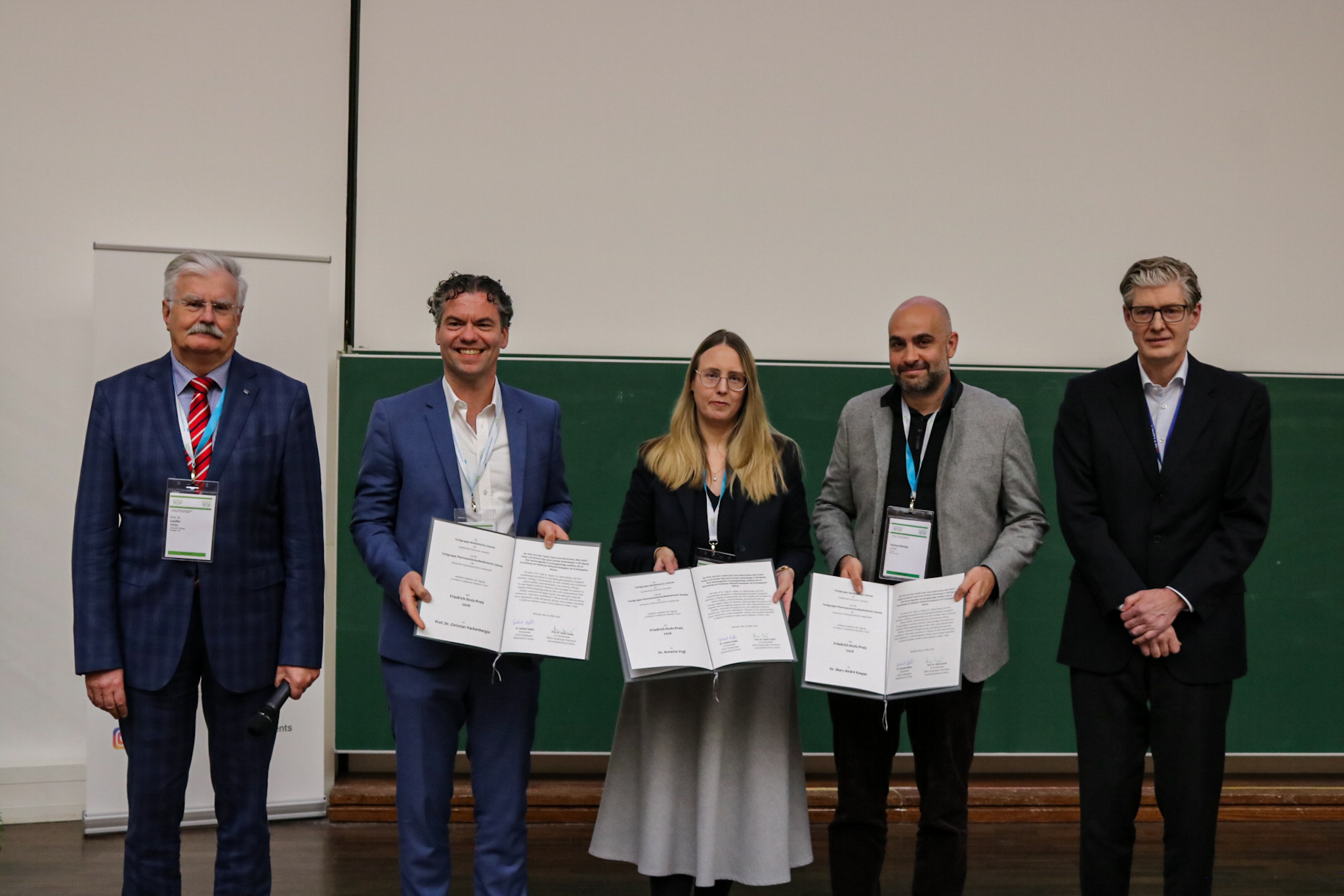
The Medicinal Chemistry Division of the Gesellschaft Deutscher Chemiker (GDCh) and the Pharmaceutical/Medicinal Chemistry Division of the Deutsche Pharmazeutische Gesellschaft (DPhG) have awarded the Friedrich Stolz Award 2026 to the team from Tubulis, a spin-off of the Leibniz-Forschungsinstitut für Molekulare Pharmakologie and LMU Munich. Honored are Prof. Dr. Christian Hackenberger from the Leibniz-FMP as co-founder and advisor and Dr. Jonas Helma-Smets, co-founder and CSO, Dr. Marc-André Kasper, VP Chemistry and Early Discovery and Dr. Annette Vogl, VP Biology and Translational Research, from Tubulis.
The Friedrich Stolz Award recognizes exceptional dedication, scientific discoveries, or innovative technologies with proven relevance that contribute to substantial therapeutic innovation or sustainable development and go beyond early research stages.
The Tubulis team was awarded for their P5 ethynylphosphonamidate conjugation chemistry, enabling a novel type of antibody-drug conjugates (ADCs).The conjugation chemistry, also termed P5-labeling, was developed at FMP in the research unit of Christian Hackenberger. This new ADC class is characterized by exceptional plasma stability, favorable pharmacokinetic properties, and pronounced anti-tumor efficacy. Building on this, NaPi2b-targeting exatecan ADCs with particularly stable linkers, reduced off-target toxicity, and optimized molecular architecture were generated. The culmination of this work is the development candidate TUB-040, which in a clinical Phase 1 study in patients with platinum-resistant ovarian cancer demonstrates promising tumor remissions, a wide therapeutic window, and good tolerability. This work shows how innovative chemistry can be directly translated into novel, potentially more effective treatment options for hard-to-treat cancers.
The prize is awarded in memory of industrial pharmacist and drug researcher Friedrich Stolz, whose visionary innovative power serves as a model for application-oriented, therapeutically relevant research.
Photo: Awarded the Friedrich Stolz Prize: Prof. Dr. Stefan Laufer (GDCh), Prof. Dr. Christian Hackenberger, Dr. Annette Vogl, Dr. Jonas Helma-Smets and Dr. Franz von Nussbaum (from left to right). © GDCh
Source: FMP
Friedrich Stolz Award for the Tubulis Team
Innovation / 26.03.2026
Eckert & Ziegler: Strong FY 2025 with Positive Outlook
Eckert & Ziegler SE (ISIN DE0005659700, TecDAX) set a new record in fiscal year 2025 with sales of €312.0 million. Compared to the previous year, sales rose by approximately €16 million (+5%). EBIT before special items from continuing operations (adjusted EBIT) increased by just under €12 million year-over-year to €77.7 million (+18%). Net income rose by approximately €15 million (+46%) to €48.8 million; this corresponds to earnings per share of €0.78 (previous year: €0.53, adjusted for stock split).
In the Medical segment, sales increased by €22.6 million, or 15%, to €171.3 million. The business with pharmaceutical radioisotopes remains the most important source of revenue.
The Isotope Products segment generated sales of €150.1 million, a decrease of €7.9 million (-5%) compared with the previous year. This was mainly due to a temporary shift toward lower-margin products compared with the same period last year. In addition, the cyberattack in 2025 led to project-related delays.
For the 2026 fiscal year, the Executive Board expects an adjusted EBIT of approximately €80 million. The corresponding sales forecast amounts to approximately €320 million. This forecast is based on a weighted average exchange rate of $1.20 per euro. Adjusted for currency effects and the licensing business, this corresponds to a growth of 9% in sales and 21% in earnings (adjusted EBIT).
The Executive Board and Supervisory Board will propose to the Annual General Meeting a dividend of €0.22 (previous year: €0.17, adjusted for stock split) per share entitled to dividends.
The 2025 financial statements can be found here: https://www.ezag.com/fy2025en/
Overview
FY 2025:
- Sales: €312.0 million (previous year: €295.8 million)
- adjusted EBIT: €77.7 million (previous year: €65.9 million)
- Net income: €48.8 million (previous year: €33.3 million)
Forecast 2026:
- Sales of approx. €320 million
- adjusted EBIT of approx. €80 million
About Eckert & Ziegler.
Eckert & Ziegler SE with more than 1.000 employees is a leading specialist for isotope-related components in nuclear medicine and radiation therapy. The company offers a broad range of services and products for the radiopharmaceutical industry, from early development work to contract manufacturing and distribution. Eckert & Ziegler shares (ISIN DE0005659700) are listed in the TecDAX index of Deutsche Börse.
Contributing to saving lives.
Research, Innovation, Patient care / 23.03.2026
Launch of the Einstein Center for Early Disease Interception
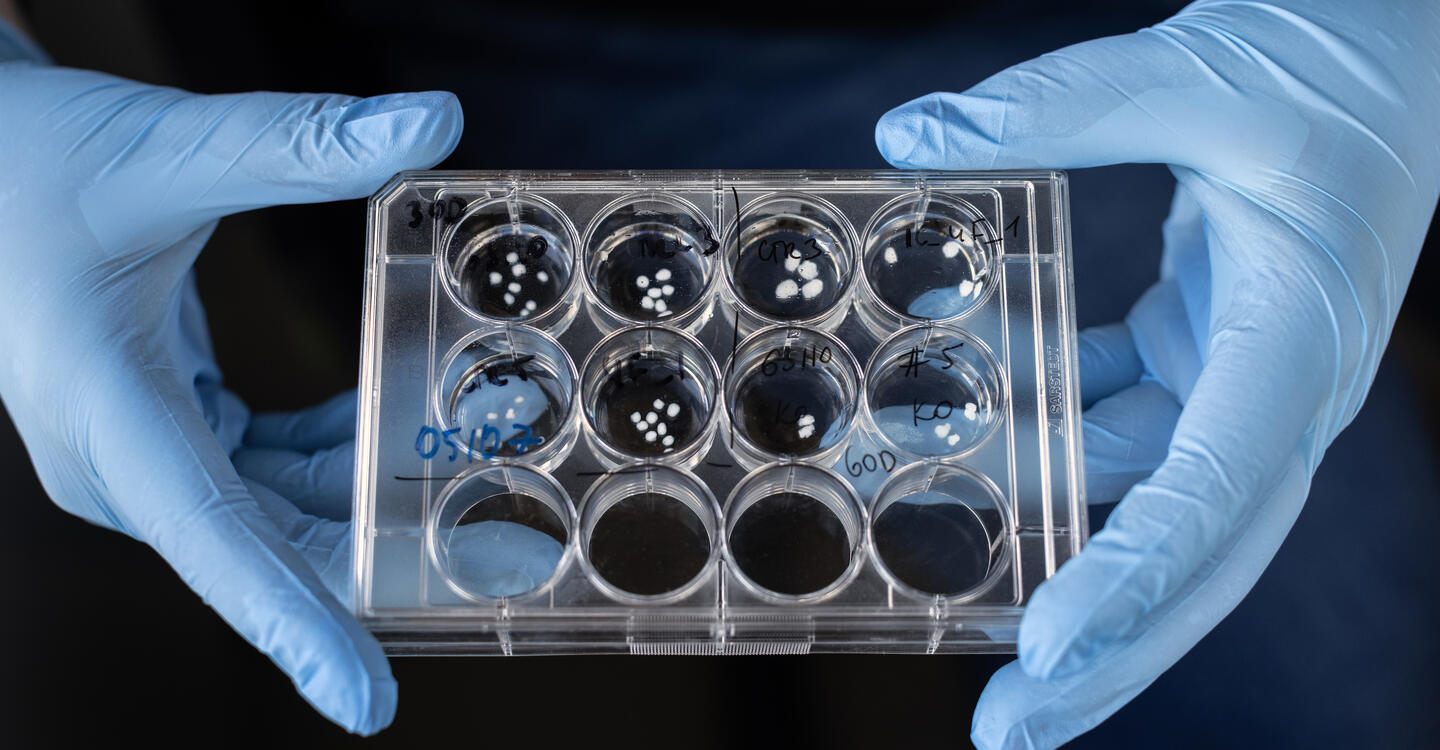
At the Einstein Center for Early Disease Interception, researchers from twelve Berlin institutions will be pooling their expertise to explore new approaches to prevention, long before symptoms appear, and bring them quickly into practice. The center opens today with a ceremony
Joint press release by the Max Delbrück Center, Charité – Universitätsmedizin Berlin, Berlin Institute of Health at Charité, and Technische Universität Berlin
Serious diseases often develop unnoticed over many years. By the time symptoms appear, organ damage is often too extensive to be reversed completely. In many cases, there are no effective treatments to stop diseases from progressing.
Researchers from twelve leading Berlin institutions are heading the charge to change the way we think about prevention. Using the latest technologies – including advances made by researchers from Berlin – they aim to unravel what happens inside cells at the very earliest stages of disease. Such knowledge will enable them to develop early interventions, when only individual cells are affected and diseases are still controllable.
The Einstein Center for Early Disease Interception (EC-EDI) is bringing together the necessary expertise to study such early disease mechanisms. The center is being officially inaugurated today at the Max Delbrück Center’s Berlin Institute for Medical Systems Biology in Mitte after a two-year preparatory phase. Invited guests include politicians, scientists and the public. The Einstein Foundation Berlin is funding the center with €6 million and is supporting the recruitment of young international talent with additional funds from the state of Berlin.
A dynamic network for key technologies
Over the next six years, researchers will further develop, integrate, and apply key technologies to the effort. These include single-cell multiomic and spatial biology technologies, patient-specific organoids, 3D bioprinting, and AI-based modeling of mechanisms and disease trajectories. A platform for cross-institutional collaboration will also be established to help translate research findings into clinical practice more quickly in partnership with industry and investors – while generating societal and economic value for the state of Berlin. Initial focus areas include respiratory and neurological diseases, such as inflammatory lung diseases, tuberculosis, Alzheimer’s disease, and multiple sclerosis.
Participants in EC-EDI include Charité – Universitätsmedizin Berlin, the Berlin Institute of Health at Charité, the Max Delbrück Center, Technische Universität Berlin, Freie Universität Berlin, Humboldt-Universität zu Berlin, and additional non-university institutions such as the Museum für Naturkunde and several Max Planck Institutes.
Statements from Einstein Center spokespersons
Professor Nikolaus Rajewsky (Head Spokesperson; Director of the Berlin Institute for Medical Systems Biology at the Max Delbrück Center and Professor at Charité):
“We are advancing molecular prevention and intervention – and aim to bring our research to patients as quickly as possible. Major breakthroughs do not arise solely in the clinic, in labs, or on a computer. The Einstein Center creates a shared, open platform with clear rules and short pathways. Clinicians, basic researchers, and data scientists will collaborate across institutions, as well as with companies and investors. This will enable us to work faster and will hopefully help further establish Berlin as a leading international hub in this field.”
Professor Leif Erik Sander (Project Head; Director of the Department of Infectious Diseases and Critical Care Medicine at Charité and Research Group Leader at BIH):
“Conventional methods often fail to detect the early signs of emerging diseases. Moreover, we don’t always understand what is actually going wrong at the molecular level or how we could intervene to stop these diseases. This is where early disease interception comes in: Using high-resolution technologies, we aim to understand what sets things on the wrong track and create opportunities to correct that course very early on. The train, so to speak, needs to be put back on the track to health. We want to use our findings to develop innovative solutions, such as new diagnostic tests and medications. This is how research leads to medical progress and value creation – and that strengthens Berlin as a hub for innovation and business.”
Dr. Janine Altmüller (Head of the Core Unit Genomics at the Berlin Institute of Health at Charité, BIH):
“New methods are key to the Einstein Center’s vision: Never before has it been possible to examine characteristic features such as nucleic acids or proteins of individual cells in their natural tissue context with such precision and high resolution. Even the smallest changes that mark the onset of a disease can now be digitalized and, with the help of AI for example, better deciphered and understood. This knowledge is crucial for developing targeted interventions. At the Einstein Center, experts from various disciplines will be working together toward this goal, thereby accelerating the translation of scientific findings into clinical applications.”
Professor Jens Kurreck (Executive Director of the Institute of Biotechnology, Technische Universität Berlin):
“The Einstein Center for Early Disease Interception provides a unique platform for close collaboration among leading Berlin-based research institutions and enables a better understanding of the early mechanisms of disease development using various human models. It is particularly important to offer young scientists access to state-of-the-art technologies within this consortium and to create optimal conditions for them to build their scientific careers.”
Further information
Research, Innovation, Patient care / 19.03.2026
Strengthen international cooperation in clinical trials
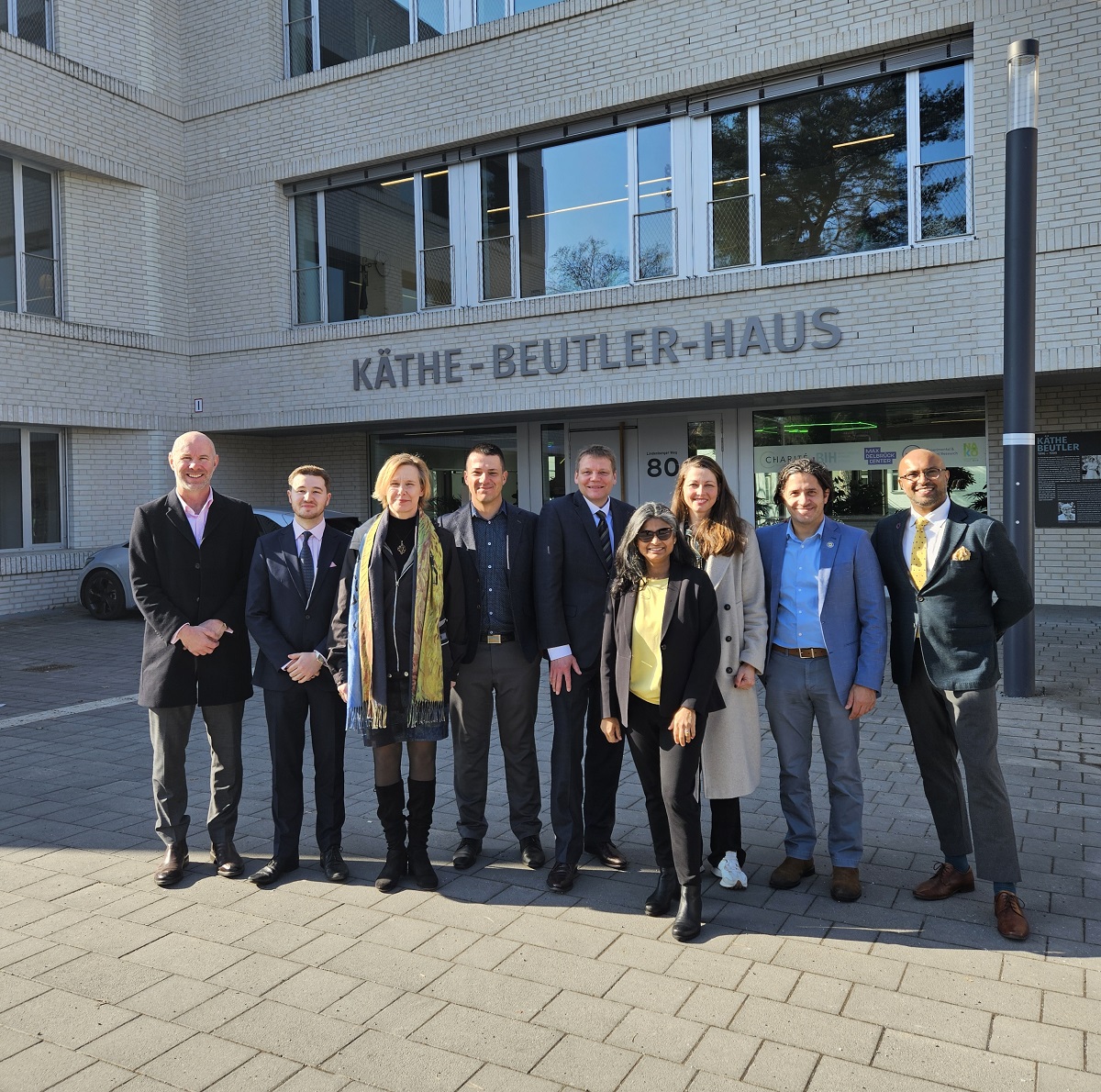
As part of the Australian Clinical Trials Initiative, ACTI, Australian companies and representatives of the Australien Government’s Trade and Invest Commission, Austrade, visited the Berlin-Buch Science and Biotech Campus today. The initiative promotes Australia as an attractive location for clinical trials.
Dr. Christina Quensel, CEO der Campus Berlin-Buch GmbH, welcomed the guests and, during a tour, provided information about the campus’s ecosystem of basic biomedical and clinical research, life science startups, and biotechnology companies. Biotech and medtech companies operate here in one of Europe's leading biotech parks.
The delegation gained insight into two scientific core facilities the Proteomic Lab of the Berlin Institute of Health in the Charité und the Cryo Electron Microscopy, a collaborative scientific infrastructure involving Charité – Universitätsmedizin Berlin, the Max Delbrück Center, and the Leibniz Research Institute for Molecular Pharmacology.
At the BerlinBioCube startup center, the guests visited the startups CheckImmune GmbH, a CRO, and T-knife GmbH, a pharmaceutical company that develops highly innovative cancer therapies.
During a networking lunch, the delegation engaged in intensive discussions with executives and stakeholders of the BiotechPark Berlin-Buch.
Many thanks to our guests for the exciting exchange!
Minesh Lalla, Senior Business Development Manager at Peter MacCallum Cancer Centre (CTS)
Jason Erasmus, Business Development Manager at Beyond Drug Development (CRO)
Tim Vale, Business Development Manager at Resolian Bioanalytics (Lab)
Karl Boehle, Senior Business Development Manager, Austrade
Pallavi Mishra, South Australia Trade & Investment Manager, Austrade
George Zafiris MBA, Prime Financial Group (R&D Tax Advisors)
Bellberry (Ethics)
The delegation then proceeded to Berlin Partner for Technology and Business, which, in cooperation with Austrade, had hosted an exclusive seminar on opportunities for German-Australian collaboration in clinical trials. The event highlighted how the Australian clinical trial ecosystem is structured and the key strengths and efficiency advantages it offers. Executives were invited The event was aimed at pharmaceutical and biotech R&D leaders, clinical operations and trial strategy decision-makers, CROs and clinical service providers, as well as leaders from academic, hospital, and research institutions, and stakeholders in policy, innovation, and the ecosystem.
Research / 17.03.2026
Fat tissue fuels gut inflammation
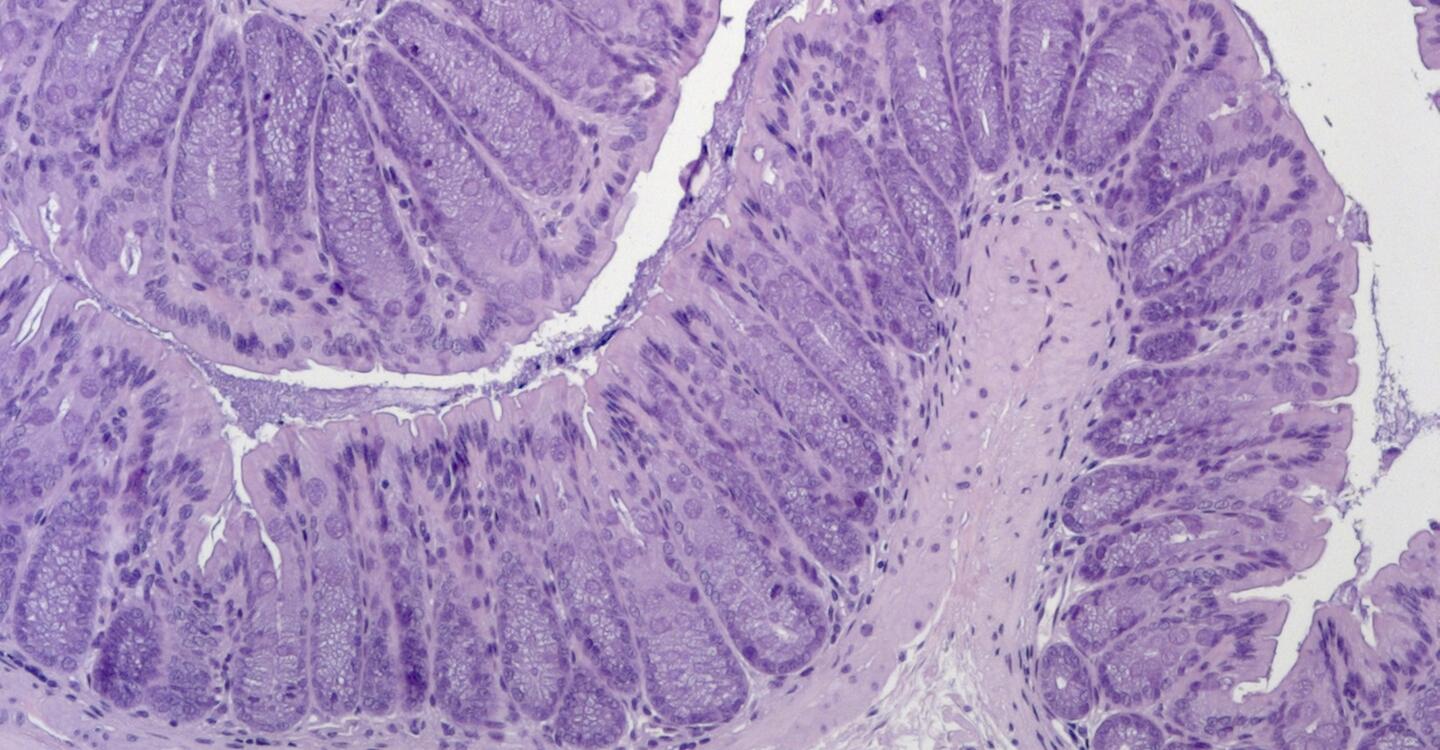
Researchers at the Max Delbrück Center and Charité – Universitätsmedizin Berlin show that adipose tissue amplifies gut inflammation in Crohn’s disease. The study, published in the “Journal of Clinical Investigation,” also reveals how genetic changes in immune cells may contribute to the disease.
Crohn’s disease is a chronic inflammatory disorder of the intestinal tract affecting millions of people worldwide. One prominent feature of the disease is “creeping fat” — adipose tissue that wraps around inflamed sections of the intestine. Scientists have long suspected that this fat tissue may influence disease progression, but the underlying mechanisms have remained unclear
Now, researchers from Charité – Universitätsmedizin Berlin, the Berlin Institute for Medical Systems Biology at the Max Delbrück Center (MDC-BIMSB) and their collaborators show that fat tissue releases signals that ultimately damage the intestinal barrier in Crohn’s disease. They also show that acquired genetic mutations in immune cells may fuel the disease.
“There is a longstanding link between obesity and Crohn’s disease,” says Dr. Ashley Sanders, Group Leader of the Genome Instability and Somatic Mosaicism Lab at the Max Delbrück Center and a senior author of the paper. “While it’s fairly well established that adipose tissue secretes molecular signals that promote inflammation, here we detail the link between fat-derived signals and intestinal inflammation.”
Mice with no fat tissue
The researchers first conducted experiments in a mouse model of generalized lipodystrophy – an extremely rare disease in which affected people lack fat tissue among other symptoms.
When they exposed the mice to a chemical substance known to cause intestinal inflammation, they found the lipodystrophy mice were more resistant than normal mice. Their intestinal barrier remained stable and they had low levels of pro-inflammatory immune cells, particularly Th1 and Th17 T cells – specialized subsets ofimmune cells that coordinate immune responses.
When the team transplanted adipose tissue back into the lipodystrophy mice, they became more susceptible to the chemically induced gut inflammation. Remarkably, they observed this effect only when the transplanted fat was capable of producing leptin, suggesting that leptin plays a central role in regulating the immune system in mice.
“These findings were expected because previous research had already established that fat tissue is an active immune organ,” says Dr. Britta Siegmund, a senior author of the paper at Charité — Universitätsmedizin Berlin. “But they nevertheless highlight that signals derived from adipose tissue can substantially amplify intestinal inflammatory responses.”
Puzzling clinical findings
However, the results appeared to conflict with findings from a clinical case at Charité: A patient with acquired generalized lipodystrophy who had developed Crohn’s disease, despite having no fat tissue at all. “This was curious and we wanted to understand why this patient had developed the disease,” Siegmund adds.
Using single-cell sequencing, the Sanders lab examined immune cells extracted from the patient’s blood and intestinal tissue. The analyses showed an unusually large group of cells that carried a mutation in a gene called NRAS, which helps regulate cell growth and survival. This suggested that these cells had multiplied from a single original cell in a process called clonal expansion – such mutated cells arise spontaneously and are not inherited. Cells with mutated NRAS survive longer and divide more than they should, potentially driving chronic inflammation.
“This mutation likely helped the inflammatory T cells survive and expand over time,” explains Sanders. “That persistent expansion may have fueled the systemic and intestinal inflammation that was observed. What’s more, our results show how powerful single-cell genomic technologies can be for uncovering hidden genetic changes in individual immune cells,” she adds.
Toward more personalized treatment
Among other pro-inflammatory signals, adipose tissue also secretes mediators called adipokines — including leptin, which is best known for regulating appetite and metabolism. In the study, the lipodystrophy patient was given a synthetic form of leptin to treat type-2 diabetes. While the hormone improved the patient’s metabolic health, it also increased pro-inflammatory signaling and raised levels of Th17 immune cells.
“The finding highlights how adipokines such as leptin and genetic changes in immune cells interact to influence chronic inflammatory diseases,” says Dr. Carl Weidinger, another senior author of the study at Charité. This dual role of metabolic and genetic factors could help explain why Crohn’s disease behaves differently in different people, he adds. “Understanding these interactions may help us develop more precise, personalized approaches to treatment.”
Text: Gunjan Sinha
Further information
Genome instability and somatic mosaicism
Literature
Marilena Letizia, Toka Omar, Patrick Weidner et al. (2026): “Characterization of intestinal immune responses in generalized human and murine lipodystrophy.” Journal of Clinical Investigation, DOI: 10.1172/JCI192322.
Image
Colon tissue from a mouse model of acquired generalized lipodystrophy. Colon tissue remains intact after exposure to a chemical that causes gut inflammation. © Anja Kühl, Charité
Living / 16.03.2026
Bebauungsplan 3-89 für das Neue Stadtquartier Elisabeth-Aue in Pankow - Bürgerinnen und Bürger sind aufgerufen ihre Stellungnahme abzugeben
Vom 16.März bis einschließlich 20. April 2026 findet die öffentliche Auslegung zum Entwurf des Bebauungsplans 3-89 (Elisabeth-Aue, Teilprojekt 1) im Bezirk Pankow, Ortsteil Blankenfelde, statt. Die Beteiligung der Öffentlichkeit ist der letzte formelle Schritt vor den abschließenden Abstimmungen in den parlamentarischen Gremien und dem Festsetzungsbeschluss.
Das Neue Stadtquartier Elisabeth-Aue gehört zu den großen Wohnungsbauvorhaben Berlins. Es ist eines der insgesamt 24 Neuen Stadtquartiere, in denen stadtweit bezahlbarer Wohnraum und soziale Infrastruktur wie Kitas und Schulen geschaffen wird. Das Projekt wird nach Fertigstellung von den landeseigenen Wohnungsbaugesellschaften HOWOGE und Gesobau mitpreisgebunden vermietet. Etwa 870 Wohnungen, eine Oberschule mit entsprechenden Sport,- Frei- und sonstigen Flächen, öffentliche Grünflächen sowie öffentliche Straßenverkehrsflächen werden auf der Teilfläche 1 (B-Plan 3-89) entstehen und sorgen so für ein attraktives neues Zuhause in Berlin.
Vom 16.03.2026 bis einschließlich 20.04.2026 kann der Entwurf des Bebauungsplans 3-89 im Internet eingesehen werden, um sich über Ziele, Zwecke und Auswirkungen der Planung zu informieren und eine Stellungnahme abzugeben.
Zusätzlich zur Veröffentlichung im Internet werden die nach § 3 Abs. 2 Satz 1 BauGB zu veröffentlichenden Unterlagen in Form einer öffentlichen Auslegung in dem genannten Zeitraum von Montag bis Donnerstag 09:00 bis 17:00 Uhr, Freitag 09:00 bis 16:00 Uhr sowie nach telefonischer Vereinbarung unter 90173-3856/-4233 oder nach Terminvereinbarung per E-Mail (3-89@senstadt.berlin.de) in der Senatsverwaltung für Stadtentwicklung, Bauen und Wohnen, Württembergische Straße 6, 10707 Berlin, Raum 006 zur Verfügung gestellt.
Ebenfalls einsehbar sind die Unterlagen in dem genannten Zeitraum von Montag bis Freitag 09:00 bis 18:00 Uhr im Bezirksamt Pankow in der Storkower Str. 97, 10407 Berlin, im Erdgeschoss im Foyer zur rechten Seite.
Die während der Auslegungsfrist abgegebenen Stellungnahmen werden mit den anderen öffentlichen und privaten Belangen abgewogen.
Information und Beteiligung ist über folgenden Link möglich: https://be.beteiligung.diplanung.de/plan/3-89 & https://www.berlin.de/sen/stadtentwicklung/neue-stadtquartiere/elisabeth-aue/
Research, Patient care / 13.03.2026
How cancer immunotherapies affect the heart
Checkpoint inhibitors help fight cancer but increase the risk of heart disease. An interdisciplinary team, including researchers from the Max Delbrück Center, is investigating how the therapy can be made safer. The Hector Foundation is supporting the project with €1.3 million.
Checkpoint inhibitors have become standard cancer therapy in recent years. These antibody drugs stimulate the immune system to attack malignant cells more aggressively. They were first widely used to treat patients with melanoma, but are now also indicated for patients with lung, kidney, or bladder cancer because the immunotherapy treatment is more effective than other options.
However, the drugs are not good for the heart. “We estimate that cancer patients receiving immunotherapy with checkpoint inhibitors have about a threefold increased risk of heart disease such as coronary artery disease,” says cardio-oncologist Dr. Lorenz Lehmann from Heidelberg University Hospital. Together with an interdisciplinary team of researchers, Lehmann is studying the biological mechanisms that cause these side effects in an effort to reduce the therapy’s impact on the heart.
The consortium, called ATHERIC-CARE (Atherosclerosis Risk in Cancer Patients after Immune Checkpoint-Inhibitor Therapy – Assessment and Exploration), includes Dr. Isabel Poschke from the German Cancer Research Center in Heidelberg, Dr. Henrike Maatz from the Max Delbrück Center in Berlin-Buch, Professor Sylvia Saalfeld from Kiel University, and Professor Oliver Müller from the University Hospital Schleswig-Holstein in Kiel. Beginning February 1, 2026, the Hector Foundation will fund the multicenter team’s research with €1.3 million over three years.
Inflamed coronary arteries
Coronary artery disease is a form of atherosclerosis affecting the coronary arteries. Lipids and other substances from the bloodstream accumulate on the inner walls of the vessels and trigger chronic inflammation. Over time, the blood vessels become increasingly narrowed, which can lead to heart failure or a heart attack. ATHERIC-CARE is primarily investigating how checkpoint inhibitors activate or accelerate this inflammatory mechanism.
The scientists are using DNA analyses to investigate which immune cells drive atherosclerosis, for example. In animals, they are studying early inflammatory mechanisms and analyzing computed tomography images of affected individuals with assistance from machine learning tools. Such analyses can not only detect metastases, but also reveal changes in the coronary arteries.
“Our task will be to determine which genes become active in the cells of the coronary arteries and in the surrounding tissue – in other words, what exactly is happening at the molecular level in the different cell types,” says Dr. Henrike Maatz, a scientist in the Genetics and Genomics of Cardiovascular Diseases lab headed by Professor Norbert Hübner at the Max Delbrück Center. To find out, she will primarily be using two methods: single-nucleus RNA sequencing (snRNA-seq) and spatial transcriptomics.
Research for better quality of life
“For example, we want to characterize more precisely the interaction between immune cells and endothelial cells, which line the inside of blood vessels,” explains Maatz. “Our goal is to understand how immunotherapy promotes T cell-mediated inflammation in blood vessels, which can lead to unstable vascular deposits and atherosclerosis.” Using spatial transcriptomics, she also aims to determine how immune cells are distributed within plaques. The Hector Foundation is supporting the research with about €286,000.
“By bringing together the results generated in the consortium’s different research areas, we aim to identify biomarkers and strategies that make immunotherapy safer – and thereby improve patients’ quality of life,” says project leader Lehmann.
Maatz is looking forward to the upcoming collaboration: “Together, we will of course achieve much more than a single research group could,” she says. “And we have already worked very successfully with Lorenz Lehmann on other projects.”
Further information
Patient care / 12.03.2026
Darmkrebsmonat März: Risikofaktor rotes Fleisch? Was Sie über Darmkrebs wissen sollten
Darmkrebs gehört zu den häufigsten Krebserkrankungen in Deutschland. Im Helios Klinikum Berlin-Buch werden jedes Jahr über 100 Patient:innen mit Darmkrebs operiert und behandelt. Anlässlich des Darmkrebsmonats März informiert Prof. Dr. med. Roger Wahba, Chefarzt der Allgemein-, Viszeral- und Onkologischen Chirurgie am Helios Klinikum Berlin-Buch, über die Bewertung von rotem und verarbeitetem Fleisch als Risikofaktor und ordnet die Erkenntnisse im Kontext der Darmkrebsprävention ein.
Bereits 2015 hat die Internationale Agentur für Krebsforschung (IARC), eine Einrichtung der Weltgesundheitsorganisation (WHO), rotes Fleisch als wahrscheinlich krebserregend (Gruppe 2A) und Fleischwaren als krebserregend (Gruppe 1) eingestuft. Unter rotem Fleisch versteht man das Muskelfleisch von Säugetieren wie Rind, Schwein oder Lamm. Als Fleischwaren gelten hingegen alle Produkte, in welchen Fleisch durch Pökeln, Räuchern, Salzen oder andere Verfahren verarbeitet und haltbar gemacht wurden, wie etwa Wurst, Schinken oder getrocknetes Fleisch.
Darmkrebs ist eine der häufigsten Krebsarten in Deutschland. Epidemiologische Auswertungen deuten darauf hin, dass der regelmäßige Konsum von verarbeitetem Fleisch mit einem erhöhten Darmkrebsrisiko verbunden ist: Der tägliche Verzehr von 50 Gramm verarbeitetem Fleisch erhöht das Risiko für Darmkrebs um 18 Prozent. Für rotes Fleisch wurde bei einer täglichen Aufnahme von 100 Gramm ein Anstieg des Darmkrebsrisikos um 17 Prozent festgestellt (Lancet Oncology 2015; doi: 10.1016/S1470-2045(15)00444-1). Das bestätigt auch Prof. Dr. med. Roger Wahba, Chefarzt der Allgemein-, Viszeral- und Onkologischen Chirurgie am Helios Klinikum Berlin-Buch: „Es zeigt sich, dass der Verzehr von rotem und vor allem verarbeitetem Fleisch mit einer erhöhten Inzidenz von Darmkrebs in Zusammenhang steht. Das ist insbesondere auf die sekundären krebserzeugenden Stoffe zurückzuführen“. Diese entstehen hauptsächlich bei der Zubereitung unter hohen Temperaturen, wie beim Braten oder Grillen von Fleisch und Fleischwaren, aber auch bei der industriellen Verarbeitung.
Wichtig ist: Bei dieser Einschätzung handelt es sich um eine Risikobewertung auf Bevölkerungsebene. Ein eindeutiger Ursache-Wirkungs-Nachweis für den Einzelfall lässt sich daraus nicht ableiten. Gleichwohl zeigt sich, dass in Gesellschaften mit traditionell hohem Fleischkonsum die Darmkrebsinzidenz höher ist als in Regionen mit überwiegend pflanzenbasierter Ernährung. Auch Ernährungsempfehlungen wie die Ernährungspyramide tragen dieser Einschätzung zunehmend Rechnung. Orientierung bietet eine pflanzenbetonte Kost: Ein großer Anteil der täglichen Ernährung sollte aus Gemüse, Obst, Vollkornprodukten und Hülsenfrüchten bestehen.
Im Helios Klinikum Berlin-Buch behandelt das Team der Allgemein-, Viszeral- und Onkologischen Chirurgie hoch spezialisiert Patient:innen mit Darmkrebserkrankungen. Ein Schwerpunkt liegt dabei auch auf der Behandlung des Darmkrebses gerade auch ohne Operation. Für Darmkrebspatient:innen empfiehlt das Team eine ballaststoffreiche, pflanzenbasierte Ernährung; vor, während und nach einer Darmkrebsoperation. „Beobachtungsstudien deuten darauf hin, dass ein gesunder Lebensstil und eine Umstellung der Ernährung hin zu mehr pflanzlichen Lebensmitteln mit einer günstigeren Prognose assoziiert sein kann“, so Prof. Dr. med. Roger Wahba.
Neben der Ernährung ist auch das Alter ein wesentlicher Risikofaktor: Mit zunehmendem Alter steigt die Darmkrebsinzidenz an, besonders zwischen 70 bis 80 Jahren. Langjährige Ernährungs- und Lebensstilgewohnheiten könnten hierzu beitragen. Ob und in welchem Ausmaß der Wandel hin zur stärker pflanzenbasierten Ernährung künftig die Zahl der Neuerkrankungen an Darmkrebs beeinflusst, wird sich erst mit zeitlichem Abstand zeigen.
Gleichzeitig ist Darmkrebsprävention auch für junge Menschen relevant. „Diese können gerade im Sinne der Primärprävention mit der Anpassung ihrer Ernährung, regelmäßiger Bewegung und dem Wahrnehmen von Vorsorgeuntersuchungen ihr persönliches Risiko aktiv beeinflussen“, betont Prof. Dr. med. Wahba. Um dieser Entwicklung Rechnung zu tragen, baut das Helios Klinikum Berlin-Buch künftig sein Angebot für jüngere Menschen aus und plant spezielle Informations- und Vorsorgeformate.
Zusätzlich kann die Reduktion des Konsums von rotem und verarbeitetem Fleisch nicht nur gesundheitliche Vorteile bieten, sondern auch zur Verringerung der Treibhausgasemissionen beitragen. Auch diese Dimension sollte im Sinne der Nachhaltigkeit nicht vernachlässigt werden und behält ihre Relevanz über den Darmkrebsmonat März hinaus.
Das Helios Klinikum Berlin-Buch ist ein modernes Krankenhaus der Maximalversorgung mit über 1.000 Betten in mehr als 60 Kliniken, Instituten und spezialisierten Zentren sowie einem Notfallzentrum mit Hubschrauberlandeplatz. Jährlich werden hier mehr als 55.000 stationäre und über 144.000 ambulante Patienten mit hohem medizinischem und pflegerischem Standard in Diagnostik und Therapie fachübergreifend behandelt, insbesondere in interdisziplinären Zentren wie z.B. im Brustzentrum, Darmzentrum, Hauttumorzentrum, Perinatalzentrum, der Stroke Unit und in der Chest Pain Unit. Die Klinik ist von der Deutschen Diabetes Gesellschaft als „Klinik für Diabetiker geeignet DDG“ zertifiziert. Zudem ist die Gefäßmedizin in Berlin-Buch dreifach durch die Fachgesellschaften der DGG (Deutsche Gesellschaft für Gefäßchirurgie und Gefäßmedizin), der DGA (deutsche Gesellschaft für Angiologie) und der DEGIR (deutsche Gesellschaft für interventionelle Radiologie) als Gefäßzentrum zertifiziert.
Gelegen mitten in Berlin-Brandenburg, im grünen Nordosten Berlins in Pankow und in unmittelbarer Nähe zum Barnim, ist das Klinikum mit der S-Bahn (S 2) und Buslinie 893 oder per Auto (ca. 20 km vom Brandenburger Tor entfernt) direkt zu erreichen.
Fresenius Helios ist der führende private Gesundheitsdienstleister in Europa und versorgt mit rund 140 Kliniken und zahlreichen ambulanten Einrichtungen jährlich rund 27 Millionen Menschen. Zusammen mit Fresenius Kabi, Anbieter von Gesundheitsprodukten für kritisch und chronisch Kranke, gehört Fresenius Helios zum Gesundheitskonzern Fresenius. Mit seinen rund 130.000 Mitarbeitenden der Helios Gruppe in Deutschland sowie Quirónsalud in Spanien und Lateinamerika erzielte Fresenius Helios 2025 einen Gesamtumsatz von mehr als 13,5 Milliarden Euro.
In Deutschland betreibt Helios mehr als 80 Kliniken, rund 200 Medizinische Versorgungszentren (MVZ), sechs Präventionszentren und 30 arbeitsmedizinische Zentren. Helios behandelt im Jahr 2025 rund 5,6 Millionen Menschen in Deutschland, davon mehr als 4 Millionen ambulant. Seit seiner Gründung setzt Helios auf messbare, hohe medizinische Qualität und Datentransparenz und ist bei über 90 Prozent der Qualitätsziele besser als der bundesweite Durchschnitt. In Deutschland beschäftigt Helios rund 80.000 Mitarbeitende und erwirtschaftete im Jahr 2025 einen Umsatz von rund 8,1 Milliarden Euro. Helios steht mit 35 eigenen Bildungszentren für Aus-, Fort- und Weiterbildung im Gesundheitswesen. Sitz der Unternehmenszentrale ist Berlin.
Quirónsalud verfügt über 57 Kliniken, davon sieben in Lateinamerika, rund 130 ambulante Gesundheitszentren sowie über 300 Einrichtungen für betriebliches Gesundheitsmanagement. Jährlich werden hier rund 22 Millionen Patient:innen behandelt, davon mehr als 20 Millionen ambulant. Quirónsalud beschäftigt rund 50.000 Mitarbeitende und erwirtschaftete 2025 einen Umsatz von mehr als 5,4 Milliarden Euro.
Living / 11.03.2026
Jetzt FEIN-Mittel für ehrenamtliche Arbeit beantragen - 78.900 Euro stehen zur Verfügung
Ehrenamtliche Initiativen und Projekte, die bei der Verbesserung der öffentlichen Infrastruktur des Bezirks Pankow helfen wollen, können ab sofort finanzielle Unterstützung beim Bezirksamt beantragen. Dem Bezirk stehen hierfür 78.900 Euro aus Mitteln der Senatsverwaltung für Stadtentwicklung, Bauen und Wohnen im Rahmen des Projekts Freiwilliges Engagement in Nachbarschaften (FEIN) zur Verfügung. Die Verteilung dieser Mittel für die einzelnen Bereiche der öffentlichen Infrastruktur (Grünflächen, Jugendclubs, Schulen etc.) hat das Bezirksamt jetzt beschlossen.
Anträge können bis 10. April 2026 eingereicht werden
Gefördert werden die Aufwertung und Verbesserung von Schulen, Sportflächen, Kitas, Jugendclubs, öffentlichen Spielplätzen, Senioren- und Stadtteilzentren, Nachbarschaftstreffs, Selbsthilfekontaktstellen, öffentlichen Straßen und Plätzen sowie Grünflächen. Formlose Anträge können per Post bis einschließlich Freitag, den 10. April 2026 bei den Abteilungen oder im Büro der Bezirksbürgermeisterin im Rathaus Pankow, Breite Straße 24A-26, 13187 Berlin, oder per E-Mail: bzbmstab@ba-pankow.berlin.deeingereicht werden.
Was wird gefördert?
Gefördert werden vorrangig Renovierungen, Reparaturen, Pflanzungen und ähnliche Arbeiten, für die notwendige Sachmittel benötigt werden. Die Mittel müssen unter Angabe von Zweck, Art, Umfang, Zeitrahmen und Kosten beantragt werden. Zur zügigen Bearbeitung sind unbedingt die IBAN und BIC der Mittelempfänger sowie die Telefonnummer, unter der diese tagsüber zu erreichen sind, mitzuteilen.
Weitere Informationen zum Projekt Freiwilliges Engagement in Nachbarschaften (FEIN):
https://www.berlin.de/ba-pankow/ueber-den-bezirk/ehrenamtliches-engagement/artikel.708426.php
Patient care / 10.03.2026
Qualität entscheidet: Helios Kliniken im Cluster Berlin-Brandenburg liefern medizinische Spitzenergebnisse
Helios kann mit seiner medizinischen Qualität überzeugen. Die nun für 2025 veröffentlichten Qualitätszahlen zeigen: Patient:innen erhalten bei Helios eine Versorgung auf höchstem Niveau.
Welches Krankenhaus bietet die beste Behandlung für mich oder meine Angehörigen? Entscheidend für die Antwort sind verlässliche und transparente Informationen über die Qualität medizinischer Leistungen. Ergebnisqualität ist für Helios seit über 25 Jahren gelebter Standard und folgt dem Dreiklang: flächendeckend und konsequent messen, veröffentlichen, verbessern. Der Anspruch: Für jedes medizinische Ziel will Helios besser sein als der Bundesdurchschnitt.
Wie sieht es aus im Helios Cluster Berlin-Brandenburg?
„Helios geht seinen Weg der Spezialisierung in Clustern und der transparenten Veröffentlichung von Qualitätsdaten konsequent weiter. Im Cluster Berlin-Brandenburg (Berlin-Buch, Emil von Behring, Bad Saarow) konnten wir 2025 alle medizinischen Ziele mit wenigen Ausnahmen erreichen. Dieses Ergebnis erstreckt sich über nahezu alle relevanten Fachbereiche und belegt die hohe Qualität der medizinischen Versorgung ebenso wie die Wirksamkeit der clusterbasierten Spezialisierungsstrategie“, sagt Cluster-Lead Carmen Bier.
Im standortübergreifenden Helios Cluster Berlin-Brandenburg wird eine medizinische Betreuung auf höchstem Niveau geboten. In allen Fachbereichen, dazu zählen beispielsweise die Kardiologie, die Onkologie und die Chirurgie, verbindet sich medizinische Expertise mit technologischer Exzellenz. Hochqualifizierte Spezialist:innen arbeiten interdisziplinär zusammen und gewährleisten so eine ganzheitliche Versorgung, die konsequent auf die Bedürfnisse der Patient:innen ausgerichtet ist.
Die Qualitätsergebnisse von Helios liegen seit Jahren bei rund 90 Prozent. 2025 erreichten sie mit knapp 92 Prozent sogar einen neuen Höchststand. Auch für die Zukunft nimmt sich Helios in Sachen Qualitätssteuerung einiges vor. Die klassische Messung blickt zurück. Künftig geht es stärker darum, klinische Daten näher am Behandlungsgeschehen zu nutzen und Risiken früher zu erkennen. Die Ergebnisqualität bleibt der Maßstab und wird daher immer weiter um digitale Unterstützung im laufenden Prozess ergänzt.
Über das Cluster Berlin-Brandenburg
Mit dem Clusteransatz verbessert Helios durch Bündelung von Kompetenz und Intensivierung des Netzwerkes die medizinische Qualität zum Wohle der Patient:innen. Zum Cluster Berlin-Brandenburg gehören das Helios Klinikum Berlin-Buch, das Helios Klinikum Emil von Behring und das Helios Klinikum Bad Saarow.
Weitere Informationen und Details im Internet unter www.helios-gesundheit.de/qualitaet
Das Helios Klinikum Berlin-Buch ist ein modernes Krankenhaus der Maximalversorgung mit über 1.000 Betten in mehr als 60 Kliniken, Instituten und spezialisierten Zentren sowie einem Notfallzentrum mit Hubschrauberlandeplatz. Jährlich werden hier mehr als 55.000 stationäre und über 144.000 ambulante Patienten mit hohem medizinischem und pflegerischem Standard in Diagnostik und Therapie fachübergreifend behandelt, insbesondere in interdisziplinären Zentren wie z.B. im Brustzentrum, Darmzentrum, Hauttumorzentrum, Perinatalzentrum, der Stroke Unit und in der Chest Pain Unit. Die Klinik ist von der Deutschen Diabetes Gesellschaft als „Klinik für Diabetiker geeignet DDG“ zertifiziert. Zudem ist die Gefäßmedizin in Berlin-Buch dreifach durch die Fachgesellschaften der DGG (Deutsche Gesellschaft für Gefäßchirurgie und Gefäßmedizin), der DGA (deutsche Gesellschaft für Angiologie) und der DEGIR (deutsche Gesellschaft für interventionelle Radiologie) als Gefäßzentrum zertifiziert.
Gelegen mitten in Berlin-Brandenburg, im grünen Nordosten Berlins in Pankow und in unmittelbarer Nähe zum Barnim, ist das Klinikum mit der S-Bahn (S 2) und Buslinie 893 oder per Auto (ca. 20 km vom Brandenburger Tor entfernt) direkt zu erreichen.
Das Helios Klinikum Emil von Behring in Berlin-Zehlendorf gehört zu den führenden medizinischen Einrichtungen der Region und bietet ein breites Spektrum an hochspezialisierter Medizin. Die Klinik für Orthopädie und Unfallchirurgie versorgt jährlich zahlreiche Patientinnen und Patienten mit modernsten Behandlungsmethoden und steht für eine qualitativ hochwertige, innovative und patientenorientierte Versorgung.
Das Helios Klinikum Bad Saarow ist ein Krankenhaus der qualifizierten Regelversorgung und gehört mit 629 Betten zu den modernsten und größten Kliniken der Region. 19 Fachabteilungen, drei Institute, eine Zentrale Notaufnahme, ein Zentrallabor und verschiedene zertifizierte Zentren ermöglichen ein umfassendes Spektrum modernster Diagnostik und innovativer Therapien. Insgesamt arbeiten am Klinikstandort und in den am Klinikum angeschlossenen medizinischen Einrichtungen etwa 1.300 Mitarbeiter:innen. Als Akademisches Lehrkrankenhaus der Medizinischen Hochschule Brandenburg Theodor Fontane nimmt das Klinikum an der Lehre und Ausbildung von Medizinstudenten teil.
Fresenius Helios ist der führende private Gesundheitsdienstleister in Europa und versorgt mit rund 140 Kliniken und zahlreichen ambulanten Einrichtungen jährlich rund 27 Millionen Menschen. Zusammen mit Fresenius Kabi, Anbieter von Gesundheitsprodukten für kritisch und chronisch Kranke, gehört Fresenius Helios zum Gesundheitskonzern Fresenius. Mit seinen rund 130.000 Mitarbeitenden der Helios Gruppe in Deutschland sowie Quirónsalud in Spanien und Lateinamerika erzielte Fresenius Helios 2025 einen Gesamtumsatz von mehr als 13,5 Milliarden Euro.
In Deutschland betreibt Helios mehr als 80 Kliniken, rund 200 Medizinische Versorgungszentren (MVZ), sechs Präventionszentren und 30 arbeitsmedizinische Zentren. Helios behandelt im Jahr 2025 rund 5,6 Millionen Menschen in Deutschland, davon mehr als 4 Millionen ambulant. Seit seiner Gründung setzt Helios auf messbare, hohe medizinische Qualität und Datentransparenz und ist bei über 90 Prozent der Qualitätsziele besser als der bundesweite Durchschnitt. In Deutschland beschäftigt Helios rund 80.000 Mitarbeitende und erwirtschaftete im Jahr 2025 einen Umsatz von rund 8,1 Milliarden Euro. Helios steht mit 35 eigenen Bildungszentren für Aus-, Fort- und Weiterbildung im Gesundheitswesen. Sitz der Unternehmenszentrale ist Berlin.
Quirónsalud verfügt über 57 Kliniken, davon sieben in Lateinamerika, rund 130 ambulante Gesundheitszentren sowie über 300 Einrichtungen für betriebliches Gesundheitsmanagement. Jährlich werden hier rund 22 Millionen Patient:innen behandelt, davon mehr als 20 Millionen ambulant. Quirónsalud beschäftigt rund 50.000 Mitarbeitende und erwirtschaftete 2025 einen Umsatz von mehr als 5,4 Milliarden Euro.
Research / 07.03.2026
Equality in research drives innovation
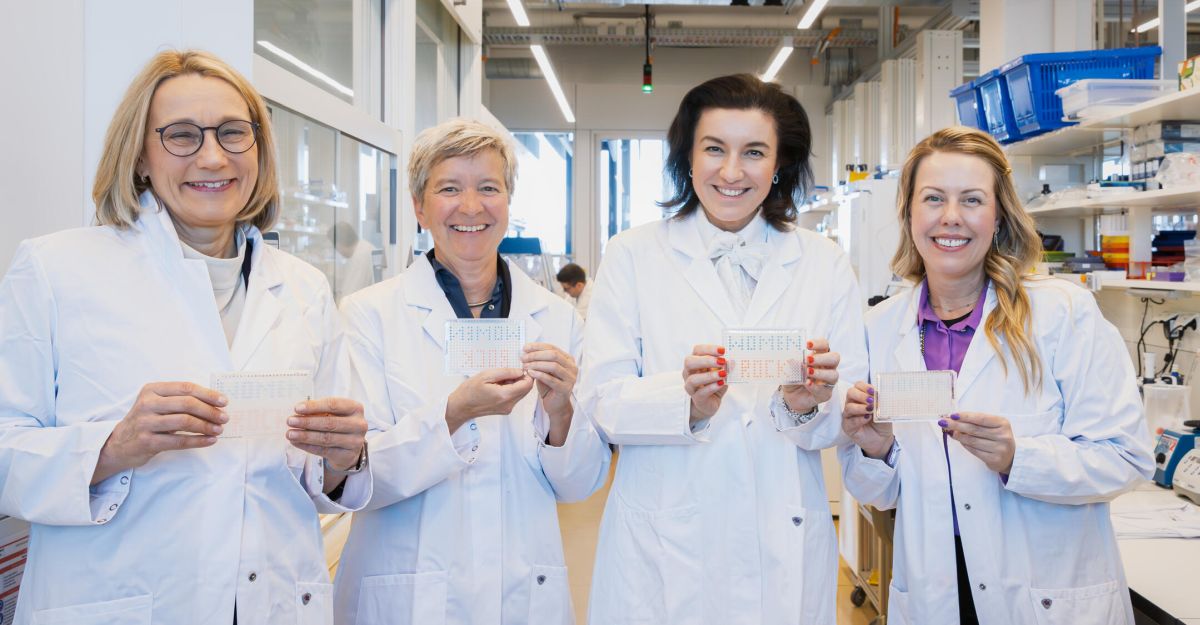
Marking International Women's Day, Federal Research Minister Dorothee Bär met with female researchers at the Max Delbrück Center
Statement from Federal Research Minister Bär:
“Equality is essential for Germany's capacity for innovation and long-term competitiveness. It is a decisive driver of progress. If we want to address the major challenges and megatrends of our time, be it digitalization, space research, medicine of the future, or key technologies, we cannot afford to leave half of the brightest minds out of driving Germany’s future forward. This is why the Federal Ministry of Education and Research, together with the states, is supporting equality at universities with a 2030 female professors program and the visibility of female researchers with the “Focus on Innovative Women” funding guidelines. In order to further strengthen social awareness of gender issues in research, we are currently designing a federal scientific award for gender research, which is to be announced later this year.”
Statement from Professor Maike Sander, Scientific Director and Chair of the Executive Board of the Max Delbrück Center:
“The discoveries made at the Max Delbrück Center lay the foundation for the medicine of the future. To get there, we need talented individuals who are enthusiastic about innovation and eager to contribute their ideas – regardless of gender or background. A total of 60 percent of our researchers are women. We have also been successful in recruiting early-career female group leaders. However, we still have some catching up to do when it comes to permanent professorships. This is why we specifically promote female scientists, for example through mentoring programs. We also approach exceptional candidates worldwide. More than half of our group leaders have been recruited internationally. We want to create an inspiring environment for all of them. We need a scientific culture in which careers are defined not by traditional role expectations, but by curiosity, talent, and courage. There is still much to be done.”
Photo: From left to right: Maike Sander, Katja Simon, Dorothee Bär and Ashley Sanders in a lab.
Maike Sander is Scientific Director of the Max Delbrück Center. Katja Simon is Head of Scientific Talent Management, Dorothee Bär is Federal Minister of Research, Technology and Space, Ashley Sanders is scientific group leader.
© Felix Petermann, Max Delbrück Center
Source: Max Delbrück Center
Equality in research drives innovation
Research, Education / 06.03.2026
Viele Preise bei „Jugend forscht” in Berlin-Buch
Es ging um Teichwasser, Pestizide und Chili im Boden: Beim regionalen Wettbewerb von „Jugend forscht“ präsentierten 85 Schüler*innen auf dem Campus Berlin-Buch 43 Projekte. Unter dem Motto „Maximale Perspektive“ hatten sie sich mit Neugier und kreativen Ideen ganz realen Herausforderungen gestellt.
Carlo ging jeden Tag auf dem Weg zur Schule an einem Teich vorbei. Er fragte sich immer, wie sauber das Wasser darin wohl sei. Cosima wollte wissen, ob Pestizide die Populationen einer Bakterienart dezimieren, die im Boden für die Stickstofffixierung wichtig sind. Und Fin wollte herausfinden, ob Capsaicin – der Hauptwirkstoff von Chili, der auf der Zunge brennt und kribbelt – das Wachstum von Gemüse beeinflussen kann.
Es sind nur ein paar der von Neugier getriebenen Fragen, die Berliner Schüler*innen in Projekte verwandelt haben, die sie am 25. Februar 2026 beim regionalen Wissenschaftswettbewerb „Jugend forscht“ im Max Delbrück Communications Center (MDC.C) auf dem Campus Berlin-Buch präsentierten.
Um zukunftsorientiertes Denken zu fördern, lautete das diesjährige Motto „Maximale Perspektive“. Die Schüler*innen konnten Projekte aus den Bereichen Biologie, Chemie, Physik oder Technik einreichen, die innovative Lösungen für gesellschaftliche Probleme bieten, und dabei ihr kreatives und kritisches Denken beweisen.
Spaß und Neugier sind entscheidend
Ulrich Scheller, Leiter des Campus Berlin-Buch, eröffnete die Veranstaltung mit einer Begrüßungsrede. Er ermunterte die Schüler*innen, „Spaß zu haben und immer neugierig zu bleiben“. Im Laufe des Nachmittags stellten insgesamt 85 Schüler*innen im Alter zwischen 8 und 20 Jahren ihre 43 wissenschaftlichen Projekte den Jurymitgliedern und dem Publikum vor.
Carlo, ein Sechstklässler, hatte eine schwimmende Plattform mit einem Loch gebaut, durch die er das Teichwasser mit verschiedenen Sonden auf den Säuregehalt und andere Schadstoffe testen konnte. Cosima hatte herausgefunden, dass das Pestizid Glyphosat – ein gängiges Unkrautvernichtungsmittel – eine Bakterienart schädigen kann, die für die Stickstofffixierung im Boden wichtig ist. Und Fin hatte beobachtet, dass Capsaicin, wenn es dem Boden zugesetzt wird, das Wurzelwachstum von Gartenkresse hemmt.
Oft hatten persönliche Erlebnisse die Schüler*innen zu ihren Projekten inspiriert. Ein Team des Käthe-Kollwitz-Gymnasiums beispielsweise hatte eine Kamerahalterung für eine Drohne gebaut, mit der sich detailliertere Bilder von Menschen aufnehmen lassen als mit vielen handelsüblichen Kameras. Die Idee dazu kam von einem Schüler, dessen Großeltern eine Überschwemmung miterlebt hatten. Die Rettungskräfte hatten die Menschen, die damals evakuiert werden mussten, nur schwer finden können.
Mehrere Schüler*innen äußerten sich bestürzt über die zunehmende Verschmutzung der Ozeane durch Plastikmüll – was ihr Interesse geweckt hatte, biologisch abbaubare Kunststoffe zu entwickeln.
Forschung beginnt mit Fragen
Vor der Preisverleihung am Freitag, dem 27. Februar, konnten alle Interessierten an einem Experimentierkurs im Gläsernen Labor und an mehreren Führungen teilnehmen – durch Labore des Max Delbrück Center, des Leibniz-Forschungsi2nstituts für Molekulare Pharmakologie (FMP) und des Campusunternehmens FyoniBio.
Am Nachmittag vergab die Jury die Preise, darunter Geld, Abonnements für wissenschaftliche Zeitschriften und Besuche von Ausstellungen – in zwei separaten Altersgruppen „Jugend forscht Junior“ und „Jugend forscht“ sowie in verschiedenen Kategorien: Biologie, Chemie, Physik, Technik. Außerdem wurde ein Sonderpreis in der Kategorie Interdisziplinär vergeben. Die Erstplatzierten haben sich für den Landeswettbewerb an der Technischen Universität Berlin qualifiziert.
Darüber hinaus gab es mehrere Sonderpreise in allen naturwissenschaftlichen Kategorien und Extra-Kategorien wie Umwelttechnik und Engagement. Gesponsert hatten diese Preise unter anderem das Max Delbrück Center, das FMP, das Experimental and Clinical Research Center (ECRC), das Gläserne Labor und der Campus Berlin-Buch.
„Wir freuen uns sehr, dass wir die Begeisterung junger Menschen für die Wissenschaft wecken können“, sagte Kirsten Bodensiek, die Administrative Vorständin des Max Delbrück Center, während der Feierstunde zu den Schüler*innen. „Wissenschaft beginnt nicht mit Antworten, sondern mit klugen Fragen. Mit euren Projekten leistet ihr einen Beitrag zur Wissenschaft von morgen.“
„Es ist wirklich toll, euch jedes Jahr hier zu sehen“, fügte Dr. Henning Otto, Wissenschaftlicher Referent am FMP, hinzu. „Ihr seid einfach großartig! Wenn ihr eine Karriere in der Wissenschaft anstrebt, dann wählt einen Ort wie diesen – einen wunderbaren Campus mit ganz vielen neugierigen Menschen.“
Die Preisträger:
Biologie
Preisstifterin ist die Helmholtz Gemeinschaft Deutscher Forschungszentren e.V.
3. Platz: Marie Thürling, Frieda Kliche, Charlotte Lange
Hans-und-Hilde-Coppi-Gymnasium
„Wie verändert sich der Vitamingehalt von Obst durch verschiedene Verarbeitungen?“
3. Platz: Marek Ebert
Käthe-Kollwitz-Gymnasium
„Hydroponik von Anfang an“
2. Platz: Klas Koesling
Rosa-Luxemburg-Gymnasium
„Verwendung von Kaffeeabfällen zur Herstellung von hochwertigen Tierfutterbestandteilen“
1. Platz: Cosima Höer, Moritz Pasternak
Freie Universität Berlin, Primo-Levi-Gymnasium
„Stickstofffixierende Bodenbakterien – Haben Pestizide und Dünger einen Einfluss?“
Biologie Jugend forscht Junior
3. Platz: Carlo Kühn
Primo-Levi-Gymnasium
„Untersuchung des Kreuzpfuhls“
1. Platz: Leif Neuberger, Oskar Kubitschko, Julian Dietrich
Lessing-Gymnasium
„Stopp den Schimmel – Naturfarben im Test“
Der 2. Platz wurde nicht vergeben.
Chemie
Preisstifter ist der Fonds der Chemischen Industrie im Verband der Chemischen Industrie e.V. (VCI).
3. Platz: Cedric Neuberger
Lessing-Gymnasium
„Atemkalk – Unser Klimaretter?“
2. Platz: Pepe Fynn Jost, Sarah Herrmann, Anna Skrabania
Primo-Levi-Gymnasium
„Eigenbau eines Gaschromatographen“
1. Platz: Giulia-Matilda Oettel
Lessing-Gymnasium
„Self-Healignin – Entwicklung eines faserverstärkenden Thermoplasts auf Ligninbasis“
Chemie Jugend forscht Junior
1. Platz: Lina Ebert
Heinrich-Roller-Grundschule
„Der Curry-Fleck muss weg!“
Physik
Preisstifterin ist die Max-Planck-Gesellschaft zur Förderung der Wissenschaften e.V.
3. Platz: Vico Grollmus, Maria Anufrieva
Primo-Levi-Gymnasium
„3D-gedrucktes Interferometer für Schülerexperimente“
2. Platz: Magnus Vogel
Robert-Havemann-Gymnasium
„Aufbau, Kalibrierung und Nutzung eines 3m-Radioteleskops“
1. Platz: Kari Linnea Geisinger
Herder-Gymnasium
„Der Teebeutel-Oszillator“
Physik Jugend forscht Junior
1. Platz: Lino Phielipeit, Simon Wiese
Primo-Levi-Gymnasium
„Tischtennis Reloaded“
Technologie
Preisstifter ist der Verein Deutscher Ingenieure e.V. (VDI).
3. Platz: Rasmus Wilke
Käthe-Kollwitz-Gymnasium
„Autonomes Messboot zur Erfassung von Gewässerdaten“
2. Platz: Tony Nguyen
Käthe-Kollwitz-Gymnasium
„FokusPilot – Lernruhe mit Eigensteuerung“
1. Platz: Conrad Speiser
Rosa-Luxemburg-Gymnasium
„Firebug – Bionischer Infrarotsensor zur intelligenten Branderkennung“
1. Platz / Interdisziplinär: Siddharta Kollar, Iulia Dinu
Käthe-Kollwitz-Gymnasium
„Sentr: die automatisierte Lösung für Warenlogistik im Supermarkt“
Technologie Jugend forscht Junior
2. Platz: Ryan Bartsch, Rodja Cichos
Primo-Levi-Gymnasium
„Micro-mouse“
Der 1. Platz wurde nicht vergeben.
Quelle: Max Delbrück Center
Viele Preise bei „Jugend forscht” in Berlin-Buch
economic development, Innovation / 03.03.2026
T-knife Therapeutics Announces Authorization of Clinical Trial Application for TK-6302, A Multi-Armored, CRISPR based T cell Therapy for Solid Tumors
Phase 1 ATLAS trial to evaluate TK-6302 in patients with advanced PRAME-positive solid tumors authorized for initiation
SAN FRANCISCO and BERLIN, March 03, 2026 - T-knife Therapeutics, Inc., a biopharmaceutical company developing next-generation T cell therapies to fight cancer, today announced the authorization of its Clinical Trial Application (CTA) to begin the Phase 1 ATLAS trial of TK-6302 in Europe. TK-6302 is a multi-armored PRAME-targeted T cell therapy specifically engineered to overcome the challenges associated with treating solid tumor cancers. The ATLAS trial, which is poised to begin this year, is an adaptive, first-in-human, open-label, Phase 1 trial of TK-6302 in patients with advanced PRAME-positive solid tumors.
“We are proud to achieve this important milestone, which enables the initiation of the Phase 1 ATLAS clinical trial and our transition to becoming a clinical-stage company,” stated Thomas M. Soloway, President and Chief Executive Officer of T-knife. “TK-6302 is a highly differentiated therapy, engineered for greater potency against PRAME, a clinically validated target with attractive commercial potential. PRAME is highly prevalent across multiple high unmet-need solid tumor indications, including squamous non-small cell lung, ovarian, endometrial, skin, and triple-negative breast cancers. Today’s announcement reflects the dedication, expertise, and urgency our team brings to transforming innovative science into life-changing therapies.”
Peggy Sotiropoulou, Ph.D., Chief Scientific Officer of T-knife, added, “The CTA was supported by a comprehensive and compelling preclinical data package demonstrating TK-6302’s best-in-class anti-tumor efficacy. By bolstering T-cell fitness and persistence while overcoming challenging tumor mediated immune barriers, TK-6302 has the potential to deliver meaningful clinical benefit, including deep, durable responses across a range of solid tumor cancers. Bringing a first-of-its-kind multi-armored, CRISPR gene-edited T cell therapy into the clinic underscores our commitment to pushing scientific boundaries in the service of delivering transformative therapies to patients.”
About TK-6302
TK-6302 is a PRAME-targeted T cell therapy that has been “supercharged” by the inclusion of multiple armoring innovations: a high affinity PRAME targeting receptor to enhance cytotoxicity; a costimulatory CD8 coreceptor to engage CD4 T cells and enhance T cell fitness and persistence; and a FAS-based checkpoint converter designed to boost engraftment and promote T cell survival in the hostile tumor micro-environment. Preclinical data with TK-6302 demonstrated sustained serial killing and cytokine secretion in a model mirroring the inhibitory ligand expression in PRAME-expressing tumors. In a complex 3-dimensional (3D) spheroid tumor model, TK-6302 eliminated multiple rounds of tumors and demonstrated superior anti-tumor activity compared to controls. TK-6302 is manufactured with a non-viral gene editing process for improved T cell receptor expression, and it has been successfully manufactured at-scale using the clinical process.
About T-knife Therapeutics
T-knife is a biopharmaceutical company dedicated to developing T cell therapies to deliver broad, deep and durable responses to solid tumor cancer patients. The company’s unique approach leverages its proprietary platforms and synthetic biology capabilities to design the next-generation of supercharged T cells with best-in-class potential.
T-knife was founded by leading T cell and immunology experts utilizing technology developed at the Max Delbrück Center for Molecular Medicine together with Charité – Universitätsmedizin Berlin, is led by an experienced management team, and is supported by a leading group of international investors, including Andera Partners, EQT Life Sciences, RA Capital Management and Versant Ventures. For additional information, please visit the company’s website at www.t-knife.com.
www.t-knife.comResearch / 25.02.2026
Gut microbes affect the heart via the brain
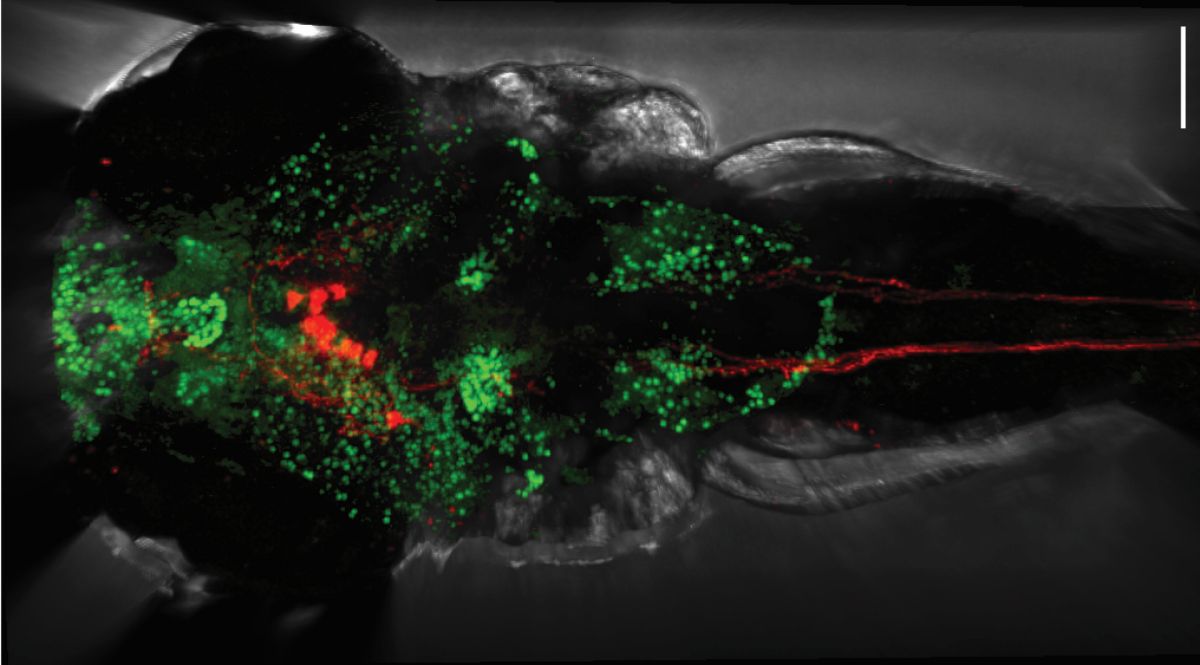
Researchers at the Max Delbrück Center have uncovered how a bacterial metabolite produced in the gut regulates heart function through specific brain cells. The findings, published in “Circulation Research,” reveal a new gut-brain-heart axis and point to potential therapies for hypertension and heart failure.
Hypertension and heart failure affect millions worldwide. Yet in many patients, doctors cannot fully explain why the heart becomes stiff and struggles to relax – a condition known as diastolic dysfunction.
Researchers in the lab of Dr. Suphansa Sawamiphak, Group Leader of Cardiovascular-Hematopoietic Interaction at the Max Delbrück Center, have identified a direct communication line between gut bacteria, the brain, and the heart. Using zebrafish as a model, the team discovered that certain gut microbes produce a small molecule called indole-3 acetic acid (IAA) from the dietary amino acid tryptophan. IAA acts on neurons in the brain, which in turn, control the heart. The study was published in “Circulation Research.”
“We were surprised that a single bacterial metabolite could influence the central nervous system, the heart, and major hormonal systems at the same time,” says Bhakti Zakarauskas-Seth, lead author of the paper. “It shows that the brain can act as a central hub in gut-heart communication.”
Tracking a signal from gut to brain
To understand how gut bacteria might influence the heart, the researchers focused on a distinct group of neurons in the hypothalamus known as hypocretin (Hcrt) in zebrafish larvae. These cells produce Hcrt neuropeptides, also known as orexins, which regulate many involuntary functions in the body – such as sleep and hunger – and also heart activity. When IAA levels dropped, Hcrt neurons became overactive. This increased sympathetic nerve signals to the heart, causing the heart muscle to stiffen, impairing its ability to relax properly.
When the researchers supplemented the larvae with IAA, neuronal activity normalized, heart function and blood pressure improved, and even related hormones such as renin and angiotensinogen returned to healthier levels.
They then examined data from a cohort of patients – humans also have Hcrt neurons – and found that IAA levels were reduced in patients with hypertension. Notably, they observed a sex-specific effect, with hypertensive women showing significantly lower levels of IAA in their serum samples than men.
Implications for patients and prevention
Diastolic dysfunction very common – up to half of all people over age 70 have some level of impairment. It is also is the underlying functional mechanism of heart failure with preserved ejection fraction (HFpEF), which accounts for over 50% of all heart failure cases.
For these patients, the findings open several potential avenues for better care, says Zakarauskas-Seth. “IAA levels could serve as a biomarker to identify patients at high risk of hypertension or heart failure. Therapeutically, boosting IAA production – for example through diet, probiotics, or supplementation – could become a new strategy to prevent or treat cardiovascular disease.”
That a single bacterial metabolite can influence the central nervous system, the heart, and major hormonal system also underscores a broader message, she adds. “The body does not operate in isolated compartments. Gut health, microbial balance, and diet directly shape how well the heart functions.” The researchers will need to validate their findings in other animal models and clinical studies will be needed to determine whether restoring IAA can benefit patients.
Text: Gunjan Sinha
Photo: Rückenansicht einer Zebrafischlarve: Aktive Nervenzellen sind grün, Hypocretine herstellende Neurone und ihre Ausläufer rot dargestellt. © Bhakti Zakarauskas-Seth, AG Sawamiphak, Max Delbrück Center
Source: Press Release Max Delbrück Center
Gut microbes affect the heart via the brain
Research / 24.02.2026
Similar kinases play distinct roles in the brain
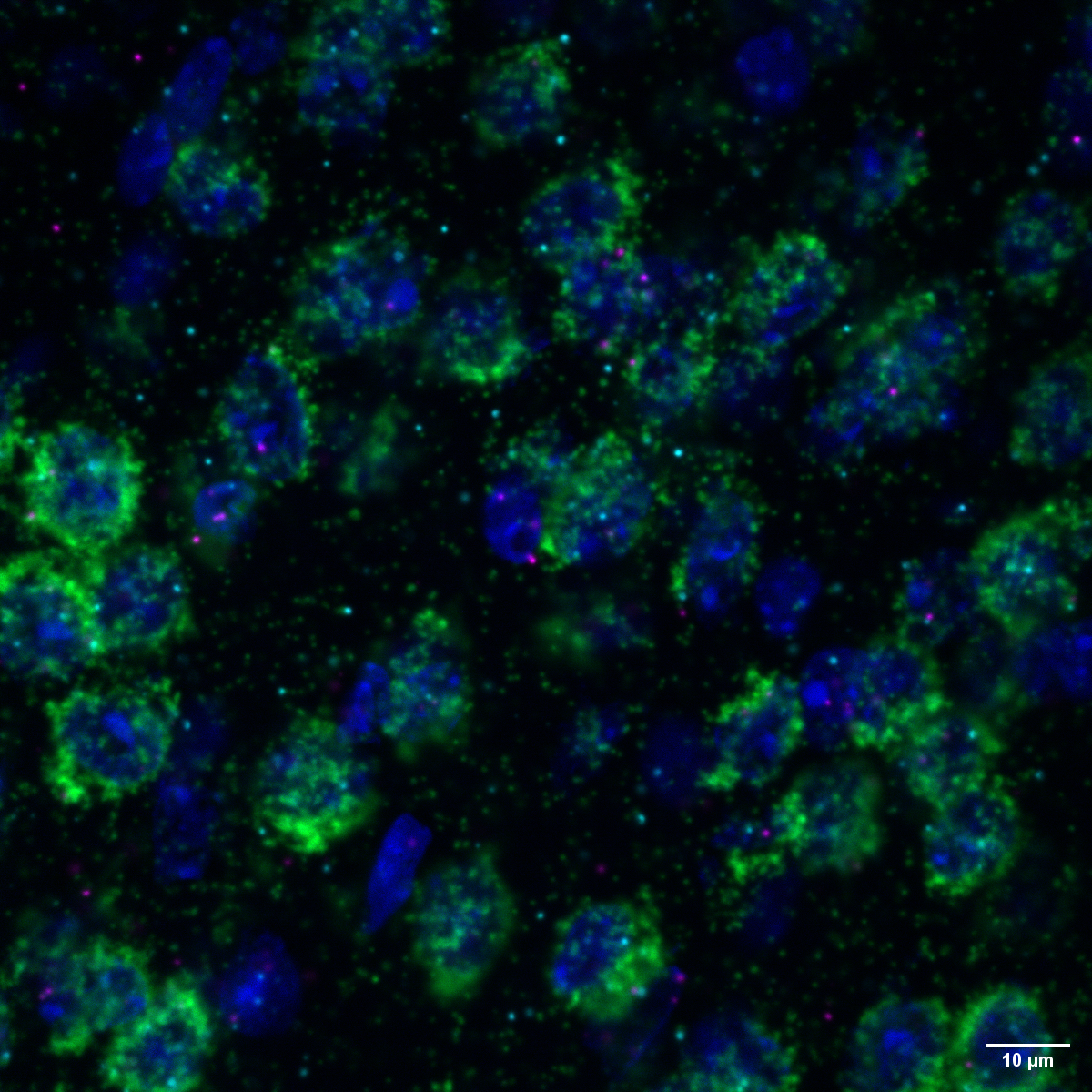
Researchers at the Max Delbrück Center show that two closely related enzymes, MNK1 and MNK2, act on the brain to regulate different behaviors. Their findings, published in “Molecular Psychiatry,” could help guide development of more precise therapies for neurological disorders.
Structurally, they look similar: MNK1 and MNK2 belong to the same enzyme family and are best known for regulating how cells make proteins. Their starring role in such a crucial cellular function has cast them into the spotlight as potential drug targets to treat nervous system disorders and chronic pain. But would it matter whether a drug targets only one of them?
In a study published in “Molecular Psychiatry,” researchers led by Rosalba Olga Proce, a doctoral student in the Molecular and Cellular Basis of Behavior lab led by Dr. Hanna Hörnberg at the Max Delbrück Center, set out to determine whether the two enzymes – also called kinases – perform distinct functions in the brain. The team found clear differences. Mice lacking MNK1 showed less interest in newly introduced objects than controls and impaired memory of objects. By contrast, mice without MNK2 appeared normal in object recognition tests but showed enhanced interest in social contacts.
“The behavioral differences we observed suggest that each kinase has a specialized function,” says Proce. “It might be preferable to target each kinase individually when designing drugs.”
Mouse behavior and molecular data
To uncover how these behavioral changes arose, the researchers used genetically engineered mice in which either the MNK1 or MNK2 gene was knocked out. They then combined behavioral testing with large-scale molecular analyses of brain tissue.
The team focused in particular on the cerebral cortex and on synapses – contact points where neurons communicate. Using proteomics, transcriptomics, and phosphoproteomics, they compared protein levels, gene expression, and protein phosphorylation patterns between the two types of mice.
Mice lacking MNK1 had an abundance of ribosomal proteins, which play a central role in transcribing messenger RNA into proteins. By contrast, in mice lacking MNK2, the expression and phosphorylation of proteins responsible for transmitting messages in synapses was reduced.
Notably, the researchers found that the molecular differences between the two kinases were far more pronounced in synapses than in whole-brain samples.
“We were surprised to see these differences,” says Hörnberg. “This suggest that the kinases may have different functions in the cell body compared to synapses.”
Toward more selective therapies
Instead of broadly inhibiting both kinases, future therapies might selectively target one kinase or the other to achieve more specific effects, Hörnberg adds.
She and her colleagues now aim to identify other molecules with which MNK1 and MNK2 interact. They also plan to study in greater detail, how these kinases regulate translation of messenger RNA into proteins during synaptic plasticity – the strengthening or weakening of connections between neurons over time. Synaptic plasticity is the fundamental mechanism underlying learning and memory – enabling the brain to rewire itself based on experience.
By clarifying how protein synthesis is fine-tuned at synapses, the team hopes to lay the groundwork for more precise interventions in neurological and psychiatric disorders.
Text: Gunjan Sinha
Photo: Section of mouse brain tissue showing that messenger RNA for MNK1 (magenta) and MNK2 kinase (turquoise) – important enzymes that regulate the production of proteins – are both expressed in excitatory neurons (green) in the cortex.
© Erika Uddström, Hörnberg Lab, Max Delbrück Center
Source: Press Release Max Delbrück Center
Similar kinases play distinct roles in the brain
Research, Innovation, Patient care / 18.02.2026
Weichen stellen, um Innovationskraft zu sichern
Landespolitik besuchte den Campus Berlin-Buch anlässlich der IHK-Roadshow zum Gesundheitsstandort Berlin 2030
Auf Einladung der IHK Berlin informierten sich am 17. Februar Mitglieder des Abgeordnetenhauses von Berlin auf dem Campus Berlin-Buch über Innovationsbedingungen in der Gesundheitswirtschaft und darüber, wie Berlin als international führender Gesundheitsstandort bis 2030 gestärkt werden kann.
In ihrem aktuellen Positionspapier „Gesundheitsstandort Berlin 2030“ sieht die IHK als Kernthemen, um die Innovationskraft Berlins zu stärken, u.a. eine schnellere Umsetzung von Forschung in marktfähige Lösungen, einen verlässlichen Zugang zu Daten und Räumen, eine reibungslose Infrastruktur- und Kapitalnutzung sowie eine dauerhafte Integration internationaler Fachkräfte.
Innovationstreiber und Motor der Gesundheitsbranche: Campus Berlin-Buch
Dr. Christina Quensel, Geschäftsführerin der Campus Berlin-Buch GmbH und Prof. Dr. Maike Sander, Wissenschaftliche Vorständin des Max Delbrück Center, begrüßten die Gäste im Gründerzentrum BerlinBioCube und stellten Buch als Berliner Zukunftsort vor.
In Berlin-Buch arbeiten rund 6.500 Menschen in der Gesundheitswirtschaft, davon rund 3.000 auf dem Wissenschafts- und Biotechcampus. Exzellente biomedizinische Forschungseinrichtungen und einer der größten Biotechparks bilden ein starkes Ökosystem für Innovationen. Bedeutende Spin-offs wie T-knife, Captain T Cell oder Tubulis haben ihren Ursprung in der hiesigen Forschung. Der Campus hat das Potenzial, gemeinsam mit neuen Firmen, weiteren Forschungsinstituten oder Pharma-Partnern Innovationssysteme und Hubs weiter auszubauen. Benachbarte Flächen sind bereits für Neuansiedlungen und wachsende Biotech-Firmen reserviert. „Start-ups benötigen die Interaktion mit anderen Start-ups, sie benötigen schnell Partner und Zugang zu Hochtechnologien – all dies bietet unser Standort“, so Dr. Quensel.
Neue Hubs in Berlin wie das Bayer Co.Lab oder das CLIC begrüßt Dr. Quensel als komplementäre Entwicklungen, die die Innovationskraft der Stadt stärken.
Standortbedingungen verbessern – in Buch und berlinweit
Als wichtige Entwicklungsthemen für den Standort wurden eine bessere Verkehrsanbindung und der Bau von Wohnungen für Mitarbeitende benannt.
Dr. Andreas Hüser, Geschäftsführer von CheckImmune, einer Ausgründung aus der Charité, gab in den Räumen seines Start-ups einen Einblick in Herausforderungen, mit denen sich Gründer in den Life Sciences in Berlin konfrontiert sehen. „Wir benötigen in unserer Stadt einen Wandel. Wer gründen möchte, sollte Unterstützung von allen Beteiligten bekommen. Damit wir Sogwirkung in ganz Europa und darüber hinaus entwickeln, brauchen wir für unsere Innovationen hochqualifizierte Sparringpartner in den Regulierungsbehörden und eine deutlich schlankere Bürokratie. Behörden sollten sich als Unterstützer verstehen.“ Dr. Verena Schöwel, CEO und Mitgründerin des Campus-Spin-offs MyoPax ergänzte: „Das Warten auf Genehmigungen kostet Start-ups Geld, weil inhaltlicher Fortschritt in dieser Phase blockiert ist.“
Diskutiert wurde eine mögliche Orientierung an Best-Practise-Lösungen anderer Bundesländer, die weniger komplizierte Zulassungsbedingungen haben.
Potenzial sieht Dr. Hüser auch darin, Netzwerke mit VC-Investoren zu intensivieren, um Life-Science-Innovationen stärker als Teil von DeepTech ins Rampenlicht zu rücken. Es gäbe in Berlin mit seiner hochkarätigen Forschungslandschaft und dem wachsenden Mindset für Gründungen alle Voraussetzungen dafür.
Dr. Quensel betonte, dass Deutschland hervorragende Förderbedingungen für die Entwicklung wissenschaftlicher Innovationen böte, aber privates Kapital unabdingbar sei, um neue Medikamente auf den Markt zu bringen: „Eine künftige bessere Gesundheitsversorgung darf nicht am Geld scheitern.“
Hidden Champion mit globaler Perspektive
Im Anschluss besuchten die Abgeordneten die Konzernzentrale der Eckert & Ziegler SE auf dem Campus. Der Vorstandsvorsitzende, Dr. Harald Hasselmann, stellte das global agierende Unternehmen mit Schwerpunkt Radiopharmazie vor, das in 30 Jahren weltweit Standorte aufgebaut hat und über 1.000 Mitarbeitende hat.
Dr. Hasselmann zeigte noch einmal auf, wie bedeutsam eine verbesserte Anbindung für den Standort ist und unterstrich die Wichtigkeit von schnelleren Bearbeitungszyklen bei Genehmigungen.
Anhand des von IHK Berlin, Gesundheitsstadt Berlin und VBKI entwickelten Positionspapiers wurden im Anschluss politische Rahmenbedingungen diskutiert für eine schlankere Regulatorik, für eine Strategie zur einheitlichen Erfassung und Nutzung von Gesundheitsdaten für die Forschung sowie die Bindung von Tech-Talenten.
Lars Mölbitz, IHK Berlin, betonte: „Das Positionspapier zeigt ganz praktisch, welche Hürden den Berliner Gesundheitsstandort bremsen und wie sich diese Hürden überwinden lassen. Der Abbau dieser Hürden kann die Gesundheitswirtschaft Berlins deutlich voranbringen.“
Link zum Positionspapier: https://www.ihk.de/berlin/gesundheitsstandort-2030
Research / 18.02.2026
New material boosts MRI image quality
MRI scans often struggle to capture clear images of deep or delicate tissues. Researchers at the Max Delbrück Center now report in “Advanced Materials” a new lightweight antenna that boosts image quality and may shorten scan times ¬– without changing existing MRI machines.
Magnetic resonance imaging (MRI) is one of medicine’s most powerful diagnostic tools. But certain tissues deep inside the body – including brain regions and delicate structures of the eye and orbit that are of particular relevance for ophthalmology – are difficult to image clearly. The problem is not the scanner itself, but the hardware that sends and receives radio signals.
Now, researchers led by Nandita Saha, a doctoral student in the Experimental Ultrahigh Field Magnetic Resonance lab of Professor Thoralf Niendorf at the Max Delbrück Center have developed an advanced materials-based MRI antenna that overcomes these limitations – delivering enhanced images more quickly and that can be used in existing MRI machines. The research was published in “Advanced Materials.”
Niendorf and his team worked closely with researchers at Rostock University Medical Center, combining expertise in MRI physics with clinical ophthalmology and translational imaging. The Rostock team is also supporting clinical validation of the technology.
“By using concepts from metamaterials, we were able to guide radiofrequency fields more efficiently and demonstrate how advanced physics can directly improve medical imaging,” says Niendorf, senior author of the paper. “This work shows a pathway toward faster, clearer MRI scans that could benefit patients in many clinical areas.”
Rethinking MRI hardware with metamaterials
MRI works by sending radiofrequency (RF) signals into the body and detecting how tissues respond inside a strong magnetic field. The stronger the signal response, the better the image. Conventional MRI antennas – also called RF coils – often struggle to collect enough signal from deep or anatomically complex regions. This leads to images that lack detail and prolongs scan times.
The research team addressed this bottleneck by integrating metamaterials directly into the MRI antenna. Metamaterials are engineered structures that interact with electromagnetic waves in ways not found in natural materials. The engineered RF antenna increases signal strength from targeted tissues, improves spatial resolution and image sharpness and enables faster data acquisition. Crucially, the antenna fits into existing MRI systems, avoiding the need for new infrastructure. The team validated the technology by imaging the eye and orbit region in a group of volunteers at 7.0 Tesla.
"Our research demonstrates clear relevance for ophthalmological applications as it can facilitate anatomically detailed, high-spatial resolution MRI of the eye,” says Professor Oliver Stachs, a co-author of the paper at University Medicine Rostock. “It offers the potential to open a window into the eye and into (patho)physiological processes that in the past have been largely inaccessible.”
“Our goal was to rethink MRI hardware from the modern physics of antenna design,” adds Saha. This technology can also be tuned to protect sensitive areas of the body during MRI, for example, to reduce unwanted heating around medical implants, she adds. It could also be used to focus RF energy more effectively for MRI guided therapies for various cancer treatments, such as gentle heating of tumors (hyperthermia) or thermal ablation of tissue.
Better diagnostics
For patients, MRI scans can be uncomfortable and time-consuming – even more so when images need to be repeated because important details are hard to see. Faster scans mean patients spend less time inside scanners. Clearer images mean doctors can make diagnoses with greater confidence. And because the new antenna is lightweight and compact, it can also be designed to better fit specific parts of the body, improving comfort even further.
The technology could also be adapted to support MRI systems running at magnetic field strengths lower or higher than 7.0 T, to image target anatomy other than the eye, orbit or the brain or to track metabolism or drug movement inside the body, says Niendorf. Special MRI scans that use other atoms, such as sodium or fluorine, could also benefit from this technology by producing clearer signals and better images, he adds.
“Innovations in imaging hardware have the potential to transform diagnostics, and this study is an important step toward next-generation MRI technology,” says Dr. Ebba Beller, a co-author of the paper at Rostock University Medical Center.
The researchers are already planning larger studies at multiple hospitals and adapting the design for other organs, such as the heart and kidneys. The collaboration will continue to be strengthened by long-standing reciprocal visiting scientist appointments of Stachs and Niendorf.
*This project was funded by the DFG as a joint collaboration between the Max Delbrück Center and the Medical University Rostock.
Source: Max Delbrück Center
New material boosts MRI image quality
Research / 06.02.2026
Leif Si-Hun Ludwig awarded professorship
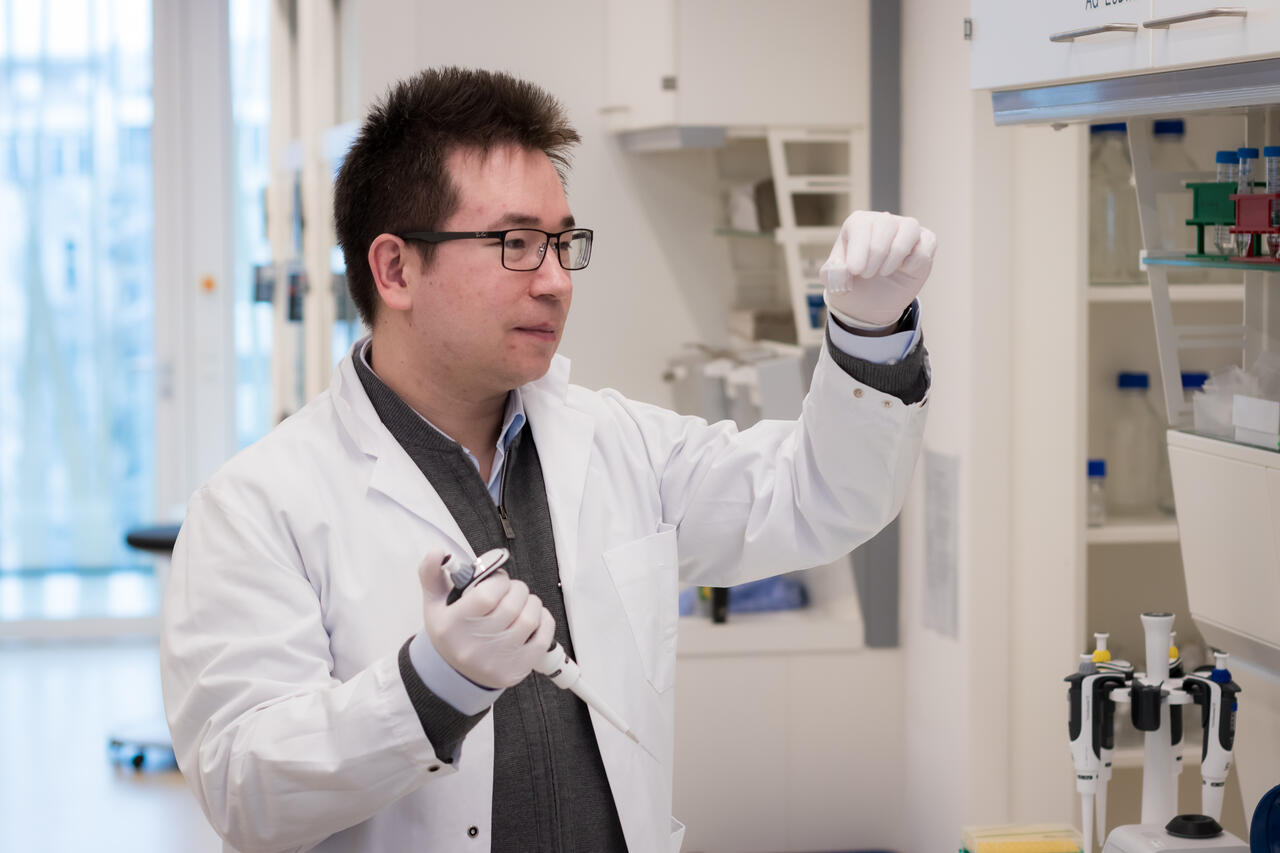
Leif Si-Hun Ludwig has been awarded a prestigious Heisenberg professorship in stem cell dynamics and mitochondrial genomics by the the Berlin Institute of Health at Charité, a position funded by the German Research Foundation (DFG).
Professor Leif Si-Hun Ludwig has led an Emmy Noether Research Group at the Berlin Institute of Health and the Max Delbrück Center since 2020. He has now been awarded a Heisenberg Professorship for Stem Cell Dynamics and Mitochondrial Genomics by the the Berlin Institute of Health (BIH) at Charité, a position funded by the German Research Foundation. Ludwig’s professorship will transition into a permanent role following an initial five-year funding period.
Studying how blood cells form
The human blood system is a marvel of constant regeneration, with millions of new cells replacing old blood and immune cells every second. These cells originate from hematopoietic (or blood-forming) stem cells in the bone marrow, maturing through several different developmental stages into the red and white blood cells, platelets, and B and T cells that keep us alive. While clinical blood tests can easily count these cells, determining the specific contribution of thousands of individual stem cells to overall blood production remains a significant challenge.
By observing natural mutations in human DNA, researchers can gain fundamental insights into how stem cells maintain healthy blood formation or how they behave when disease strikes. However, hunting for a single mutation within a genome of three billion base pairs is expensive, time-consuming and prone to error, even with today’s most advanced technology.
Cellular power plants reveal the origin of blood cells
To bypass these hurdles, Ludwig focuses on natural mutations within the mitochondrial genome – a much smaller, more manageable DNA molecule found within cellular power plants known as mitochondria. By pairing this approach with sophisticated single-cell sequencing technologies, his team can analyze tens of thousands of blood and bone marrow cells simultaneously, effectively mapping the activity of blood-forming stem cells. This single-cell analysis of natural genetic variation does more than track lineage; it provides vital information on the health of individual cells. In a clinical setting, this could eventually help doctors to predict the success of stem cell transplants or fine-tune cell and gene therapies with unprecedented precision.
Beyond this work on hematopoietic stem cells, Ludwig is tackling the challenge of inherited mitochondrial mutations. These defects are among the most common genetic disorders and can trigger a wide range of metabolic diseases affecting multiple organ systems. Despite their prevalence, the molecular causes of these conditions remain poorly understood. By investigating how mitochondrial gene variants influence different cellular and metabolic phenotypes, Ludwig aims to lay the groundwork for new therapeutic approaches.
“The Heisenberg program supports outstanding scientists, so it was no surprise to us that Ludwig was selected for this honor,” says Prof. Christopher Baum, Chair of the BIH Board of Directors and Chief Translational Research Officer of Charité. “His exceptional work combines basic research and application-oriented studies. Ludwig and his team are thus strengthening the translational network that brings together the BIH, Charité, and the Max Delbrück Center for the benefit of patients.”
Research / 06.02.2026
Professorship awarded to Mina Gouti
Mina Gouti has been awarded a professorship at Charité – Universitätsmedizin Berlin. The appointment will strengthen her pioneering organoid research at the Max Delbrück Center and deepen collaboration with clinicians to advance personalized medicine.
Dr. Mina Gouti, Group Leader of the Stem Cell Modeling of Development and Disease lab at the Max Delbrück Center, has been appointed W3 Professor of Complex Organoid Models for Personalized Medicine in the Medical Faculty, Charité – Universitätsmedizin Berlin. The permanent position recognizes her achievements in developing advanced organoid systems to understand how specific types of spinal cord neurons and skeletal muscle cells grow in space and time during development.
“This professorship will enable my team to fully leverage Berlin’s exceptional biomedical ecosystem and to work closely with clinicians at Charité to create complex organoids for personalized medicine,” Gouti says. This close interaction is essential for translating patient-derived organoid models into clinically relevant insights.”
The Gouti lab has developed three-dimensional neuromuscular organoids from human pluripotent stem cells that replicate key features of spinal cord neurons and skeletal muscle – providing powerful platforms for studying neuromuscular diseases such as spinal muscular atrophy and amyotrophic lateral sclerosis, and for drug screening. Such organoids can also be grown from cells derived from individual patients to model their specific disease.
The position reflects a shared vision between the Max Delbrück Center and Charité to accelerate translational research through fostering closer collaboration between clinicians researchers. “We now have the long-term perspective required to develop complex, functional organoids as predictive platforms for personalized medicine and early disease interception,” says Gouti. “We hope our research will lead to better health outcomes not only for people with neuromuscular diseases, but also those at high risk of developing them.”
Text: Gunjan Sinha
Further information
Research, Innovation / 05.02.2026
Pentixapharm publishes positive Phase II data on Pentixafor PET diagnostics
The study confirms PENTIXAFOR-PET as a non-invasive alternative to adrenal vein catheterization in primary aldosteronism
-
In the study, [68Ga]Ga-Pentixafor PET/CT was well tolerated and demonstrated high specificity and moderate sensitivity for identifying unilateral aldosterone-producing adenomas compared with adrenal vein sampling (AVS) and surgical outcomes
-
The data strengthens the clinical foundation for Phase 3 development and support the role of molecular imaging in guiding treatment decisions in the population with hypertension and underlying primary aldosteronism
Pentixapharm Holding AG (Frankfurt Prime Standard: PTP), an advanced clinical-stage biotech developing novel radiopharmaceuticals, today announced publication of new Phase 2 clinical data in the Journal of Nuclear Medicine demonstrating the potential of [68Ga]Ga-Pentixafor PET/CT as a non-invasive imaging tool for subtyping primary aldosteronism (PA), the leading endocrine cause of hypertension.
The investigator-initiated study, funded by an Australian philanthropic foundation, the CASS Foundation, and the Medical Research Future Fund, was conducted as a prospective cohort study in Australia. It evaluated [68Ga]Ga-Pentixafor PET/CT as a potential alternative to adrenal vein sampling (AVS), the current standard of care for distinguishing unilateral aldosterone-producing adrenal adenomas from bilateral disease. AVS is invasive, resource-intensive, and available only in highly specialized centers, creating barriers to timely and accurate patient stratification.
Results published online show that [68Ga]Ga-Pentixafor PET/CT demonstrated high specificity and moderate sensitivity for identifying unilateral aldosterone-producing adenomas when compared with AVS and surgical outcomes. Importantly, the imaging approach was well tolerated and strongly preferred by patients, with 28 of 29 participants indicating PET/CT as the favoured diagnostic test.
“These data provide evidence that molecular imaging with [68Ga]Ga-Pentixafor PET/CT can support accurate and patient-friendly subtyping of primary aldosteronism,” said Dr. Elisabeth Ng, of the Hudson Institute of Medical Research and the Endocrinology Unit at Monash Health, the lead investigator of the study. “The high specificity observed is particularly relevant for identifying patients who may benefit from curative surgery, while the strong patient preference for PET/CT highlights the potential to expand access to and acceptance of diagnostic testing for patients with primary aldosteronism.”
The study recruited adults with primary aldosteronism and an adrenal adenoma visible on CT imaging. Diagnostic performance was assessed by comparing PET-derived lateralisation indices with AVS results and biochemical outcomes following adrenalectomy. The findings support the clinical utility of [68Ga]Ga-Pentixafor PET/CT as a noninvasive decision-support tool for identifying patients who may benefit from curative surgery.
“This published data builds on earlier investigator-initiated studies, including the CASTUS Step 1 trial and demonstrates reproducible performance across independent studies and geographies. Together, these data strengthen the clinical foundation of Pentixapharm’s primary aldosteronism program and support readiness for Phase 3 development,” said Dirk Pleimes, CEO and CMO of Pentixapharm. “Here, at Pentixapharm, we are continuing to advance our clinical and regulatory strategy for primary aldosteronism while engaging with investigators, regulators, and potential partners to maximise the clinical and commercial impact of our molecular imaging platform.”
As new therapeutic options, including aldosterone synthase inhibitors, are expected to enter the treatment resistant hypertension market, accurate and scalable subtyping of primary aldosteronism is becoming increasingly important. Noninvasive imaging solutions may play a critical role in guiding treatment decisions and optimising patient outcomes in this evolving therapeutic landscape.
The full article, titled “Identification of Aldosterone-Producing Adrenal Adenomas Using [68Ga]Ga-Pentixafor PET/CT in an Australian Cohort,” is available in the Journal of Nuclear Medicine.
About 68Ga-PentixaFor in treatment-resistant hypertension and primary aldosteronism
[68Ga]Ga-PentixaFor is a novel gallium-68-labeled radiodiagnostic designed to selectively target and visualize the chemokine receptor CXCR4 using high-resolution PET/CT imaging. Clinical experience with [⁶⁸Ga]Ga-PentixaFor PET/CT in approximately 1,600 patients across different indications has demonstrated its ability to non-invasively image CXCR4 expression in vivo.
Recent research has shown strong CXCR4 overexpression in aldosterone-producing adrenal tumors, a hallmark of unilateral primary aldosteronism. Primary aldosteronism is a common but historically underdiagnosed cause of secondary hypertension, largely because reliably distinguishing unilateral from bilateral disease remains challenging with current diagnostic tools. Unilateral disease is typically treated by surgical removal of the affected adrenal gland whereas bilateral disease requires life-long medical therapy. By visualizing CXCR4 expression in aldosterone-producing tissue, [⁶⁸Ga]Ga-PentixaFor has the potential to support more reliable subtyping of primary aldosteronism and thereby better guide appropriate treatment decisions.
About the prospective phase 2 pilot study
The prospective pilot study recruited adults with PA and an adrenal adenoma visible on CT and evaluated 68Ga-Pentixafor PET/CT as a noninvasive nuclear imaging alternative to AVS, assessing its diagnostic accuracy and acceptability compared with AVS in a multiethnic population. PentixaFor was supplied by Pentixapharm AG. The study was published in the Journal of Nuclear Medicine (JNM), which is a top-ranked peer-reviewed publication covering molecular imaging, PET/CT, and theranostics [Ng E, Jong I, Lau KK, Akram M, Morgan J, Nelva P, Simpson I, Haskali MB, Fuller PJ, Shen J, Yang J. Identification of Aldosterone-Producing Adrenal Adenomas Using [68Ga]Ga-Pentixafor PET/CT in an Australian Cohort. J Nucl Med. 2026 Jan 29:jnumed.125.271006. (doi: 10.2967/jnumed.125.271006. Epub ahead of print. PMID: 41611475].
About Pentixapharm
Pentixapharm is an advanced clinical-stage biotech expanding the boundaries of radiopharmaceuticals. Headquartered in Berlin, Germany, the company develops precision diagnostics and therapeutics in oncology and cardiology to transform patient care. Its clinical pipeline is anchored by CXCR4-targeted PET-CT programs, including a Phase 3-ready candidate for the improved diagnosis of hypertensive patients with primary aldosteronism, which is intended to enable targeted treatment of the underlying causes of hypertension. CXCR4-based developments also include pioneering therapeutic programs in hematological cancers. Furthermore, Pentixapharm is advancing a next-generation antibody platform targeting CD24, an emerging immune-checkpoint marker over-expressed in multiple hard-to-treat cancers. Complemented by CXCR4 and CD24 intellectual property protection and a reliable isotope supply chain, Pentixapharm is poised to deliver meaningful patient benefit and sustainable growth in one of the fastest-growing areas of precision medicine.
Innovation / 29.01.2026
Eckert & Ziegler on Track as Planned and Achieves Another Record Year in 2025
Fiscal Year 2025 (preliminary):
- Sales: approx. € 312 million (PY: € 295.8 million)
- EBIT before special items: approx. € 78 million (PY: € 65.9 million)
- Net income: approx. € 48 million (PY: € 33.3 million)
According to preliminary, unaudited figures for the 2025 financial year, Eckert & Ziegler SE (ISIN DE0005659700, TecDAX) generated sales of around € 312 million and adjusted EBIT of around € 78 million. Sales are up around 5% on the previous year, while adjusted EBIT is up by around 18%. Net profit (from continuing and discontinued operations), which is only reported here for comparison purposes, rose to around € 48 million (previous year: € 33.3 million).
The forecast for the 2026 financial year will be published on 26 March 2026 together with the complete, audited annual financial statements for the 2025 financial year.
About Eckert & Ziegler.
Eckert & Ziegler SE with more than 1.000 employees is a leading specialist for isotope-related components in nuclear medicine and radiation therapy. The company offers a broad range of services and products for the radiopharmaceutical industry, from early development work to contract manufacturing and distribution. Eckert & Ziegler shares (ISIN DE0005659700) are listed in the TecDAX index of Deutsche Börse.
Contributing to saving lives.
economic development / 29.01.2026
OMEICOS Therapeutics Announces Positive Phase 2 Study Outcome Demonstrating OMT-28’s Potential in Primary Mitochondrial Diseases (PMD)
Trial Results Support Transition into Late-Stage Development with Program Expected to be Phase 2b/3-ready in H2 2026
OMEICOS, a clinical-stage biopharmaceutical company developing first-in-class small molecule therapeutics for mitochondrial and inflammatory disorders, announced the successful conclusion of its multi-centre, open-label Phase 2a PMD-OPTION Study evaluating its lead program OMT-28 in patients with Primary Mitochondrial Disease (PMD). The study results demonstrate OMT-28’s therapeutic potential to improve the physical condition in PMD based on significant recovery of the impaired mitochondrial fitness in the responding patients. The study further underscored the excellent safety and tolerability profile of OMT-28, which has now been evaluated in more than 220 individuals. OMEICOS is preparing for a potentially pivotal Phase 2b/3 study in PMD patients with myopathy and/or cardiomyopathy across EU and US sites and expects to be ready to initiate this study later this year, subject to the completion of partnering discussions.
PMD represents a heterogeneous group of conditions including the more prevalent subtypes MELAS, non-MELAS, and MIDD. PMD patients suffer from debilitating and life-threatening health consequences, such as severely limited physical stamina and disease-related changes in the heart and skeletal muscles, as well as associated neurological disorders. OMT-28, an orally available biased modulator, targets the GPCR-receptor S1PR1 (Sphingosine-1-Phosphate Receptor 1 thereby driving downstream activation of the mitochondrial sirtuin family members SIRT1 and SIRT3. By targeting S1PR1 and activating SIRT1/SIRT3, OMT-28 combines immunomodulation with mitochondrial protection—a dual mechanism to tackle inflammation and energy deficits in primary mitochondrial diseases.
“Improving physical performance through enhanced mitochondrial metabolism and reduced oxidative stress holds great promise in PMD. Our PMD-OPTION study results indicate a strong correlation between OMT-28 treatment, the observed positive impact on mitochondrial bioenergetics and fitness, and relevant clinical improvements in functional measures, which could translate into significant patient benefit,” said Dr. Robert Fischer, CEO/CSO of OMEICOS Therapeutics. “The profound effects on NAD⁺ and GSH levels, as well as simultaneous improvement of the NAD⁺/NADH and GSH/GSSG ratios we have seen in the responder group, are integrative indicators of electron transport chain function improvements and cellular redox homeostasis. Overall, the results offer a robust path for late-stage development.”
Study Design and Results Summary
The PMD-OPTION study enrolled a total of 29 PMD patients with mitochondrial tRNA point mutations or single mtDNA deletions across nine expert sites in Germany, Italy, and The Netherlands. The study generated strong interest among patients and key opinion leaders (KOLs), resulting in timely recruitment and a high degree of compliance with the study protocol and follow-up appointments. The study included a 12-week untreated run-in phase as an integrated control, capturing the patients’ natural history and baseline parameters for evaluating treatment results. Subsequently, all patients received a 24 mg once-daily dose of OMT-28 for a treatment period of up to 24 weeks. The study ended after a subsequent four-week follow-up period. The level of GDF-15, a prospective biomarker for reflecting cellular stress and inflammation, was used as a screening and inclusion criteria, while reduction of GDF-15 was used as a primary endpoint next to demonstrating safety and tolerability in PMD patients. The study outcome did not support the choice of GDF-15 in this setting suggesting that OMT-28 is acting downstream of the release mechanism of GDF-15.
To assess clinically meaningful improvements in the study population, the PMD-OPTION study utilized a combination of objective exercise endpoints and patient-reported outcomes. Using these measures, the study demonstrated a response rate of more than 60%. In the 12-Minute Walk Test (12 MWT) and the 5x Sit-to-Stand Test (5xSST), both accepted endpoints for pivotal studies, the entire study population showed improvements over baseline, while OMT-28 responders exhibited profound and statistically significant (12 MWT) clinical improvements compared to non-responders.
These results strongly correlated with a highly significant increase in total NAD+ levels in the responder group compared to baseline, and a clear separation between responders and non-responders in NAD+/NADH ratios over the course of the study. In patients responding to OMT-28 treatment, mean NAD+ levels were approximately 30% higher compared to baseline, bringing this crucial indicator of mitochondrial energy metabolism and redox status close to healthy ranges. Similarly, OMT-28 demonstrated a significant improvement in total GSH and GSH/GSSG ratios—key indicators of reduced oxidative stress in mitochondrial diseases—thereby reestablishing normal, healthy levels and even showing a trend toward further enhancement. Together, these results demonstrate that OMT-28’s ability to normalize both NAD⁺/NADH and GSH/GSSG ratios addresses the core pathologies of PMD—energy deficiency and oxidative stress—differentiating it from single-mechanism approaches and supporting its potential as a first-in-class therapy.
About OMEICOS
OMEICOS Therapeutics has discovered a series of metabolically robust synthetic analogues of omega-3 fatty acid-derived epoxyeicosanoids that have the potential to treat mitochondrial dysfunction, inflammatory, cardiovascular and other diseases. Epoxyeicosanoids activate cell type-specific endogenous pathways that promote organ and tissue protection. OMEICOS’ small molecules are orally available and show improved biological activity and pharmacokinetic properties compared to their natural counterparts. For more, please visit: www.omeicos.com
Education / 29.01.2026
Ausstellung „Pankows Partnerstadt Riwne – Persönliche Berichte vom Alltag im Krieg“ eröffnet am 9. Februar im Rathaus Pankow
Die Sonderausstellung „Pankows Partnerstadt Riwne – Persönliche Berichte vom Alltag im Krieg“ wird am Montag, dem 9. Februar 2026 um 19 Uhr im Rathaus Pankow eröffnet (Breite Str. 24a-26, 13187 Berlin, Foyer 2. Etage). Grußworte sprechen Bezirksbürgermeisterin Dr. Cordelia Koch und der Vorsitzende des Partnerschaftsverein Berlin Pankow – Riwne, Uwe Lehmann. Über die aktuelle Situation vor Ort berichtetdie Buchhändlerin Viktoriia Novytska, eine der Protagonistinnen des Projektes.
Die Ausstellung ist an zwei Orten zu sehen: vom 10. bis 20. Februar im Rathaus und vom 21. Februar bis 14. März 2026 im Rathaus-Center.
Zur Entstehung der Ausstellung
Im März 2025 besuchten Beschäftigte des Museums Pankow die westukrainische Partnerstadt. Bereits Ende 2022 hatten der Bezirk Pankow und Riwne eine Solidaritätspartnerschaft abgeschlossen, die am 12. Juli 2024 in eine offizielle Städtepartnerschaft mündete.
Während des Aufenthalts fanden zahlreiche Begegnungen und Besichtigungen statt. Dabei entstanden Interviews mit Einwohnerinnen und Einwohnern, die trotz der täglichen Bedrohung ihren Alltag gestalten und sich für die Stadtgesellschaft einsetzen – darunter Lehrerinnen, Krankenschwestern, der Zoodirektor, Vertreter der Zivilgesellschaft, Geschäftsleute, Historiker:innen, Museums- und Theaterleiter:innen sowie Vertreter der jüdischen Gemeinschaft.
Fotos und Interviews
Im Mittelpunkt der daraus entstandenen Schau stehen zwölf großformatige Fotoporträts der ukrainischen Fotografin Anna Mischuk sowie Filmproduktionen von Christian Betz. Die Porträtierten berichten von ihrem Alltag im Krieg. Neben einer Chronik der Stadtgeschichte bieten weitere Kurzfilme Einblicke in die Geschichte und Gegenwart Riwnes. Themen sind u.a. die deutsche Besatzung 1941 bis 1944, die Gedenkstätte Sosenki, ein Reisebericht und die Entwicklung der Städtepartnerschaft zwischen Pankow und Riwne.
Mit der Ausstellung möchte das Museum Pankow über die Geschichte der Partnerstadt informieren und für die aktuelle Situation der Bewohnerschaft seit dem russischen Angriffskrieg sensibilisieren: „Fernab abstrakter Frontberichte möchten wir mit der Ausstellung zeigen, wie Menschen in unserer Partnerstadt Riwne sich trotz der täglichen Bedrohung für die Stadtgesellschaft einsetzen“, sagt der Museumsleiter Bernt Roder.
Laufzeit: 10.02.2026 bis 20.02.2026
Öffnungszeiten: Montag bis Freitag 9.00–18.00 Uhr,
Ort: Rathaus Pankow, Foyer (2. OG), Breite Str. 24a-26, 13187 Berlin
Laufzeit: 21.02.2026 bis 14.03.2026
Öffnungszeiten: Montag bis Samstag, 11.00–13.00 u. 14.00-18 Uhr,
Ort: Rathaus-Center Pankow, 1. OG, Breite Str. 20, 13187 Berlin
Der Eintritt ist frei.
Weitere Infos:
https://www.berlin.de/museum-pankow/aktuelles/ausstellungen/sonderausstellungen/artikel.1634821.php
https://www.berlin.de/museum-pankow/aktuelles/
Partnerschaftsverein Berlin Pankow – Riwne: www.pankow-riwne.de/
Living / 29.01.2026
Positive Zwischenbilanz bei Umsetzung des Aktionsplans „Kinderfreundliche Kommune“
Über die bisherige Umsetzung des aktuellen Aktionsplans im Rahmen des Vorhabens „Kinderfreundliche Kommune“ haben sich jetzt Vertreter:innen verschiedener Fachämter und des Vereins Kinderfreundliche Kommunen e.V. sowie die drei sachverständigen Gutachter:innen im Rathaus Pankow ausgetauscht.
Meilensteine erreicht
Fast zwei Jahre nach der Verleihung des Siegels „Kinderfreundliche Kommune“ gaben die Sachverständigen Christa Böhme, Dominik Ringler und Claudia Kittel hilfreiche Anregungen und Hinweise zur weiteren Umsetzung des Aktionsplans. Grundlage bildete der im November eingereichte Zwischenbericht, in dem zu allen 38 Maßnahmen die Umsetzungsstände geschildert wurden. Zu zentralen Meilensteinen, die im Rahmen des Halbzeitgesprächs im Fokus standen, gehören die bis 2027 gesicherte Finanzierung des Kinder- und Jugendbüros „Mitbestimmen in Pankow“ sowie verschiedene ressortübergreifende Aktivitäten rund um die Prävention von Kinder- und Familienarmut. Besonders hervorzuheben ist die neue, mehrsprachige „Seite für junge Menschen“, die unter https://www.berlin.de/ba-pankow/junge_menschenzu finden ist. Während die bezirklichen Musikschulen mit neuen Beteiligungsaktionen und der Erstellung von Kinderschutzkonzepten die Umsetzung der UN-Kinderrechtskonvention erfolgreich angehen, dienen Pankows erfolgreich gestaltete Jugendorte im öffentlichen Raum bereits überregional als Vorbild für andere Kommunen.
Stärkung der Jugendhilfeleistungen
Zum übergeordneten Ziel, die Teilhabe und Lebensqualität für die junge Generation dauerhaft zu verbessern, gehört auch, Leistungen im Bereich der Jugendhilfe möglichst zu stärken. Das, so Bezirksbürgermeisterin Cordelia Koch, gestalte sich angesichts der derzeitigen Haushaltslage als große Herausforderung. Die Bezirksverwaltung nehme jedoch den Auftrag sehr ernst, in all ihren Handlungen die UN-Kinderrechte zu berücksichtigen und den Bezirk Pankow zu einer Kinderfreundlichen Kommune zu entwickeln.
Die Umsetzungsphase für den Aktionsplan Kinderfreundliche Kommune dauert drei Jahre und endet im April 2027. Es ist möglich, anschließend einen Aktionsplan für eine zweite Umsetzungsphase zu erstellen.
Der Berliner Bezirk Pankow trägt das Siegel „Kinderfreundliche Kommune“ seit April 2024 und gehört somit zu den deutschlandweit über 50 Kommunen, die ihre Politik und Verwaltung auf Kinderfreundlichkeit ausrichten wollen. Seit über zehn Jahren begleitet der Verein Kinderfreundliche Kommunen Städte und Gemeinden bei der lokalen Umsetzung der Kinderrechte. Das Vorhaben basiert auf den internationalen Erfahrungen aus der Child Friendly Cities Initiative von UNICEF.
Ansprechpartner:innen:
Bezirksamt Pankow, OE Sozialraumorientierte Planungskoordination, Koordinator:in Kinderfreundliche Kommunen: kinderfreundlich@ba-pankow.berlin.de
Kinderfreundliche Kommunen e.V., Geschäftsführer Dominik Bär, E-Mail info@kinderfreundliche-kommunen.de
Living / 28.01.2026
Prothesenwerkstatt für Riwne: Erfolgreiche Spendenkampagne wird 2026 fortgesetzt
Prothesenwerkstatt für Riwne: Erfolgreiche Spendenkampagne wird 2026 fortgesetzt
Das im letzten Jahr gestartete Projekt zur Einrichtung einer Prothesenwerkstatt in unserer ukrainischen Partnerstadt Riwne hat Ende 2025 einen wichtigen Meilenstein erreicht: Es wurden bereits Spenden in Höhe von 18.000 Euro gesammelt. Diese Summe entspricht der erforderlichen Eigenbeteiligung, die Voraussetzung für die Förderung des Projekts durch die Servicestelle Kommunen in der Einen Welt (SKEW) ist.
Pankows Partnerstadt erhält eine moderne Prothesenwerkstatt
Im Rahmen des Projekts wird im städtischen Krankenhaus von Riwne eine moderne Prothesenwerkstatt mit neuesten Geräten eingerichtet. In einer späteren Projektphase ist die Ausbildung von Prothesentechnikern vorgesehen, sodass in den ausgestatteten Räumlichkeiten künftig verletzte Soldaten und Zivilist:innen versorgt werden können.
Nächstes Spendenziel: 12.000 Euro
Um das Projekt weiter finanzieren zu können, wird auch in diesem Jahr zu weiteren Spenden aufgerufen. Für den Bau und die Installation der Werkstatt sowie für die Schulung des Personals werden weitere 12.000 Euro benötigt. Jede Spende – ob groß oder klein – trägt dazu bei, den Betroffenen eine Zukunft mit mehr Bewegungsfreiheit und Selbstständigkeit zu eröffnen.
Die Bezirksbürgermeisterin Dr. Cordelia Koch betont: „Es ist sehr erfreulich zu sehen, wie solidarisch die Pankower Bürgerinnen und Bürger sowie zahlreiche Organisationen – allen voran der Partnerschaftsverein Pankow-Riwne – mit unserer Partnerstadt sind. Mit dem Aufbau der Prothesenwerkstatt können wir ganz konkret helfen. Die Beschaffung der benötigten Ausrüstung kann nun beginnen. Herzlichen Dank für jede einzelne Spende!“
Spendenkonto:
Bezirkskasse Pankow
IBAN: DE06 1005 0000 4163 6100 01
Verwendungszweck (bitte unbedingt angeben): 253302324375 Prothesen-Projekt Riwne
Spendenbescheinigungen sind möglich. Die Überweisung einer Spende berechtigt nicht zu einer Gegenleistung.
Kontakt bei Fragen oder für weitere Informationen:
Daryna Illienko
Tel.: 030 90295-2624
E-Mail: Daryna.Illienko@ba-pankow.berlin.de
Patient care / 26.01.2026
Das Helios Klinikum Berlin-Buch erhält Zertifizierung als Pankreaskrebszentrum
Berlin-Buch: Das Helios Klinikum Berlin-Buch ist erfolgreich als Pankreaskrebszentrum von der Deutschen Krebsgesellschaft (DKG) zertifiziert worden. Damit unterstreicht der größte Maximalversorger im Nord-Osten der Hauptstadt seinen Anspruch auf höchste Versorgungsqualität sowie ausgeprägte interdisziplinäre Expertise in der Diagnostik und Therapie von Erkrankungen der Bauchspeicheldrüse. Das Zertifizierte Pankreaskrebszentrum bündelt spezialisierte Kompetenzen aus allen relevanten Fachdisziplinen und bietet Patient:innen aus Berlin und der gesamten Region eine Behandlung auf höchstem medizinischem Niveau.
Die Deutsche Krebsgesellschaft (DKG) hat das Pankreaszentrum des Helios Klinikums Berlin- Buch als zertifiziertes Pankreaskrebszentrum anerkannt. Das Zentrum bündelt Kompetenzen aus den Fachdisziplinen der Allgemein-, Viszeral- und Onkologischen Chirurgie, Inneren Medizin und Gastroenterologie, Onkologie, Strahlentherapie und Radioonkologie, Diagnostischen und Interventionellen Radiologie sowie der Nuklearmedizin. „Die erfolgreiche Zertifizierung unseres Pankreaskrebszentrums ist ein wichtiger Meilenstein für den Standort Berlin-Buch. Sie unterstreicht nicht nur unsere medizinische Expertise, sondern auch unser stetes Bestreben, moderne Therapiekonzepte frühzeitig in die klinische Versorgung zu integrieren und damit die Behandlungsmöglichkeiten für unsere Patient:innen kontinuierlich weiterzuentwickeln“, betont Prof. Dr. med. Roger Wahba, Chefarzt der Allgemein-, Viszeral- und Onkologischen Chirurgie am Helios Klinikum Berlin-Buch.
Ein besonderer Schwerpunkt des neu zertifizierten Pankreaskrebszentrums liegt in der chirurgischen Versorgung. Hohe Fallzahlen, ausgewiesene onkologische Expertise und der Einsatz modernster Operationsverfahren gewährleisten eine exzellente Behandlungsqualität. Dazu zählt auch die robotergestützte Chirurgie, die hochpräzise und gleichzeitig besonders schonende Eingriffe ermöglicht und damit zu verbesserten postoperativen Ergebnissen sowie einer schnelleren Genesung beitragen kann.
Darüber hinaus eröffnet das Pankreaskrebszentrum neue therapeutische Perspektiven für Patient:innen mit lokal fortgeschrittenen, bislang inoperablen Tumoren. Erstmals kommt hier die Elektrochemotherapie zum Einsatz – ein innovatives Verfahren, bei dem gezielt gesetzte
elektrische Impulse die Aufnahme und Wirksamkeit von Chemotherapeutika im Tumorgewebe deutlich steigern.
Ein weiteres zukunftsweisendes High-Tech-Therapiekonzept befindet sich derzeit in Vorbereitung: die Brachytherapie mit endoskopisch eingebrachten radioaktiven Nanopartikeln. Ziel dieses Verfahrens ist es, lokal begrenzte Tumoren präzise von innen heraus zu behandeln und damit neue Möglichkeiten in der personalisierten Therapie von Pankreaskarzinomen zu eröffnen. Erkrankungen der Bauchspeicheldrüse – von gutartigen Veränderungen wie Zysten über akute und chronische Entzündungen (Pankreatitis) bis hin zu bösartigen Erkrankungen wie Pankreaskarzinomen oder neuroendokrinen Tumoren – erfordern ein hohes Maß an Expertise und eine enge interdisziplinäre Zusammenarbeit.
In der spezialisierten Pankreassprechstunde des Helios Klinikums Berlin-Buch werden Patient:innen von Ärzt:innen verschiedener Fachdisziplinen gemeinsam umfassend betreut. Die individuelle Therapieplanung erfolgt in mehrfach wöchentlich stattfindenden interdisziplinären Tumorkonferenzen. Modernste Operations- und Behandlungsmethoden, strukturierte Therapieabläufe sowie kurze diagnostische Wege gewährleisten ein Höchstmaß an Präzision und Sicherheit. Eine kontinuierliche endoskopische und radiologische Bereitschaft stellt zudem sicher, dass auch in Notfallsituationen rund um die Uhr jederzeit eine optimale Behandlungsmöglichkeit sichergestellt ist und Patient:innen optimal versorgt sind.
Mit der Zertifizierung des Pankreaskrebszentrums stärkt das Helios Klinikum Berlin-Buch seine Position als zentrale regionale Anlaufstelle für die Behandlung von Erkrankungen der Bauchspeicheldrüse und steht für eine innovative, qualitätsgesicherte Patientenversorgung auf höchstem Niveau.
Über das Helios Klinikum Berlin-Buch
Das Helios Klinikum Berlin-Buch ist ein modernes Krankenhaus der Maximalversorgung mit über 1.000 Betten in mehr als 60 Kliniken, Instituten und spezialisierten Zentren sowie einem Notfallzentrum mit Hubschrauberlandeplatz. Jährlich werden hier mehr als 55.000 stationäre und über 144.000 ambulante Patienten mit hohem medizinischem und pflegerischem Standard in Diagnostik und Therapie fachübergreifend behandelt, insbesondere in interdisziplinären Zentren wie z.B. im Brustzentrum, Darmzentrum, Hauttumorzentrum, Perinatalzentrum, der Stroke Unit und in der Chest Pain Unit. Die Klinik ist von der Deutschen Diabetes Gesellschaft als „Klinik für Diabetiker geeignet DDG“ zertifiziert.
Zudem ist die Gefäßmedizin in Berlin-Buch dreifach durch die Fachgesellschaften der DGG (Deutsche Gesellschaft für Gefäßchirurgie und Gefäßmedizin), der DGA (deutsche Gesellschaft für Angiologie) und der DEGIR (deutsche Gesellschaft für interventionelle Radiologie) als Gefäßzentrum zertifiziert.
Gelegen mitten in Berlin-Brandenburg, im grünen Nordosten Berlins in Pankow und in unmittelbarer Nähe zum Barnim, ist das Klinikum mit der S-Bahn (S 2) und Buslinie 893 oder per Auto (ca. 20 km vom Brandenburger Tor entfernt) direkt zu erreichen.
Helios gehört zum Gesundheitskonzern Fresenius und ist Europas führender privater Gesundheitsdienstleister mit rund 128.000 Mitarbeitenden. Zu Fresenius Helios gehören die Helios Gruppe in Deutschland sowie Quirónsalud in Spanien.
Patient care / 26.01.2026
Mehr Sicherheit und Effizienz im OP
Digitales Narkoseprotokoll wird zum Standard im Helios Klinikum Berlin-Buch
Das Helios Klinikum Berlin-Buch geht einen weiteren Schritt in Richtung Digitalisierung: Mit der Einführung des digitalen Narkoseprotokolls verbessert sich die Qualität der medizinischen Dokumentation deutlich. Durch die automatisierte Erfassung vitaler Parameter und eine vereinfachte Dateneingabe per Mausklick oder über voreingestellte Standards wird der Dokumentationsaufwand für das anästhesiologische Team erheblich reduziert.
„Die digitale Narkosedokumentation ermöglicht uns eine präzisere und effizientere Erfassung aller relevanten Informationen während des Eingriffs. Das bedeutet nicht nur eine Zeitersparnis für unser Team, sondern auch eine höhere Patient:innensicherheit“, erklärt Dr. med. David Schwaiberger, Chefarzt Anästhesie, perioperative Medizin und Schmerztherapie im Helios Klinikum Berlin-Buch. „Wir können uns in kritischen Situationen vollständig auf unsere Patient:innen konzentrieren, ohne diese im Nachhinein aufwändig nachdokumentieren zu müssen. Außerdem stehen uns verbesserte Möglichkeiten zur Auswertung zur Verfügung, was ebenfalls positiv für die Patientensicherheit ist.“
Optimierte Prozesse
Im Gegensatz zu den bisherigen papierbasierten Protokollen bietet die digitale Lösung eine vollständige und verlustfreie Dokumentation. Vitalparameter, Laborwerte und Medikamentendosierungen werden automatisiert erfasst und direkt in das System integriert. Dies reduziert potenzielle Fehlerquellen und erleichtert die Nachverfolgbarkeit relevanter Daten. Auch die automatische Plausibilitätsprüfung trägt dazu bei, dass alle Eingaben korrekt und vollständig sind. „Das digitale System bietet uns jetzt eine nachhaltige, langfristig sicherere Lösung, die zugleich unsere interdisziplinäre Zusammenarbeit fördert“, ergänzt Dr. Schwaiberger.
Schnellere Versorgung
Neben der verbesserten Datensicherheit und Nachvollziehbarkeit profitieren auch die Patient:innen: Das digitale Narkoseprotokoll ermöglicht eine schnellere und gezieltere Versorgung im OP und reduziert gleichzeitig den administrativen Aufwand. Dies wirkt sich positiv auf die Zufriedenheit des Personals und der Patient:innen aus.
Das digitale Narkoseprotokoll im Helios Klinikum Berlin-Buch basiert auf einer Software, die mit verschiedenen Geräten kompatibel ist. Durch integrierte Schnittstellen können Daten aus Überwachungsmonitoren und Laboren nahtlos übernommen werden, was den klinischen Alltag weiter erleichtert. „Wir sind überzeugt, dass wir durch diese Digitalisierung nicht nur unsere internen Abläufe optimieren, sondern auch einen wertvollen Beitrag zur Qualitätssicherung in der Anästhesiologie leisten. Außerdem haben wir nun die Möglichkeit die Weiterbildungsinhalte zum Facharzt für Anästhesiologie unserer Ärzt:innen in Weiterbildung adäquat zu dokumentieren“, betont Dr. Schwaiberger abschließend. Auf der Intensiv- und der Intermediate Care Station in Berlin-Buch wird das System bereits seit mehreren Jahren erfolgreich eingesetzt.
Living, Education / 23.01.2026
Neue Kultur im Quartier
Von Klangkunst bis Blindspot-Konzerte: Anna Petzer hat Leben in das leerstehende Festhaus des Ludwig Hoffmann Quartiers gebracht. Im Interview berichtet sie über Chancen, Vernetzung, Musikförderung und kulturelle Highlights für Buch
Sie engagieren sich als Künstlerin seit 2023 für die nachhaltige kulturelle Nutzung des Festhauses im Ludwig Hoffmann Quartier. Was ist das Besondere an diesem Ort?
Es ist ein Kulturhaus, das als solches konzeptionell mitbedacht wurde: Im Zentrum des Krankenhaus-Geländes wurde ein Gemeinschaftshaus gebaut, damit dort Ärzte, Mitarbeitende und Patienten zusammenkommen können. Es ist einerseits ein leerer Raum, der für mich per se spannend ist, weil er gestaltet werden kann und gleichzeitig ein Kulturraum, der mit Bühne, Tanzfläche und besonderer Akustik nach künstlerischer Belebung ruft. Und schließlich ist bemerkenswert, dass es in Buch zwar kulturelle Aktivitäten und Initiativen gibt, aber kein Kulturhaus. Für mich hieß das: Hier steht ein Kulturraum leer, und da gibt es meines Erachtens einen Bedarf – wie kann das zusammengebracht und der Ort wieder lebendig gestaltet werden?
Es gab andere Ideen für das Festhaus, die sich jedoch nicht umsetzen ließen. Der Eigentümer, Andreas Dahlke, hat mir die Chance gegeben, kulturelle Angebote zu schaffen, dafür Ansprechpartnerin zu sein und zu schauen, ob sich durch die Vermietung der Säle auch eine wirtschaftliche Perspektive für eine Kultureinrichtung aufbauen lässt.
Wie sind Sie an diese Aufgabe herangegangen?
Für mich waren drei Hauptaufgaben entscheidend: die Anbindung des Hauses an die Kunstszene Berlins, kulturelle Bildungsformate zu erproben und lokale Akteur:innen mit dem Ort zu vernetzen.
Im Frühjahr 2023 holte ich Regisseurin Nora Krahl mit Probenarbeiten für eine Virtual-Reality-Oper in den Saal. Um darüber hinaus ein Gefühl für das Haus und das Quartier zu entwickeln, setzte ich zusammen mit Kolleginnen eine erste eigene Veranstaltung, das Stimme-Voice-Festival, um. Etwa 40 Teilnehmende beschäftigten sich fünf Tage lang mit Gesang, Stimme und Atem – darunter auch Pädagog:innen aus Buch und Karow.
Die Akustik des Saales ist für mich als Musikerin reizvoll. Daher habe ich zum Tag des offenen Denkmals 2024 mit dem Klangkünstler Martin Supper eine künstlerische Intervention zu Klang und Architektur realisiert, die Besuchende einlud, die Ästhetik und das akustische Potential des Kulturdenkmals zu erleben.
Daneben war mir wichtig, den Raum für soziale Initiativen zu öffnen. Der Bucher Bürgerverein war hier mit den Bürgerforen. Hier fand die Kinder- und Jugendkonferenz des Bezirks statt. Der Verein „Kultur im Quartier“ erhielt die Möglichkeit, Räume des Festhauses für Lesungen, Flohmärkte und als Kulturtreffpunkt zu nutzen.
Parallel nahm ich in Bucher Netzwerkenteil, etwa in der Planungsraumkonferenz für Einrichtungen, die mit Kindern und Jugendlichen arbeiten. Hier hatte ich die Beteiligung an der Fête de la Musique angeregt, die 2024 erstmals in Buch stattfand.
Um die Kultur finanzieren zu können, habe ich neben der Vermietung viele Förderanträge gestellt, auch mit Partnern wie der Volkshochschule. Erfolgreich war jedoch einzig die Förderung der Blindspot-Konzerte durch die Musicboard Berlin GmbH.
Welchen Ansatz hatten diese Konzerte?
Die Konzertreihe war auf das Förderprogramm „Pop im Kiez“ angelegt. Blindspot-Konzerte, weil sie einen kulturell „blinden Fleck“ beleben. Um den Auftrittsort zu erproben, entstand ein breites Crossover-Programm.
Wir hatten zum Beispiel ein Streichquintett von renommierten klassischen Musikern da, die als „Wooden Elephant“ elektronische Alben auf analoge Instrumente übertragen. Sie spielten „Homogenic“ von Björk. Dann gab es Musik aus Lateinamerika von „Sonqo“ und „Los Pitutos“ sowie Folk und Jazz von Duo „Hjorton“, Singer-Song-Writerin „Oktober“ und Hauke Renken. „LouLou“ und „Panoptic“ verwoben Operngesang, Pop-Balladen und elektronische Musik. Und für eines der Konzerte konnte ich Hilde Kappes gewinnen, eine Ausnahmekünstlerin im Bereich der experimentellen Stimmkunst.
Welche Resonanz gab es auf die Konzerte?
In der Regel kamen rund 40 Leute. Beim Konzert von „Wooden Elephant“ war der Saal mit 100 Gästen so voll, dass es keine Stühle mehr gab. Bei weniger Publikum konnten wir durch Lichttechnik eine wohnzimmerartige Atmosphäre erzeugen. – Ich denke, insgesamt ist eine gute Wahrnehmung des Hauses entstanden, verknüpft mit Kunst und Kultur.
Wie hat die Vermietung der Säle funktioniert?
Wir haben die Räume für Events, als Drehort oder für private Feiern vermietet. Um ausreichend Einnahmen zu erzielen, müsste man sehr häufig vermieten. Immer würde etwas passieren, das mit dem Ort hier nichts zu tun hat, den Erwartungen an das Wohnquartier entgegenstünde und die Idee einer Kultureinrichtung auch nicht unterstützt. Gleichzeitig wurde die kulturelle Belebung von vielen Leuten geschätzt. Die Perspektive müsste, denke ich, eine reine Nutzung durch Kunst- und Kulturprogramm sein, welche aus dem Ort selbst wachsen darf.
Wie könnte die Zukunft als Kulturhaus gesichert werden?
Es bedürfte einer kulturpolitischen Agenda und Förderung, die es ermöglicht, Räume stabil aufzubauen und zu bespielen. Alles, was gerade wegbricht. Im Grunde müsste es jemanden geben, der diesen Kulturort in Trägerschaft mit einer kulturellen Vision übernimmt. Andreas Dahlke wäre dafür offen.
Interview: Christine Minkewitz/Campus Berlin-Buch GmbH
Das Interview erschien zuerst im Standortjournal buchinside 1/2026
21.01.2026
Kreislauffähige Verwaltung: Cradle to Cradle NGO übergibt Handlungspapier an Bezirksbürgermeisterin Dr. Cordelia Koch
Der Bezirk Berlin-Pankow will eine Vorreiterrolle in nachhaltiger Verwaltung und Kreislaufwirtschaft einnehmen. Dazu soll Cradle to Cradle (C2C) als ganzheitlicher kreislaufwirtschaftlicher Ansatz stärker in Verwaltungsprozesse integriert werden. Am 20. Januar 2026 wurde das Handlungspapier „Cradle to Cradle in Berlin-Pankow“ von Cradle to Cradle NGO an die Bezirksbürgermeisterin Dr. Cordelia Koch übergeben.
Das Handlungspapier bündelt erstmals praxisnahe Empfehlungen, die direkt an bestehende Strukturen und Prozesse der Bezirksverwaltung anknüpfen. Mit der Übergabe des Handlungspapiers setzt der Bezirk Pankow ein deutliches Zeichen: Die Transformation hin zu einer kreislauffähigen, zukunftsfähigen Verwaltung kann gelingen, wenn politische Beschlüsse, fachliche Expertise und die Erfahrung der Verwaltung zusammengeführt werden. Mit dem Handlungspapier liegt nun eine konkrete Grundlage vor, um bestehende Beschlüsse mit Leben zu füllen. Das Thema Kreislaufwirtschaft ist auch ein wichtiges Thema im Pankower Klimaschutzkonzept. So soll die Maßnahme „VW-09 Kreislauffähige Verwaltung“ das Thema im Bezirksamt verankern.
Entstehung und Hintergrund
Das Handlungspapier ist Ergebnis eines mehrjährigen Prozesses. Bereits 2021 beschloss die Bezirksverordnetenversammlung (BVV), Cradle to Cradle im Bezirk Berlin-Pankow schrittweise umzusetzen. Im selben Jahr trat Pankow dem kommunalen Netzwerk C2C Regionen bei. Im Jahr 2025 folgte eine gemeinsame Veranstaltungsreihe von Bezirksamt und Cradle to Cradle NGO. Mitarbeitende aus verschiedenen Fachämtern entwickelten dabei konkrete Ansätze für die Verwaltungspraxis. Die Workshops fanden überwiegend im C2C LAB in Berlin statt und bildeten die fachliche Grundlage für das nun vorliegende Handlungspapier.
Drei priorisierte Handlungsfelder
Aus den Ergebnissen der Veranstaltungsreihe leitet das Handlungspapier drei priorisierte Handlungsfelder ab:
● Bauen: Künftig sollten Bau- und Sanierungsprojekte stärker so geplant werden, dass eingesetzte Materialien gesund, rückbaubar und wiederverwendbar sind. Gebäude werden dabei als Materiallager verstanden.
● Beschaffung: Vorgeschlagen wird eine verbindliche Dienstanweisung, die klare Kriterien für die Beschaffung von Produkten und Dienstleistungen festlegt.
● Verwaltung: Empfohlen wird, C2C strategisch in bestehende ämterübergreifende Steuerungsrunden sowie in Weiterbildungsangebote für Mitarbeitende zu integrieren.
Warum Cradle to Cradle
Cradle to Cradle ist ein ganzheitlicher Ansatz, der über die klassische Kreislaufwirtschaft hinausgeht. Ziel ist nicht nur, Schäden zu reduzieren, sondern durch das Handeln positiv zu wirken und Mehrwert zu schaffen. Ziel ist ein positiver Fußabdruck. Produkte und Prozesse werden so gestaltet, dass kein Abfall entsteht, sondern Materialien in biologischen und technischen Kreisläufen zirkulieren. Eingesetzte Materialien sollen sowohl für Mensch als auch Umwelt gesund sein. Ökologische, wirtschaftliche und soziale Aspekte werden dabei gemeinsam gedacht. Dieser Ansatz soll der Komplexität einer kommunalen Verwaltung gerecht werden und Lösungsansätze für unterschiedliche Verwaltungsbereiche bieten.
Mehrwert für die Menschen im Bezirk
Die Umsetzung der vorgeschlagenen Maßnahmen wirkt sich direkt auf den Alltag der Bürger:innen aus. Gesündere Gebäude verbessern etwa das Raumklima. Öffentliche Mittel werden effizienter eingesetzt durch geringere Lebenszykluskosten. Zudem stärkt der Ansatz regionale Wertschöpfung und Innovation.
Kontakt:
Leitstelle Klimaschutz Angelika Haaser (Klimaschutzbeauftragte)
klimaschutz@ba-pankow.berlin.de
https://www.berlin.de/ba-pankow/politik-und-verwaltung/beauftragte/klimaschutz/artikel.1632779.php
Living / 21.01.2026
Kreislauffähige Verwaltung: Cradle to Cradle NGO übergibt Handlungspapier an Bezirksbürgermeisterin Dr. Cordelia Koch
Der Bezirk Berlin-Pankow will eine Vorreiterrolle in nachhaltiger Verwaltung und Kreislaufwirtschaft einnehmen. Dazu soll Cradle to Cradle (C2C) als ganzheitlicher kreislaufwirtschaftlicher Ansatz stärker in Verwaltungsprozesse integriert werden. Am 20. Januar 2026 wurde das Handlungspapier „Cradle to Cradle in Berlin-Pankow“ von Cradle to Cradle NGO an die Bezirksbürgermeisterin Dr. Cordelia Koch übergeben.
Das Handlungspapier bündelt erstmals praxisnahe Empfehlungen, die direkt an bestehende Strukturen und Prozesse der Bezirksverwaltung anknüpfen. Mit der Übergabe des Handlungspapiers setzt der Bezirk Pankow ein deutliches Zeichen: Die Transformation hin zu einer kreislauffähigen, zukunftsfähigen Verwaltung kann gelingen, wenn politische Beschlüsse, fachliche Expertise und die Erfahrung der Verwaltung zusammengeführt werden. Mit dem Handlungspapier liegt nun eine konkrete Grundlage vor, um bestehende Beschlüsse mit Leben zu füllen. Das Thema Kreislaufwirtschaft ist auch ein wichtiges Thema im Pankower Klimaschutzkonzept. So soll die Maßnahme „VW-09 Kreislauffähige Verwaltung“ das Thema im Bezirksamt verankern.
Entstehung und Hintergrund
Das Handlungspapier ist Ergebnis eines mehrjährigen Prozesses. Bereits 2021 beschloss die Bezirksverordnetenversammlung (BVV), Cradle to Cradle im Bezirk Berlin-Pankow schrittweise umzusetzen. Im selben Jahr trat Pankow dem kommunalen Netzwerk C2C Regionen bei. Im Jahr 2025 folgte eine gemeinsame Veranstaltungsreihe von Bezirksamt und Cradle to Cradle NGO. Mitarbeitende aus verschiedenen Fachämtern entwickelten dabei konkrete Ansätze für die Verwaltungspraxis. Die Workshops fanden überwiegend im C2C LAB in Berlin statt und bildeten die fachliche Grundlage für das nun vorliegende Handlungspapier.
Drei priorisierte Handlungsfelder
Aus den Ergebnissen der Veranstaltungsreihe leitet das Handlungspapier drei priorisierte Handlungsfelder ab:
● Bauen: Künftig sollten Bau- und Sanierungsprojekte stärker so geplant werden, dass eingesetzte Materialien gesund, rückbaubar und wiederverwendbar sind. Gebäude werden dabei als Materiallager verstanden.
● Beschaffung: Vorgeschlagen wird eine verbindliche Dienstanweisung, die klare Kriterien für die Beschaffung von Produkten und Dienstleistungen festlegt.
● Verwaltung: Empfohlen wird, C2C strategisch in bestehende ämterübergreifende Steuerungsrunden sowie in Weiterbildungsangebote für Mitarbeitende zu integrieren.
Warum Cradle to Cradle
Cradle to Cradle ist ein ganzheitlicher Ansatz, der über die klassische Kreislaufwirtschaft hinausgeht. Ziel ist nicht nur, Schäden zu reduzieren, sondern durch das Handeln positiv zu wirken und Mehrwert zu schaffen. Ziel ist ein positiver Fußabdruck. Produkte und Prozesse werden so gestaltet, dass kein Abfall entsteht, sondern Materialien in biologischen und technischen Kreisläufen zirkulieren. Eingesetzte Materialien sollen sowohl für Mensch als auch Umwelt gesund sein. Ökologische, wirtschaftliche und soziale Aspekte werden dabei gemeinsam gedacht. Dieser Ansatz soll der Komplexität einer kommunalen Verwaltung gerecht werden und Lösungsansätze für unterschiedliche Verwaltungsbereiche bieten.
Mehrwert für die Menschen im Bezirk
Die Umsetzung der vorgeschlagenen Maßnahmen wirkt sich direkt auf den Alltag der Bürger:innen aus. Gesündere Gebäude verbessern etwa das Raumklima. Öffentliche Mittel werden effizienter eingesetzt durch geringere Lebenszykluskosten. Zudem stärkt der Ansatz regionale Wertschöpfung und Innovation.
Kontakt:
Leitstelle Klimaschutz Angelika Haaser (Klimaschutzbeauftragte)
klimaschutz@ba-pankow.berlin.de
https://www.berlin.de/ba-pankow/politik-und-verwaltung/beauftragte/klimaschutz/artikel.1632779.php
Innovation / 14.01.2026
A fresh take on proteomics
Start-up company Absea Biotechnology GmbH is developing new proteomics technologies. An interview with Dr. Philip Lössl, Senior VP Science and Business Development
What makes the Absea Biotechnology Group special?
Absea Biotechnology develops protein science technologies to advance proteomics. One of our main areas of focus is developing monoclonal antibodies for the entire human proteome. These antibodies can detect highly specific molecular biomarkers or diseased cells, such as those associated with cancer or autoimmune diseases. In collaboration with our sister companies in China and the U.S., we have amassed the world’s largest library of recombinant human proteins, which we are continually expanding through our high-throughput protein production platform. Alongside this, we are establishing mass spectrometry pipelines in Berlin to better understand protein–drug interactions (PDIs).
We see ourselves as partners and service providers in proteomics, in vitro diagnostics, and pharmaceutical and life sciences research.
How did the Absea Biotechnology Group come about?
Immunology professor Wei Zhang laid the groundwork. While earning her Ph.D. at Cambridge, she collaborated with Nobel Prize winners César Milstein and Gregory Winter, who studied the fundamentals of monoclonal antibodies. After founding her first antibody company, Zhang worked closely with the Human Protein Atlas project. Absea later developed an even larger partnership with Olink, a Swedish company that is now part of ThermoFisher. Since then, Absea has developed thousands of protein antigens and monoclonal antibodies for Olink. In 2020, the Absea Group was reorganized around bioinformatician Tao Chen to better support this proteome-wide approach. In 2023, we established our Berlin-based start-up, focusing on mass spectrometry research and development.
What is the secret behind Absea’s extensive protein library?
Tao Chen developed a machine learning-based algorithm for designing protein constructs. These constructs correspond to natural sequences found in our bodies, though they are sometimes slightly shorter. Thanks to the algorithm, we know exactly how to shorten the proteins in order to produce them efficiently and cost-effectively with a high success rate.
What innovations are you pursuing?
Our antibody and protein libraries map the proteome and support affinity-based methods. This treasure trove of molecules can also help us develop more unique mass spectrometry technologies and complement “making molecules” with “mapping molecules.” Our scientific advisors, Mikhail Savitski from the European Molecular Biology Laboratory (EMBL) in Heidelberg and Fan Liu from the Leibniz-Forschungsinstitut für Molekulare Pharmakologie (FMP), both leading experts in mass spectrometry proteomics, encouraged us in this endeavor. Together with Matthias Mann– Germany’s most cited researcher, one of the founding fathers of proteomics, and a researcher at the Max Planck Institute of Biochemistry (MPIB) in Martinsried – we published an approach to using our proteins for clinical testing mass spectrometry.
What does this approach entail?
Proteomics typically only allows for the relative quantification of protein biomarkers: a physician could tell you that you have more of a certain protein in your blood than last time, but they could not tell you the exact amount. Therefore, absolute quantification of biomarkers is important for clinical diagnostics. Until now, peptides labeled with heavy isotopes have been used for this purpose. However, this method only allows the part of the protein biomarker covered by the peptide to be seen and quantified. For this reason, we started producing whole proteins labeled with isotopes. Until now, this was not possible on a large scale. Thanks to our many years of experience in protein production, however, we have figured out how to do this.
When these labeled proteins are added to the sample, they are much more similar to the biomarker because both are proteins. Unlike peptides, proteins can be included in sample preparation. This enables researchers to monitor where deviations occur. During sample preparation, the biomarker and the labeled protein are broken down into peptides. The isotope-labeled counterpart is also found in the peptides. This provides a large number of data points for quantifying the biomarker. If the correlation with the labeled counterpart is incorrect, further mass spectrometry measurements can determine what happened in this region.
This allows parallel and highly sensitive testing of entire protein panels for a specific disease to detect abnormal quantities. At this level, the results could be relevant to clinical practice.
A path to clinical application would therefore be possible.
That is our hope. The plasma proteomics community is proposing the same approach. We are already working with a European university hospital, but we are still in the research and development phase.
However, we have even more plans: we are developing a methodology platform to better map protein–protein and protein–drug interactions at the molecular level. Our goal is to analyze these interactions directly in intact cells, tissue lysates, and cell lysates to gain a better understanding of diseases and the effects of drugs. Ultimately, we want to help our partners develop more effective drugs.
How would you go about doing that?
The first step is to determine if a drug binds to the intended protein and if there are any other unexpected – or even undesirable – binding partners. We use mass spectrometry technology to accomplish this. This technology can show us which protein areas are blocked by a drug across the entire proteome. We also discover the precise location where the drug binds. This information tells us, for example, whether the drug can inactivate the protein or prevent it from interacting with other proteins.
The second step involves protein-protein interactions (PPIs). Which PPIs occur in treated or untreated cells? Which ones occur in healthy or diseased cells? Crosslinking mass spectrometry provides an overview of the entire cellular network. Using our antibody libraries, we can then go into greater depth: we can use crosslinking to fix all protein–protein contacts in the cell. Then, the protein of interest can be enriched using one of our numerous antibodies and extracted from the cell with all its interaction partners for analysis.
Which customers are you targeting with this approach?
For pharmaceutical customers, we can identify disease-relevant protein targets for drugs in the early stages of development. By showing exactly how drugs work, we can determine which candidates are worth further development.
Another customer group consists of protein biotechnology companies that specialize in AI. Our comprehensive, high-quality datasets contain thousands of PPIs and PDIs, providing these companies with valuable information for developing their AI models.
Starting in January, your start-up will be located in the BerlinBioCube incubator
We look forward to being in the same building as the other start-ups, exchanging ideas and supporting each other. I believe this is an ideal ecosystem for us to grow in. We already have academic collaborations on campus with the FMP and the Max Delbrück Center. We also have strong relationships with biotech companies. We see a lot of potential for joint projects at this location.
The interview first appeared in Standortjournal buchinside 1/2026.
Living / 14.01.2026
Für ein gewaltfreies Miteinander, gegen Antisemitismus und Rassismus – 27. Lichterkette anlässlich des 81. Jahrestages der Befreiung des KZ Auschwitz
Anlässlich des 81. Jahrestages der Befreiung des Konzentrationslagers Auschwitz findet am Dienstag, dem 27. Januar 2026 ab 18 Uhr die mittlerweile 27. Lichterkette in Pankow statt. Treffpunkt ist um 18 Uhr vor dem ehemaligen Jüdischen Waisenhaus Pankow, der heutigen Janusz-Korzcak-Bibliothek, in der Berliner Str. 120/121, 13187 Berlin. Es wird darum gebeten, eigene Kerzen mitzubringen.
Nach der Auftaktveranstaltung, die um 18 Uhr von Bezirksbürgermeisterin Cordelia Koch eröffnet wird, ziehen die Teilnehmenden mit Kerzen weiter zur Pankower Kirche. Auf dem Weg wird es einen Halt mit Redebeiträgen vor dem ehemaligen Gartenhaus von Josef Garbáty geben. Auf der Kreuzung Breite Str. / Berliner Str. wird der Verkehr für eine Gedenkminute unterbrochen. Anschließend findet in der Kirche Alt-Pankow eine Gedenkveranstaltung mit Pankower Chören statt.
Holocaust-Gedenktag am 27. Januar
Der 27. Januar ist seit 1996 offizieller Gedenktag in der Bundesrepublik Deutschland. Seit 1999 gestalten Engagierte in Pankow eine Lichterkette, um an die Befreiung von Auschwitz durch die sowjetischen Soldaten zu erinnern. In diesem Jahr jährt sich die Befreiung schon zum 81. Mal.
Die Kommission für Bürgerarbeit gibt gemeinsam mit der Evangelischen Kirchengemeinde Alt-Pankow und der Kreisvereinigung Pankow der Verfolgten des Naziregimes – Bund der Antifaschistinnen und Antifaschisten (VVN-BdA) am Tag des Gedenkens an die Opfer des Holocaust dem Erinnern einen Ort, einen Raum und eine Gestalt mit der nunmehr 27. Lichterkette.
Es geht den Veranstaltenden nicht nur um das Gedenken für die ermordeten jüdischen Menschen und die vielen anderen Opfer. Sie wollen auch verdeutlichen, dass die Herausforderungen offensichtlich wachsen. Auch deshalb soll mit der Veranstaltung ein Beitrag für das Zusammenleben in gegenseitiger Akzeptanz geleistet werden – unabhängig von Herkunft, Religion und Lebenseinstellung. Alle Interessierten sind dazu aufgerufen, sich vor dem Hintergrund eines zunehmenden Rassismus, des anwachsenden Antisemitismus und Nationalismus mit ihrer Teilnahme an der Gedenkveranstaltung für ein solidarisches Miteinander im Bezirk zu engagieren. Im Sinne des Gedenkens wird darum gebeten, auf nationale Symbole und Parteifahnen zu verzichten.
Weitere Informationen: https://lichterkette-pankow.de/
Pressekontakt:
Jutta Kayser, Tel. 030 – 47 54 06 42, info@lichterkette-pankow.de
Living / 13.01.2026
3. Pankower Gastronomiegipfel am 22. Januar in der WABE rückt Außengastronomie in den Fokus
Das Bezirksamt Pankow lädt am 22. Januar 2026 von 13:00 bis 15:00 Uhr zum 3. Pankower Gastronomiegipfel in die WABEin der Danziger Straße 101, 10405 Berlin ein. Unter dem Titel „Mehr Vielfalt, mehr Verantwortung: Gastronomie als Motor der Stadt“ steht die Außengastronomie im Mittelpunkt der Veranstaltung.
Für das Bezirksamt Pankow ist die Gastronomie ein zentraler Treiber urbaner Lebendigkeit: Sie schafft Begegnungsräume, steigert die Aufenthaltsqualität und setzt wirtschaftliche Impulse. Gleichzeitig kommt es insbesondere im Zusammenhang mit Außengastronomie immer wieder zu Nutzungskonflikten, etwa durch Lärm oder unterschiedliche Erwartungen von Anwohnenden und Betrieben.
Herausforderungen und Lösungsansätze für die Außengastronomie im Fokus
Vor dem Hintergrund des Schankvorgartenkonflikts um das Café „SchwarzSauer“ im Jahr 2025 widmet sich der diesjährige Gastronomiegipfel den Herausforderungen und Lösungsansätzen für die Außengastronomie in urbanen Lagen. Beim nunmehr dritten Dialogforum für die Branche sollen Gastronominnen und Gastronomen erneut ihre Perspektiven einbringen und eigene Anliegen formulieren. Ziel ist es, den Austausch zwischen Gastronomie, Verwaltung und Nachbarschaft weiter zu vertiefen.
Nach der Eröffnung durch die Bezirksbürgermeisterin Dr. Cordelia Koch um 13:00 Uhr folgt eine Podiumsdiskussion zum Thema „Aktueller Rahmen für die Außengastronomie – Lösungen und Perspektiven“. Die Diskussion wird moderiert von Philip Ibrahim, Vizepräsident des DEHOGA Berlin. Auf dem Podium diskutieren Dr. Cordelia Koch, Rechtsanwalt Tjarde Elix, die Gastronomen Verda Sindiran und Thorsten Sowade sowie Max E. Neumann vom Tourismusverein Berlin-Pankow e. V.
Ziel des 3. Pankower Gastronomiegipfels ist es, das gegenseitige Verständnis für die unterschiedlichen Interessen von Gastronomie, Verwaltung und Nachbarschaft zu stärken. Darüber hinaus sollen konkrete Ideen und Ansatzpunkte für nachbarschaftsverträgliche Lösungen in den urbanen Gebieten des Bezirks gesammelt werden. Der Gipfel versteht sich als Auftakt für einen konstruktiven Austausch und als Beginn eines gemeinsamen Lern- und Verständigungsprozesses.
Um Anmeldung per E-Mail an info.wirtschaft@ba-pankow.berlin.de wird gebeten.
Living / 13.01.2026
Kaffeewette 2026: Pankow sammelt bis 5. Februar Kaffee und unterstützt die Kältehilfe
Die vom Reinickendorfer Einzelhändler Michael Lind initiierte Kaffeewette gegen die Kälte startet am 19. Januar in eine neue Runde. Erstmals werden dann fast alle Berliner Bezirke dabei sein. Alle Interessierten sind aufgerufen, bis Donnerstag, den 5. Februar 2026, Kaffee für die Kältehilfe zu spenden. Mit dem Ziel möglichst viel Kaffee für die Einrichtungen der Kältehilfe in ihren Bezirken zu sammeln, damit eine große Geldspende obendrauf kommt: Denn jeder Bezirk, der es schafft, mindestens 500 Kaffeepäckchen zu sammeln, erhält von Herrn Michael Lind oder seinen Aktionspartnern Ralf Oelmann, Hasan Ilter und Mike Baer je 2.500 Euro zusätzlich für die Kältehilfe im jeweiligen Bezirk. Und am Ende steht natürlich auch die Challenge: Welcher Bezirk schafft es, den meisten Kaffee für die Kältehilfe zu sammeln?
Vier Bürgerämter als Sammelstellen
Das Bezirksamt Pankow hat dazu Sammelstellen in den vier Bürgerämtern eingerichtet. Die Kaffeespenden können vom 19. Januar bis 5. Februar zu den regulären Öffnungszeiten (Mo. 8 – 16, Di. Do. 9.30 – 18, Mi. 8 – 14, Fr. 8 – 13 Uhr) jeweils in den Zimmern der Leitung abgegeben werden:
- Bürgeramt Weißensee, Berliner Allee 252-260, 13088 Berlin, Raum 160
- Bürgeramt Buch, Franz-Schmidt-Straße 8-10, 13125 Berlin, am Infotresen
- Bürgeramt Prenzlauer Berg, Fröbelstraße 17, Haus 6, am Platz 9
- Bürgeramt Pankow, Breite Straße 24A-26, 13187 Berlin, Raum EG 06
Dazu erklärt Bezirksbürgermeisterin Dr. Cordelia Koch: „Ich finde es toll, dass wir dieses Jahr auch mit dabei sind und setze auf die Spendenbereitschaft und Nächstenliebe der Pankower Bevölkerung. Als einwohnerstärkster Bezirk sollten wir einen respektablen Beitrag leisten können. Ich rufe die Pankowerinnen und Pankower auf, die Aktion durch zahlreiche Spenden zu unterstützen und bedanke mich herzlich für die Bereitschaft dazu.“
Ergebnispräsentation am 9. Februar 2026
Vor einem Jahr hatten die Reinickendorfer 3051 Päckchen gesammelt und damit die Challenge gewonnen. Als Titelverteidiger lädt das Bezirksamt Reinickendorf Berlins Bezirksbürgermeisterinnen und Bezirksbürgermeister zum offiziellen Abschluss der Kaffeewette am Montag, dem 9. Februar 2026 um 12.00 Uhr in das Foyer des Ernst-Reuter-Saales im Rathaus ein.
Michael Lind: „In einer von vielen als hilflos beschriebenen Zeit muss man anpacken, einfach machen, was im Kleinen bewirken, damit Großes in Gang kommt. Und manchmal ist es eben eine heiße Tasse Kaffee aus der Kaffeewette, eine freundliche Geste, die zu einem stabilen Hilfsangebot von Vereinen und sozialen Diensten in den Kiezen hinführt.“
Regeln:
- Es werden ausschließlich Kaffeepäckchen (Kaffeepulver und Kaffeebohnen) für das Endergebnis berücksichtigt. Kaffeekapseln gelten nicht.
- Anderweitige Spenden wie etwa Tee, Kakao, Milch, Zucker u.ä. werden der Kältehilfe zugeleitet, ohne aber gezählt zu werden.
- Da in der Öffentlichkeit das 500-Gramm-Paket als das gängigste Format gilt, werden je 500 Gramm als ein Paket gezählt. Das heißt: z.B. 100 kg entsprechen 200 Päckchen, die gewertet werden.
Die Berliner Kältehilfe bietet täglich wohnungslosen Menschen einen sicheren Schlafplatz, warme Mahlzeiten, Kleidung, Hygienemöglichkeiten sowie ein Beratungsangebot. Insbesondere in den Wintermonaten werden dadurch Leben gerettet. In der Hauptstadt leben etwa 40.000 Menschen ohne Wohnung. Hier leistet die Kältehilfe der Berliner Stadtmission einen unschätzbaren Dienst.
Research / 09.01.2026
A double-pronged attack on malignant B cells
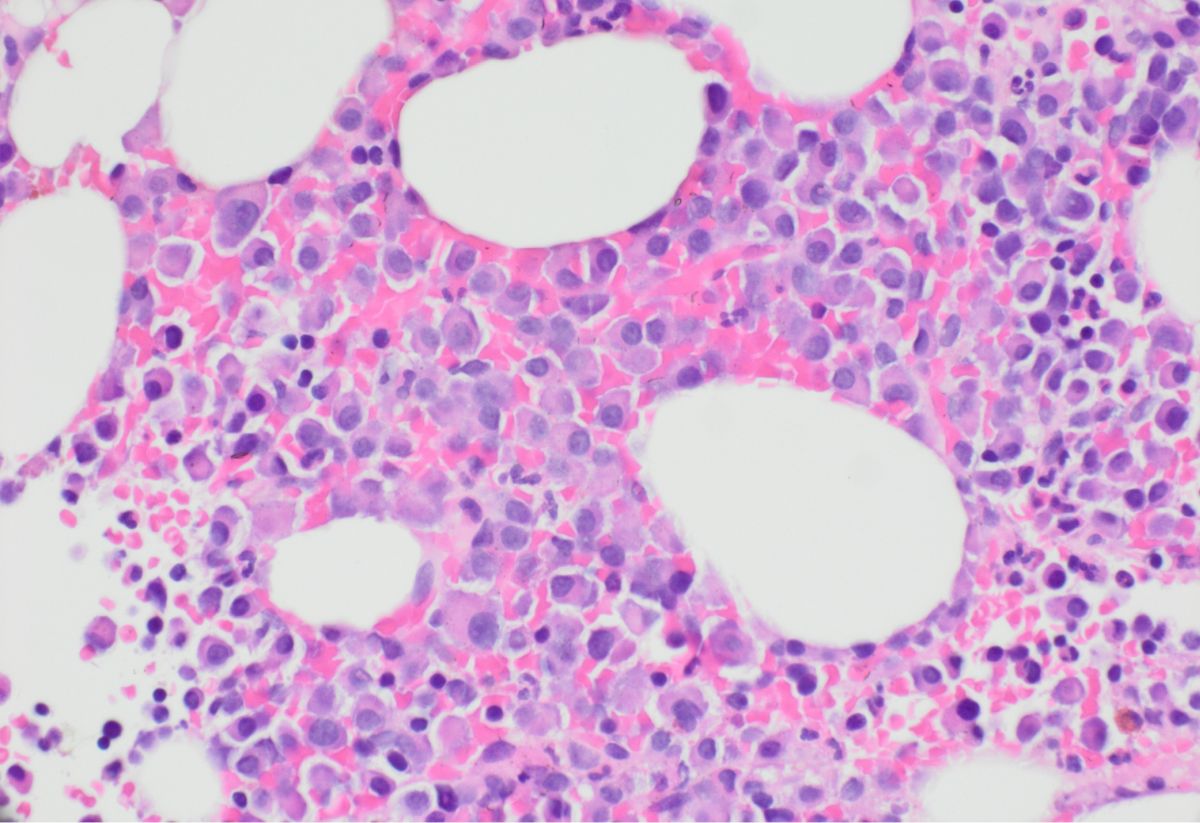
Multiple myeloma, a cancer of the bone marrow, remains difficult to treat despite modern CAR T cell therapies. In “Molecular Therapy,” a team led by Armin Rehm presents an improved immunotherapy that recognizes two distinct features of malignant cells to destroy the cancer more effectively.
Multiple myeloma is a devastating diagnosis. The disease usually develops in the bone marrow where mature B cells called plasma cells begin to proliferate uncontrollably and produce excessive amounts of antibodies, some of which are defective. The cancer, which destroys bone and other tissues, can become extremely painful. To date, it remains uncurable.
In recent years, modern CAR T cell therapies have significantly extended the lives of many myeloma patients, but their effectiveness has been limited. “In some patients, the treatment does not work at all. In others, relapse occurs sooner or later, which then often rapidly leads to death,” explains Dr. Armin Rehm, Group Leader of the Translational Tumorimmunology lab at the Max Delbrück Center.
In the journal “Molecular Therapy,” the Berlin-based researcher, Dr. Uta Elisabeth Höpken, also at the Max Delbrück Center, and an international team present an optimized immunotherapy: CAR T cells that bind to two receptors simultaneously to destroy cancer cells instead of just one, as was previously the case.
Not all patients express the BCMA receptor
Before the advent of CAR T cell therapy, multiple myeloma was treated with chemotherapy and antibody-based drugs, and sometimes combined with autologous stem cell transplants. These approaches, however, were not curative either. CAR T-cell therapies gave patients new hope.
The treatment involves collecting T cells from patients and genetically engineering them in a bioreactor to express a chimeric antigen receptor, or CAR. These receptors act as sensors that help immune cells detect specific surface proteins. In the case of multiple myeloma, the target is BCMA, a protein found almost exclusively on plasma cells, and not on normal B cells. The modified T cells are then reinfused into patients, where they seek out and destroy cancer cells in the body.
“However, BCMA protein isn’t present on all malignant plasma cells,” says Rehm. In some patients with multiple myeloma, it’s not detectable at all; in others, it disappears over the course of treatment. “That’s why we combined three methods – single-cell RNA sequencing, immunohistochemistry, and flow cytometry – to search for another surface marker characteristic of malignant B cells. That led us to BAFF-R,” says Dr. Agnese Fiori, the study’s first author and a member of Rehm’s team, who now conducts research at Charité- Universitätsmedizin Berlin.
Prevention and treatment of relapse
Two additional researchers also made significant contributions to the study: Professor Jörg Westermann, Deputy Clinic Director and Head of Hematological Diagnostics at Charité, and Professor Jan Krönke, Head of the Department of Internal Medicine C – Hematology, Oncology, Stem Cell Transplantation, and Palliative Medicine at Greifswald University Medical School.
“BAFF-R is particularly abundant on cells from multiple myeloma patients who have relapsed,” says Fiori. In addition, it is often found on abnormal plasma cells without BCMA, which are resistant to conventional treatments. “Therapeutically, it therefore makes sense in two respects to use CAR-T cells that recognize both BCMA and BAFF-R,” explains Rehm.
Around 5 to 30 percent of all patients with multiple myeloma could benefit from this dual approach, adds Rehm. For personalized therapy, it is crucial to identify these patients using an appropriate test before treatment begins, he explains. Such screening would be easy to implement in clinical practice.
Success in experiments with cancer cells
Rehm and his colleagues have tested the bispecific CAR T cells both in multiple myeloma cell lines and in patient-derived bone marrow cells. “In all of our experiments, we showed that the improved CAR T cells remain effective, even when the BCMA receptor is absent or has been lost due to therapy – that is, even when treatment with monospecific CAR T cells has failed,” he explains. He hopes that the new approach can prevent relapse in many patients and also extend lifespan – perhaps even offer a cure.
“To truly assess the potential of our method, an initial clinical trial is now necessary,” Rehm adds. Together with colleagues from the National Center for Tumor Diseases (NCT) – a long-term collaboration between the German Cancer Research Center (DKFZ), excellent partners in university medicine, and other outstanding research partners at various locations in Germany, including the Max Delbrück Center, Charité, and the Berlin Institute of Health (BIH) as partner sites in Berlin – he plans to apply for the requisite funding. He hopes patients may soon be able to benefit from the optimized CAR T cells.
Text: Anke Brodmerkel
www.mdc-berlin.deLiving, Education / 09.01.2026
Gute Vorsätze leicht umgesetzt – Die Angebote der VHS Pankow im Jahr 2026
Die Umfrage in Deutschland zu den beliebtesten guten Vorsätzen für das Jahr 2026 hat ergeben, dass von den Befragten 52% mehr Geld sparen möchten, 50% sich gesünder ernähren wollen, 48% mehr Sport treiben möchten, 37% abnehmen wollen und
35% mehr Zeit mit der Familie oder Freunden verbringen möchten. (Quelle: Statistisches Bundesamt)
Breites Themenspektrum im Programm der Volkshochschule Pankow
Bei einigen guten Vorsätzen hilft die VHS Pankow mit vielfältigen Angeboten, z. B. bei den Themen Psyche, Karriere und Persönlichkeit, Gesundheit und Wohlbefinden. So gibt es kostenfreie Online-Vorträge wie „Schluss mit Aufschieben“ und „Gewaltfreie Kommunikation 3.0“. Ebenso kostenfrei oder mit geringem Obolus sind Stadtführungen, PC-Sprechstunden und Gesundheitsvorträge, wie „Der Männerweg zur Gesundheit“ oder „Nahrungsergänzungsmittel – Durchblick im Pillen-Dschungel“. Praktischer kann es dann im Kochkurs werden, wenn es gilt, entzündungshemmend zu kochen oder nachhaltig zu genießen.
Wer lieber eine neue Sprache erlernen möchte, kann aus mehr als 40 Möglichkeiten schöpfen oder einfach mal eine (Minderheiten-)Sprache an einem Abend kennenlernen. Für eine verständlichere Kommunikation kann u. a. der Kurs „Einführung in die Leichte Sprache“ von Vorteil sein.
Raus aus dem Sessel, rein in das Bewegungsvergnügen heißt es im Gesundheitsbereich, wo aktuell 385 Kurse von Aikido bis Zumba® offeriert werden – für Jung und Alt. Für alle, die etwas für ihre Entspannung und Resilienz tun möchten, ist das Angebot eben so umfangreich wie speziell – inklusive Bildungszeitkurse für Arbeitnehmer:innen.
Über 3.000 Kurse, offen für viele Altersgruppen
Das Spektrum ist breit und steht prinzipiell allen Menschen ab 16 Jahre offen. Auch für Kinder und Familien gibt es Angebote. 480 Kursleitende bieten durch das Jahr hindurch über 3.000 Kurse an. Unter professioneller Anleitung wird entdeckt und diskutiert, trainiert und entspannt, gelacht und gestaunt.
Infos und persönliche Beratung am 14. Januar im Rathaus-Center
Am Mittwoch, den 14. Januar präsentiert die VHS Pankow ihr Frühjahrsprogramm im Rathaus-Center Pankow, Breite Str. 20, 13187 Berlin. Dort kann man sich von 10 bis 18 Uhr umfassend beraten lassen und ein Programmheft-Magazin erhalten.
Alle Informationen zu Kursen, Standorten und Services sind online unter www.vhspankow.de zu finden.
Research / 08.01.2026
A new opportunity for Berlin
The Einstein Center for Early Disease Interception has been funded with six million euros. In an interview, Nikolaus Rajewsky and Leif Erik Sander, both spokespeople of the center, explain why new technologies and cross-institutional collaboration will make disease prevention in the future possible.
The phrase “early disease interception” is included in the Einstein Center’s name. What does that mean in concrete terms?
Professor Nikolaus Rajewsky: Pathological processes in tissues often progress for years unnoticed before symptoms appear. By that point, the damage is usually substantial and can only be reversed to a limited extent. It would be far better to intervene much earlier at a stage when only individual cells are affected and when we can better influence the disease trajectory.
Thanks to major technological advances, we now effectively have a molecular super microscope. We can make disease processes visible at subcellular resolution – in tissues, in body fluids, even in the air we exhale. Artificial intelligence and machine learning are helping us to manage the enormous volumes of data generated from our research and predict disease trajectories.
We want to understand the earliest mechanisms that drive cells away from a healthy equilibrium toward disease and to control which path these cells take – that is what we mean by “interception.” We can now realistically test such targeted interventions before damage occurs, for example using organoids, which are miniaturized models of organs.
Professor Sander, how would you explain this approach to your patients?
Professor Leif Erik Sander: At its core, our approach is about very precise prevention. What matters to patients is that their quality of life and organ function are preserved – even if pathological changes have already begun at the cellular level.
In cancer screening, such approaches already exist, albeit using more conventional methods. For many other diseases, however, we currently intervene too late. When dementia is diagnosed, for example, we can only slow progression of the disease. A similar situation exists with certain lung diseases that can cause progressive tissue scarring, which can lead to death.
Conventional methods cannot detect the early warning signs of such diseases – and we do not always understand what is actually going wrong or how to intervene. This is where early disease interception comes in: we want to understand what knocks the system off course, and create opportunities to reset it at very early stages. The train should, so to speak, be put back on a healthy track.
How exactly does this super-microscope work?
Nikolaus Rajewsky: Today we can analyze very precisely at what point in time, which cells in a tissue access which information in their genome – or do not. A single histological section contains around 100,000 cells, each with about 20,000 genes. Accordingly, the resulting data volumes are enormous. Based on these data, we can reconstruct disease-relevant signaling pathways and complex metabolic networks. The decisive advance is that we no longer merely describe disease, but understand it causally. This is the prerequisite for targeted and early intervention.
What are the biggest hurdles on the path to clinical application?
Leif Erik Sander: These extremely high-resolution methods provide exactly the information we need to distinguish early disease processes. Right now, they are research tools and are very expensive. The crucial next step will be to greatly reduce the complexity and to develop robust, simplified tests that are suitable for large numbers of people.
Artificial intelligence will play a key role. We want to use it to link molecular data with routine clinical data, identify patterns, and specifically predict individual disease risks.
The Einstein Center will be funded for six years. What do you expect to achieve during this time?
Nikolaus Rajewsky: What is emerging here in Berlin goes beyond individual projects. Together, we are driving forward a new form of molecular prevention. We developed this concept within the European LifeTime consortium and described it in the journal “Nature” in 2020. Hundreds of scientists from across Europe were involved, so we are extremely well connected internationally.
With the Berlin excellence cluster ImmunoPreCept, there is a strong complementary focus on immunology. What is new with the Einstein Center is a structured, cross-institutional collaboration to find new paths toward application. Clinicians, basic researchers, and data scientists will work together systematically with their respective expertise, rather than alongside one another.
Major advances arise neither solely in the clinic nor exclusively in the laboratory nor at the computer. The Einstein Center will create a shared platform with clear rules, short paths, and without unnecessary bureaucratic hurdles. This is absolutely essential because complex collaborations otherwise often fail before they even begin.
During the two-year preparatory phase for the Einstein Center, we looked internationally for role models. There is an interesting structure in Lausanne. Then there is the Broad Institute in Boston, where Harvard, MIT, and others have joined forces. In Berlin, we want to gradually create an open network in which the basic rules are defined for everyone interested, making processes faster as a result. By the way, the topic of molecular prevention is also being addressed elsewhere in Germany and internationally.
Is Berlin well positioned to advance this concept?
Leif Erik Sander: We have state-run universities that provide education at a very high level. With Charité, we have the largest university hospital in Europe, as well as a very high density of non-university research institutions where top minds work with the most modern technologies. They contribute the expertise required for such a complex and forward-looking project. For me, this combination is Berlin’s competitive advantage that will quickly result in real added value.
For highly qualified young talent in Berlin, institutional boundaries hardly matter. They have great ideas and want to freely use technologies from different institutions to make new discoveries. That is why they come here. The Einstein Center will provide a structural framework for this. Of course, the next Broad Institute will not emerge here in just a few years. But something that is driven by a similar spirit will: top institutions working together to make a difference. Collaboration is orders of magnitude better than everyone trying on their own and focusing only on themselves. This will also lead to shared value creation.
Over the next six years, we want to initiate the first joint innovations, ranging from new diagnostic approaches to patents and spin-offs. A key milestone will be the formalized collaboration of Berlin’s leading organizations. This will offer a platform for the future from which a great deal of good can emerge, benefiting not only medicine but also Berlin as an innovation hub.
The project is quite ambitious. Where will you start?
Nikolaus Rajewsky: During the preparatory phase, young researchers came together across institutions and jointly defined initial use cases. This bottom-up dynamic is an important part of our concept.
What are these use cases?
Leif Erik Sander: We are initially focusing on two organ systems for which there is a high medical need. One focus is dementias. From a healthcare cost perspective, they are expensive to manage and are extremely burdensome for people affected and their families. In several interdisciplinary projects, we are searching for new approaches to diagnose dementias as early as possible in order to influence disease progression. The second focus is chronic lung diseases, which are also widespread conditions. It is often unclear how they develop. With current therapy, we try to slow their progression. But it would be far better to detect these diseases much earlier and cure them.
In addition, we are investigating how organ systems communicate with one another. Damage in one organ can trigger domino effects elsewhere in the body. Such systemic connections have not been not readily apparent within the disease silos in which we have been working; we are now bringing them together. The first two focus areas will hopefully inspire other researchers to use the Einstein Center platform.
Why should people seek medical care even if they feel healthy?
Nikolaus Rajewsky: Many already do, for example through mammography, dental check-ups, or in the case of known genetic risks. This form of prevention will continue to evolve. It is important to conduct societal debate on the issue of prevention openly and transparently.
Leif Erik Sander: If we want to preserve our health and social systems in Germany with an aging population, prevention is indispensable. Leaving it unaddressed would be one of the greatest strategic mistakes one could make. Oral care is a great example. Dentists hardly ever see truly poor dental health anymore. People go for check-ups and professional cleanings, even though it is not always pleasant and sometimes has to be paid for out of pocket. But it pays off in the long term.
The old saying “there is no glory in prevention” is wrong. Only if we intervene earlier and achieve cures instead of chronic long-term therapies will medical progress remain financially sustainable.
What is needed to bring us closer to this goal?
Leif Erik Sander: There is a lack of sufficient venture capital, as is the case everywhere in Europe. Political and tax frameworks also need to be improved. And we do not yet have a strong culture of commercializing our discoveries. Without these things, knowledge does not reach the patient’s bedside! Discoveries lead to medicines, tests, new devices, and eventually they become part of standard care that is covered by medical insurance. That is how medicine works.
Value creation is also part of the Einstein Center’s mission, because profits can then be reinvested. This will generate more cutting-edge research and ultimately create a highly qualified workforce with and well-paying jobs. Within the Einstein Center, we can demonstrate in a protected setting how joint innovation can succeed. This can serve as a blueprint, because in my view, Berlin still has enormous untapped economic potential in the biotech and life sciences sector.
It is an opportunity …
Nikolaus Rajewsky: I was very positively surprised by the enthusiasm with which top scientists in Berlin were involved from the very beginning. This shows that we struck a nerve.
This city needs new ideas for how we want to generate value in the future. Until World War II, there was a lot of industry here. Then mainly administrative structures followed. In recent years, a great start-up scene has emerged. But where Berlin is truly excellent is in biotech and top-level medicine. This is where value creation that benefits everyone can emerge. We are appealing to policymakers in Berlin and at the federal level to seize this opportunity.
In Boston, a huge ecosystem has developed around the biotech industry that contributes to the prosperity of the entire region. There, policymakers spoke to biologists and asked what they needed. The answer was: framework conditions that allow rapid progress. They implemented them. The Einstein Center is a beginning, and we are very grateful to the foundation for its funding. It is an invitation to consider whether such a vision for the future can make Berlin sustainably attractive.
Interview: Jana Schlütter.
Professor Nikolaus Rajewsky is Director of the Berlin Institute for Medical Systems Biology of the Max Delbrück Center. Professor Leif Erik Sander is Medical Director of the Department of Infectious Diseases and Critical Care Medicine at Charité – Universitätsmedizin Berlin. Both are spokespeople for the Einstein Center for Early Disease Interception.
www.mdc-berlin.deResearch, Innovation / 05.01.2026
A spin-off targeting neuromuscular disorders
A team led by Mina Gouti has developed a stem cell-based model that enables researchers to test new drugs to treat neuromuscular diseases and to refine existing therapies. The project, called NMJCare, was named one of the top ten ideas in the national Science4Life start-up competition.
Spinal muscular atrophy (SMA) is one of the most severe genetically inherited neuromuscular disorders, affecting about one in 10,000 children. Despite therapeutic advances in recent years, the condition remains incurable. Researchers continue to rely on reliable, patient-specific models to test new treatments.
Dr. Mina Gouti, head of the Stem Cell Modeling of Development and Disease lab and her team at the Max Delbrück Center have developed just such a model. They have grown structures from patient-derived stem cells that closely mimic the functional interaction between nerve fibers, motor neurons, and muscle fibers in the human body. Dr. Ines Lahmann, a postdoctoral researcher in Gouti’s lab, now plans to transform this scientific innovation into a market-ready product. Her project, NMJCare, has been chosen as one of the ten best submissions out of more than 120 entries in the national Science4Life start-up competition.
The award gives Lahmann access to expert guidance on building a viable business model. NMJCare will also receive support through the GeneNovate Entrepreneurship Program, which offers strategic coaching in company formation, communication, and business planning. “These are all key building blocks for driving targeted technology transfer,” says Lahmann.
One model, many options
NMJCare marks the beginning of a new phase for Lahmann. In addition to scientific questions, her focus is now shifting to topics like patents, target audience analysis, and funding strategies. “Those are things I hardly had to think about before,” Lahmann says. “But now they determine whether our idea can truly become market-ready.” The potential of NMJCare is significant: the model allows high-throughput testing of thousands of potential drug compounds before moving into costly preclinical or clinical trials.
At the same time, the system makes it possible to better understand why patients respond differently to therapies. “That’s a crucial step toward more individualized treatment approaches,” Lahmann explains. Potential users of the model include pharmaceutical companies, academic research groups, and firms in the field of personalized medicine. NMJCare can be flexibly adapted to meet their needs – by selecting specific stem cell lines or investigating short-or long-term drug effects, for example.
“For an idea to become viable, it takes constant exchange – and also critical perspectives from the outside,” says Lahmann. Through the GeneNovate and Science4Life programs, she will be connecting with like-minded peers as well as mentors from business, law, and finance. With their support, she hopes that NMJCare will evolve from a lab-based project into a full-fledged spin-off.
Source: Max Delbrück Center
A spin-off targeting neuromuscular disorders
- News
- Events
- MAGAZINE „buchinside“
- Press service/Download
-
News Archiv
- Archive News 2026
- Archive News 2025
- Archive News 2024
- Archive News 2023
- Archive News 2022
- Archive News 2021
- Archive News 2020
- Archive News 2019
- Archive News 2018
- Archive News 2017
- Archive News 2016
- Archive News 2015
- Archive News 2014
- Archive News 2013
- Archive News 2012
- Archive News 2011
- Archive News 2010
- Archive News 2009
- Archive News 2008